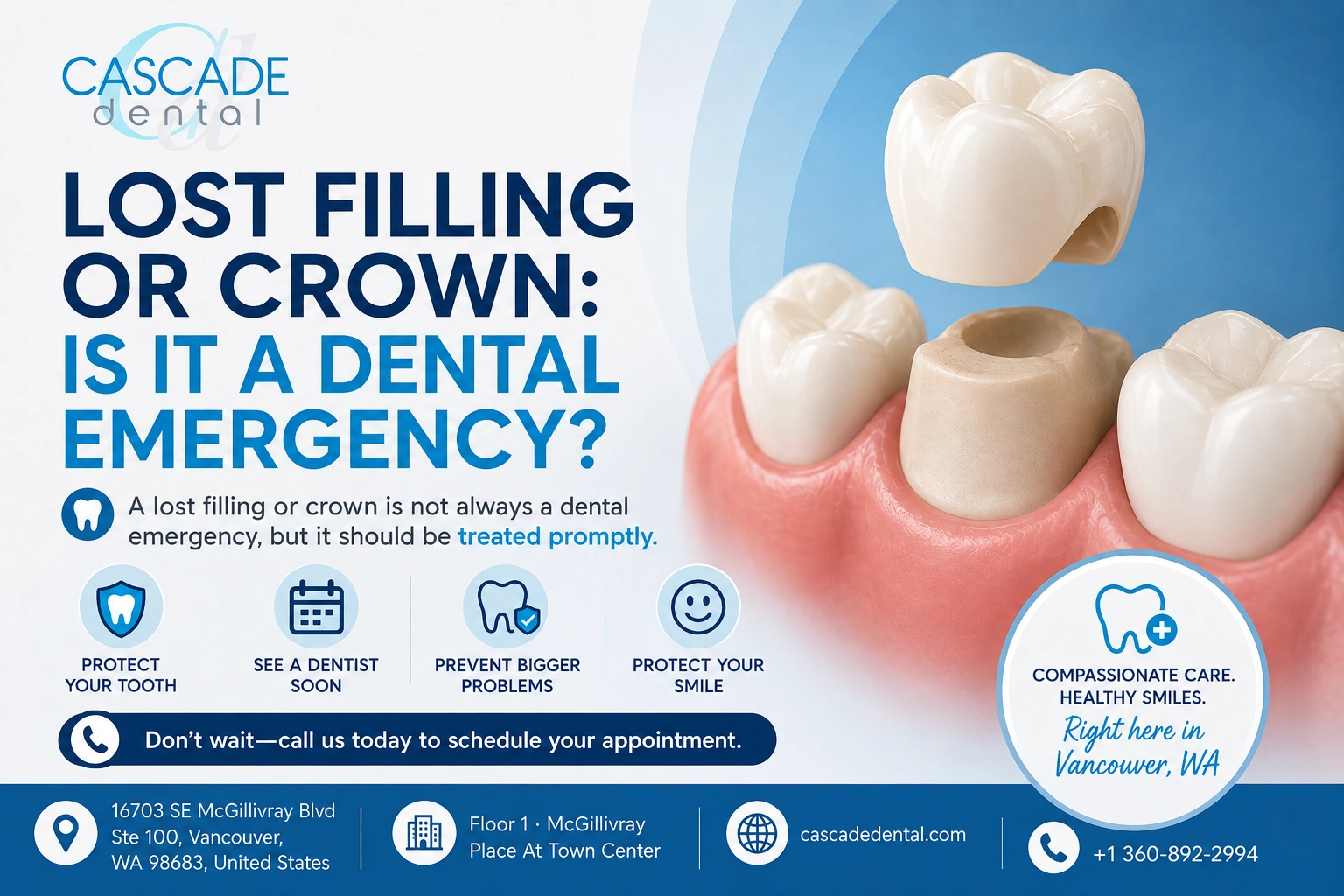
A lost filling or crown is not always a dental emergency, but it should be treated promptly. Once a filling or crown falls out, the tooth underneath may be exposed, sensitive, weakened, or more likely to break.
For patients in Vancouver, losing a dental restoration can feel stressful, especially if the tooth feels sharp, painful, or sensitive. Even if you are not in severe pain, it is important to protect the area and contact a dentist as soon as possible. Quick care can often prevent a small problem from becoming a larger one.
Lost Crown or Filling? Get Care Fast
Avoid added pain or tooth damage. Call now and get professional dental help.
Fast Answer: Is a Lost Filling or Crown a Dental Emergency?
A lost filling or dental crown is not always a dental emergency, but it should be evaluated as soon as possible. Without protection, the affected tooth is more vulnerable to sensitivity, fractures, and decay.
If you have severe pain, significant swelling, bleeding, signs of infection, or the tooth breaks, seek emergency dental care immediately. These symptoms may mean the tooth has deeper damage or an infection that needs prompt treatment.
If there is no severe pain or swelling, you may not need same-day emergency care, but you should still schedule a dental appointment quickly. A lost restoration leaves the tooth exposed, and waiting too long can make repair more difficult.
What Should You Do First?
If your filling or crown falls out, stay calm and protect the exposed tooth until you can see a dentist. The goal is to keep the area clean, avoid pressure, and prevent the tooth from breaking further.
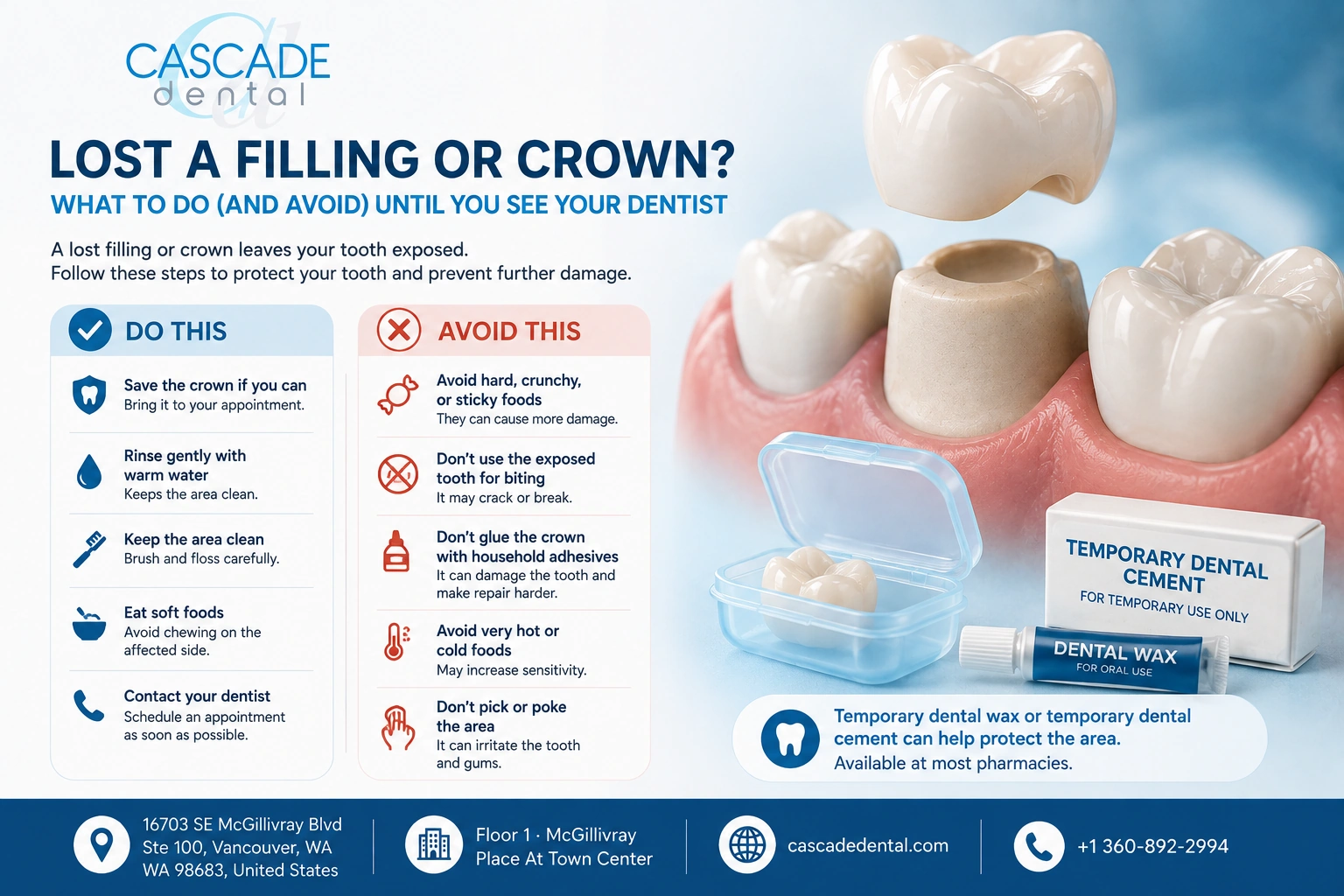
Follow these steps:
- Remove and save the crown if you can find it
- Rinse your mouth gently with warm water
- Keep the area clean by brushing and flossing carefully
- Avoid chewing on the affected side
- Contact your dentist to schedule an appointment as soon as possible
- Eat softer foods until the tooth is repaired
- Check whether the exposed tooth has a sharp edge
If the crown is intact, bring it with you to your dental visit. In some cases, it may be possible to clean and re-cement it. However, do not assume the crown can simply be put back in place. Your dentist will need to check the tooth underneath for decay, cracks, or changes in fit.
If a filling falls out, try not to poke the open area with your tongue or fingers. The exposed space may feel rough or unusual, but touching it repeatedly can irritate the tooth or surrounding gum tissue.
What Should You Avoid?
Until your appointment, avoid anything that could further damage the tooth. A tooth that has lost a filling or crown may be weaker than it feels, especially if the restoration was large.
Do not:
- Chew hard, crunchy, or sticky foods
- Use the exposed tooth for biting
- Attempt to permanently glue the crown back in place with household adhesives
- Ignore increasing pain or sensitivity
- Pick at the tooth with your fingernail or dental tools
- Eat very hot or cold foods if the tooth is sensitive
- Delay care because the pain has improved
Household glue should never be used in the mouth. It can irritate soft tissues, damage the crown or tooth, and make professional repair harder. If the exposed tooth has a sharp edge, temporary dental wax or temporary dental cement, available at many pharmacies, may help protect the area until you are seen.
Temporary dental products are only short-term solutions. They do not replace dental treatment, and they should not be used as a permanent fix.
Why Does a Lost Filling or Crown Cause Sensitivity?
A lost filling or crown can expose parts of the tooth that are not meant to be uncovered. When the inner tooth structure is exposed, the tooth may become sensitive to air, temperature, sweets, or pressure.
Sensitivity may happen because:
- Dentin is exposed
- The tooth nerve is irritated
- The tooth has decay underneath the restoration
- The bite pressure has changed
- The tooth has a crack or fracture
- Food is getting trapped in the open area
Some sensitivity is common after losing a restoration, but worsening pain should not be ignored. If the tooth hurts when biting, throbs on its own, or reacts strongly to hot or cold, the damage may be deeper than it looks.
When Is It a Dental Emergency?
A lost filling or crown becomes more urgent if you experience symptoms that suggest infection, fracture, or nerve involvement. In these cases, waiting could allow the problem to worsen.
Seek prompt dental care if you experience:
- Severe or worsening tooth pain
- Significant sensitivity that does not improve
- A cracked or broken tooth
- Swelling of the gums or face
- Bleeding that does not stop
- Signs of infection, such as pus or fever
- Pain when biting or chewing
- A bad taste coming from the tooth
- A tooth that feels loose
- A crown that fell out after trauma or injury
These symptoms may indicate damage to the tooth or an underlying infection that requires prompt treatment. Facial swelling, fever, or difficulty swallowing should be treated seriously because dental infections can spread.
If swelling affects breathing or swallowing, seek emergency medical care immediately.
Is a Lost Crown More Serious Than a Lost Filling?
Both should be evaluated, but a lost crown may expose more tooth structure than a lost filling. Crowns are often placed on teeth that have already been weakened by decay, cracks, large fillings, or root canal treatment. When a crown falls off, the remaining tooth underneath may be fragile.
A lost crown may happen because:
- The cement has worn down
- Decay developed under the crown
- The crown no longer fits properly
- The tooth structure underneath fractured
- The bite placed too much pressure on the crown
- Sticky foods pulled it loose
A lost filling may leave a hole or rough area in the tooth. If the filling was large, the tooth may also be at higher risk of breaking. Either way, a dentist should check the tooth and determine whether it can be repaired simply or needs additional treatment.
Can You Put a Crown Back on Yourself?
You should not permanently glue a crown back on yourself. If the crown is intact and the tooth is not painful, temporary dental cement from a pharmacy may help hold it in place for a short time until your appointment. However, this should only be done carefully and only as a temporary measure.
Before using temporary cement, make sure:
- The crown is clean
- The tooth is gently rinsed
- The crown fits correctly without forcing it
- You are not in severe pain
- You can remove the crown if it feels loose
- You still plan to see a dentist promptly
If the crown does not fit easily, do not force it. If it feels too high when you bite down, remove it and call your dentist. A crown placed incorrectly can damage the tooth, irritate the gums, or affect your bite.
How Will the Dentist Repair the Tooth?
Treatment depends on the condition of the tooth and the restoration. Your dentist will examine the tooth, check your bite, and may take X-rays to look for decay, fractures, or infection.
Replacing a Filling
If only the filling has fallen out and the tooth is healthy, your dentist may place a new filling to restore and protect it. The area will be cleaned, any decay will be removed, and the new filling will be shaped to match your bite.
A new filling may be enough if:
- The tooth has enough healthy structure
- The cavity or damaged area is not too large
- There is no crack extending through the tooth
- The nerve is not affected
- The tooth can support the restoration
If the missing filling was large, your dentist may recommend a crown instead of another filling to provide better strength.
Re-Cementing a Crown
If the crown is undamaged and still fits properly, it may be cleaned and re-cemented. This is often possible when the crown came loose because the dental cement wore out but the tooth underneath is still healthy.
Before re-cementing the crown, your dentist will check for:
- Decay under the crown
- Cracks in the tooth
- Damage to the crown
- Changes in the fit
- Bite issues
- Gum irritation
If everything looks healthy, re-cementing may restore the tooth without needing a new crown. However, if decay or damage is present, the tooth must be treated first.
Replacing the Crown
If the crown is damaged, worn out, or no longer fits correctly, a new dental crown may be recommended. Crowns must fit closely to the tooth to protect it from bacteria and chewing pressure. If the crown has gaps, cracks, or poor margins, it may not protect the tooth properly.
A new crown may be needed if:
- The old crown is cracked or broken
- The crown no longer fits the tooth
- Decay is present underneath
- The tooth shape has changed
- The bite has shifted
- The crown keeps coming loose
Replacing the crown helps restore strength, shape, and function while protecting the remaining tooth structure.Depending on the treatment and technology available, same-day crowns may also be an option for restoring a damaged tooth efficiently.

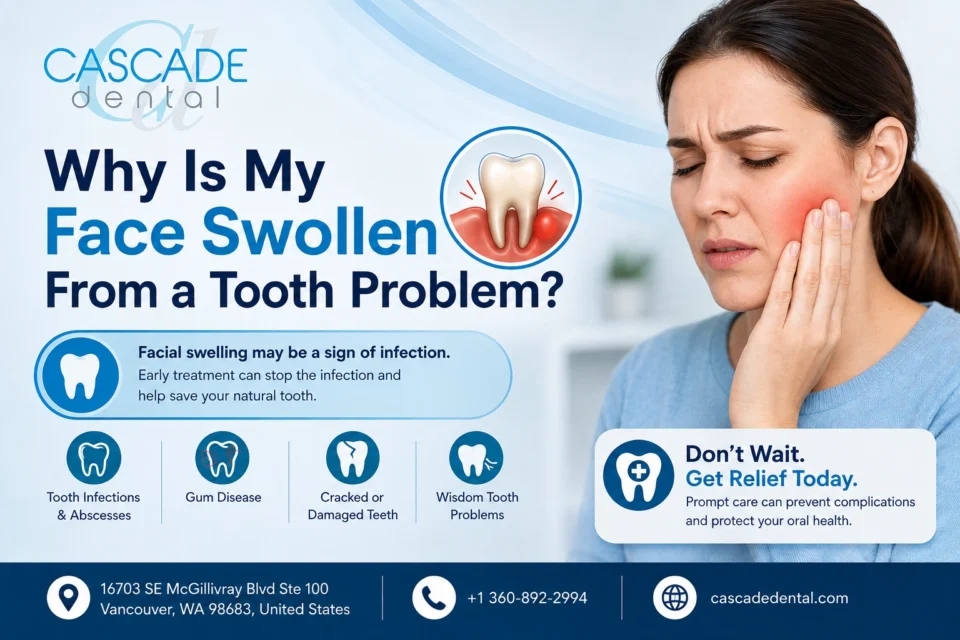
Why Is My Face Swollen From a Tooth Problem?
Facial swelling from a tooth problem is often a sign of infection, and it should be taken seriously. When bacteria…
Additional Treatment
If decay, a fracture, or damage to the tooth’s pulp is found, additional treatment may be necessary. The pulp is the inner part of the tooth that contains nerves and blood vessels. If bacteria reach this area, the tooth may become painful or infected.
Additional treatment may include:
- Removing decay
- Repairing a cracked tooth
- Root canal treatment
- Building up the tooth before a crown
- Placing a new crown
- Extracting the tooth if it cannot be saved
A root canal followed by a crown may be recommended if the nerve is infected or damaged but the tooth can still be restored. If the tooth is too broken or decayed to support a restoration, extraction may be the safest option.
Can You Wait a Few Days?
A lost restoration may not require immediate emergency treatment, but delaying care increases the risk of additional problems. Even if the tooth does not hurt, it may still be exposed to bacteria, food particles, and chewing pressure.
Waiting too long can increase the risk of:
- Tooth fracture
- Tooth sensitivity
- New decay
- Infection
- Gum irritation
- More extensive and costly treatment
- Needing a crown instead of a filling
- Losing the tooth in severe cases
Scheduling an appointment promptly helps protect the remaining tooth structure. If your dentist cannot see you right away, ask what temporary steps you should take based on your symptoms.
Why Did My Filling or Crown Fall Out?
Fillings and crowns can come loose for several reasons. Sometimes the restoration itself wears down. Other times, the tooth underneath changes because of decay, grinding, or bite pressure.
Common reasons include:
- New decay around the restoration
- Old dental cement breaking down
- Chewing sticky or hard foods
- Teeth grinding or clenching
- A cracked tooth
- A large filling weakening over time
- Trauma or injury
- Normal wear and tear
- Poor fit of an older restoration
Finding the reason matters because simply replacing the restoration may not solve the problem if decay, grinding, or bite issues are still present.
Can a Lost Filling or Crown Lead to Infection?
Yes, it can. When the tooth is no longer sealed, bacteria can enter the exposed area. If decay reaches the deeper layers of the tooth, the nerve may become irritated or infected.
Signs that infection may be developing include:
- Throbbing tooth pain
- Swelling near the tooth
- A pimple-like bump on the gums
- A bad taste in the mouth
- Fever
- Lingering sensitivity to hot or cold
- Pain that spreads to the jaw or ear
If you notice any of these symptoms, contact your dentist right away. Treating the tooth early may help prevent the infection from spreading and may improve the chance of saving the tooth.
How Can You Protect the Tooth Until Your Appointment?
While waiting to see your dentist, protect the tooth from pressure and bacteria as much as possible.
Helpful steps include:
- Chew on the opposite side
- Brush gently around the tooth
- Floss carefully to remove trapped food
- Avoid sticky candy, gum, nuts, popcorn, and hard chips
- Use temporary dental wax if there is a sharp edge
- Use temporary dental cement only as directed
- Keep the crown in a small container if it came off
- Call your dentist if pain or swelling develops
Do not sleep with a loose crown in your mouth if there is a risk of swallowing or choking on it. If it does not stay securely in place, remove it and bring it to your dental appointment.
How Can You Prevent Losing a Filling or Crown Again?
Some restorations fail because they are old, but good habits can help reduce the risk of future problems.
To protect fillings and crowns:
- Brush twice daily with fluoride toothpaste
- Floss once a day
- Keep regular dental checkups
- Avoid chewing ice or hard objects
- Limit sticky foods that can pull at restorations
- Wear a night guard if you grind your teeth
- Treat small cavities early
- Replace worn restorations when recommended
- Do not use your teeth to open packages
Routine dental exams allow your dentist to check the edges of crowns and fillings before they become loose. Early repair is often simpler than waiting until the restoration falls out completely. When a crown needs to be replaced, dentists can also use color matching for aesthetic results so the restoration blends naturally with the surrounding teeth.
When Should You Call a Dentist?
Call a dentist as soon as possible after losing a filling or crown. Even if the tooth does not hurt, it needs protection.
You should contact a dentist promptly if:
- A crown or filling has fallen out
- The tooth feels sharp or rough
- The tooth is sensitive
- The tooth hurts when biting
- You see a hole or dark area
- The crown no longer fits
- The tooth has cracked or broken
- You notice swelling, pus, or fever
- You are unsure whether the situation is urgent
Your dentist can help determine whether you need emergency care or the next available appointment.
Protect Your Tooth Until You Can Be Seen
A lost filling or crown should never be ignored. Even if you are not in pain, the exposed tooth is more vulnerable to damage. Prompt dental care can restore your tooth, relieve discomfort, and help prevent more complex treatment in the future.
If you lose a filling or crown in Vancouver, Cascade Dental can examine the tooth, determine whether the restoration can be repaired or replaced, and help protect your smile from further damage.
Lost a Filling or Crown? Don’t Wait
Protect your tooth from further damage. Call now for prompt dental care.