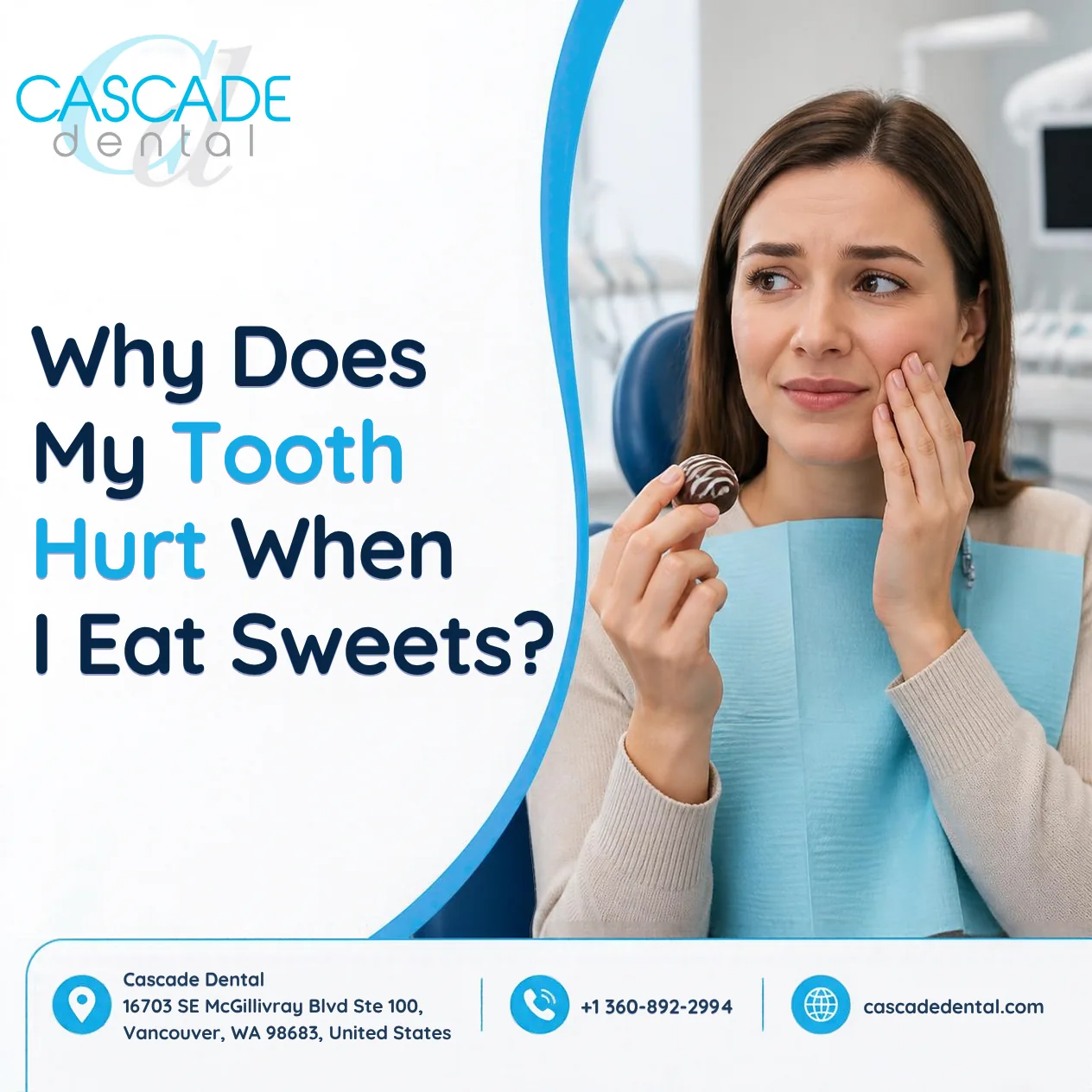
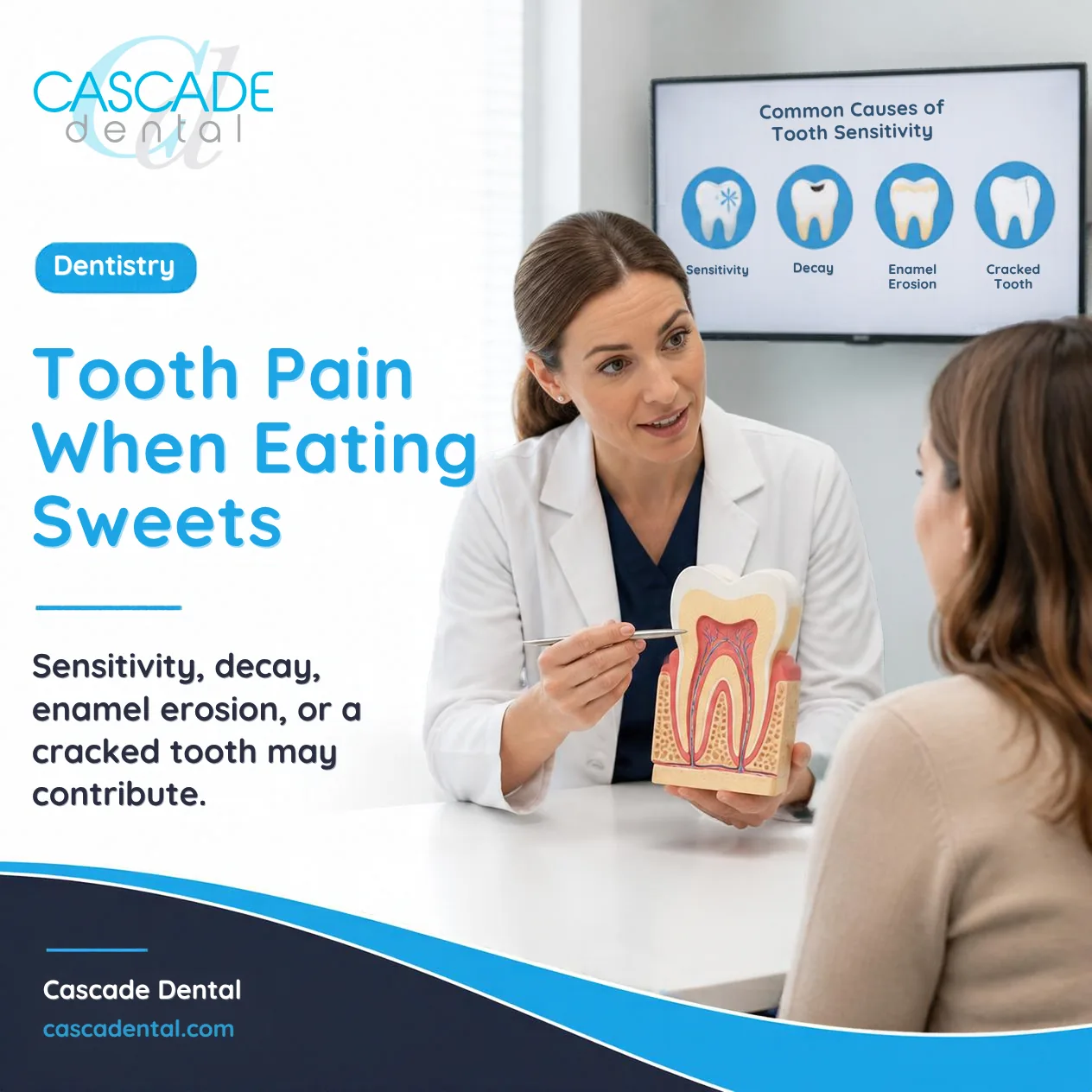
Your tooth may hurt when eating sweets because a cavity, worn enamel, exposed tooth root, crack, or damaged filling has made it sensitive. Sugary foods can trigger discomfort when the protective layers of a tooth are compromised, allowing stimulation of the sensitive dentin beneath.
A quick sting does not automatically mean you have a cavity. However, recurring pain in the same tooth deserves attention, especially when discomfort becomes stronger or continues after eating.
Understanding the possible causes can help you protect your teeth while arranging an appropriate dental evaluation.
Stop Tooth Pain Before It Gets Worse!
Pain when eating sweets may signal a dental problem. Get your teeth checked and treated before it worsens.
Why Does My Tooth Hurt When I Eat Sweets?
What causes a sharp pain when sugar touches a tooth?
A sudden sting from candy, chocolate, or another sweet food may indicate that sensitive dentin is exposed or that a tooth has an underlying dental problem.
Dentin sits beneath the protective enamel covering the visible part of a tooth.
It contains microscopic channels called dentinal tubules. When dentin becomes exposed, certain substances can cause fluid movement within these channels, stimulating nearby nerves.
Concentrated sugary foods may create an osmotic effect that contributes to this fluid movement.
This can produce a brief, sharp sensation.
However, sweet-triggered pain can also occur with tooth decay, fractures, or deteriorating dental restorations.
The sensation alone cannot identify which problem is responsible.
Why does only one tooth hurt when eating sweets?
Pain limited to one tooth may suggest a localized problem.
For example, a small cavity, exposed root surface, cracked area, or worn filling could affect one tooth without involving its neighbors.
The location of discomfort can provide useful information.
However, identifying the exact tooth is not always straightforward because dental pain can sometimes feel as though it comes from a nearby area.
If the same tooth repeatedly reacts to sweets, make a note of where the discomfort occurs and how long it lasts.
Share those details with your dentist.
How Can Cavities Cause Pain From Sugar?
Why do cavities make teeth sensitive?
A cavity develops when acids produced by plaque bacteria gradually remove minerals from tooth structure.
During early decay, the enamel surface may weaken without causing noticeable symptoms.
As decay progresses and affects dentin, the tooth can become more sensitive to sweet foods, cold drinks, or other stimuli.
Dentin is more responsive to external changes than healthy enamel.
When its protective covering is compromised, certain foods may trigger discomfort.
However, the presence or absence of pain does not reliably indicate how deep a cavity has become.
Does sweet sensitivity mean a cavity is getting worse?
Not necessarily, but recurring sensitivity should not be ignored.
Some cavities produce little discomfort even when treatment is needed.
Others may cause noticeable sensitivity relatively early.
A brief response to sugar does not establish whether decay has reached the deeper tissues of the tooth.
Dentists assess the tooth through clinical examination and dental X-rays when appropriate.
If decay has damaged the tooth enough to require restoration, a filling may be recommended.
Our tooth fillings page provides information about how damaged tooth structure can be repaired.
Can a cavity stop hurting on its own?
Dental pain can fluctuate, but a reduction in discomfort does not necessarily mean the underlying problem has resolved.
An established cavity will not repair itself simply because symptoms disappear.
Early noncavitated mineral changes may respond to appropriate preventive treatment, but a physically damaged tooth may require restoration.
Do not rely on temporary pain relief as evidence that professional evaluation is unnecessary.
Can Worn Enamel Make Teeth Sensitive to Sweets?
How does enamel protect against sensitivity?
Enamel is the hard outer layer covering the crown of a tooth.
Its mineral-rich structure helps protect the underlying dentin from temperature changes, mechanical forces, and chemical exposure.
When enamel becomes thinner or damaged, the dentin may become more vulnerable to stimulation.
This can increase sensitivity to sweets, cold drinks, and acidic foods.
Enamel wear can develop gradually, sometimes without an obvious change in tooth appearance.
What causes enamel to wear down?
Several factors can contribute to enamel wear.
Frequent exposure to acidic drinks and foods can gradually soften and dissolve enamel minerals.
Teeth grinding may produce mechanical wear, while aggressive brushing can contribute to damage near the gumline.
Certain medical conditions involving frequent acid exposure may also affect enamel.
The cause matters because treatment should address the source of the damage, not simply the resulting sensitivity.
Can sensitive enamel grow back?
Lost enamel does not regenerate in the same way that skin or other living tissues heal.
However, fluoride and saliva can support remineralization of early mineral changes when the enamel surface remains intact.
For established enamel loss, a dentist may recommend desensitizing products, protective restorations, or other care depending on the damage.
The appropriate approach depends on how much enamel remains and whether other dental problems are present.
How Do Cracks or Damaged Fillings Cause Sweet Sensitivity?
Can a cracked tooth hurt when eating sugar?
Yes. A cracked tooth may produce sensitivity when its protective structure is compromised.
Some cracks expose or affect dentin, allowing sweet foods or temperature changes to stimulate the tooth.
Cracks may also cause pain when biting or releasing pressure.
The symptoms vary depending on the crack’s location, depth, and effect on the tooth.
Not every crack is visible during a casual examination.
If you experience both sweet sensitivity and sharp discomfort while chewing, tell your dentist.
Why would an old filling become sensitive?
Fillings restore areas damaged by decay or minor fractures.
Over time, a restoration may wear, chip, loosen, or develop defects near its margins.
These changes can expose sensitive tooth structure or allow new decay to develop around the filling.
A damaged filling may also create an area where food becomes trapped.
However, sensitivity near a filling does not automatically mean the restoration is failing.
A dentist should examine the tooth before recommending replacement.
Can a recently placed filling cause sensitivity?
Some temporary sensitivity can occur after a new filling.
The tooth may react to cold, pressure, or certain foods while the surrounding tissues recover.
However, pain that becomes progressively worse, persists, or interferes with chewing should be evaluated.
A filling that feels unusually high may also create discomfort when biting.
Your dentist can assess whether adjustment or further treatment is necessary.
Can Gum Recession Expose Sensitive Tooth Areas?
Why does gum recession cause tooth sensitivity?
Gum recession occurs when the gumline moves away from its previous position, exposing more of the tooth root.
Unlike the crown of the tooth, the root is not protected by a thick enamel layer.
It is covered by cementum, which can become worn or damaged.
When underlying dentin is exposed, sweet foods and temperature changes may produce discomfort.
This can make a tooth sensitive even when no cavity is present.
What causes gums to recede?
Gum recession may be associated with periodontal disease, aggressive brushing, tooth positioning, or other contributing factors.
The condition can develop gradually.
Some patients notice that their teeth appear longer or that sensitivity occurs near the gumline.
Others do not recognize the change until a dental examination.
Treatment depends on the amount of recession, gum health, and the condition of exposed root surfaces.
Does exposed root sensitivity require a filling?
Not always.
A dentist may recommend desensitizing toothpaste, fluoride applications, or changes to brushing technique.
In some situations, bonding or another restoration may help cover a sensitive area.
More significant recession may require periodontal evaluation.
The objective is to manage sensitivity while addressing the underlying cause.
Is Sweet Sensitivity Always a Sign of Tooth Decay?
Can teeth be sensitive without having cavities?
Yes. Tooth decay is only one possible explanation.
Worn enamel, exposed dentin, gum recession, cracks, and damaged restorations can all contribute to sensitivity.
Some patients experience sensitivity across several teeth rather than one specific location.
This pattern may suggest more widespread enamel wear or exposed root surfaces.
However, symptom patterns alone cannot establish the diagnosis.
Does the duration of pain matter?
Yes. How long pain lasts can help your dentist understand the problem.
A brief, sharp sensation that stops when the sweet food is removed may be associated with exposed dentin.
Pain that lingers, throbs, occurs spontaneously, or wakes you at night may raise concern about deeper inflammation or another condition.
These distinctions are useful clinical clues, but they are not definitive.
An examination is necessary to determine whether the tooth requires preventive care, restoration, or further testing.
What Can You Do Until You See a Dentist?
How can you reduce sweet-triggered discomfort?
Until your appointment, reduce exposure to foods that repeatedly trigger pain.
Continue brushing gently twice daily with fluoride toothpaste and clean between your teeth.
A toothpaste formulated for sensitive teeth may provide relief for some patients when used consistently.
However, it cannot repair a cavity, cracked tooth, or failing restoration.
Avoid applying aspirin directly to the gums or tooth.
This can irritate or chemically burn soft tissues without treating the underlying problem.
Should you stop brushing a sensitive tooth?
No. Avoiding brushing can allow plaque to accumulate, potentially increasing the risk of decay and gum inflammation.
Use a soft-bristled toothbrush and gentle pressure.
If brushing itself causes significant pain, contact your dentist for guidance.
Do not aggressively scrub the sensitive area in an attempt to clean away the discomfort.
Can you manage the pain with medication?
Over-the-counter pain relievers may provide temporary relief for some patients when used according to their labeling and individual medical suitability.
However, medication does not correct the underlying dental problem.
Ask a pharmacist or healthcare professional if you are uncertain whether a medication is appropriate for you.
Do not exceed recommended doses or combine medications without appropriate guidance.
What Foods or Habits Should You Avoid Temporarily?
Which sweet foods commonly trigger sensitivity?
Sticky candies, concentrated syrups, sweetened beverages, and other sugary foods may trigger discomfort.
Cold desserts can produce additional sensitivity because they combine sugar with low temperatures.
If a particular food consistently causes pain, avoid it until the tooth has been evaluated.
Frequent sugary snacks also increase the number of acid attacks experienced by teeth.
Reducing repeated sugar exposure can support enamel health.
Should you avoid acidic foods too?
Acidic foods and beverages may worsen sensitivity when enamel or dentin is exposed.
Citrus drinks, soda, and other acidic products can contribute to enamel erosion with repeated exposure.
Choose water regularly and limit frequent sipping of acidic beverages.
If acidic foods cause discomfort, reducing exposure temporarily may help.
What about chewing on the sensitive side?
If biting produces pain, avoid placing unnecessary pressure on the affected tooth.
Choose softer foods until your dentist determines the cause.
Do not repeatedly bite hard objects to test whether the pain is still present.
Pain when chewing may indicate a crack, bite problem, or another condition that deserves evaluation.
When Should Sweet-Triggered Tooth Pain Be Evaluated?
When should you schedule a dental exam?
Arrange an examination when sweet sensitivity repeatedly affects the same tooth, becomes more noticeable, or interferes with eating.
An evaluation is also appropriate when pain occurs alongside cold sensitivity, chewing discomfort, or visible changes in the tooth.
You do not need to wait until pain becomes severe.
Some dental problems are easier to address when identified before extensive damage develops.
A dentist can evaluate possible causes without assuming that every sensitive tooth needs a filling.
What happens during the examination?
Your dentist may ask when symptoms began, what triggers the discomfort, and how long it lasts.
They examine the affected tooth, surrounding gums, and existing restorations.
Depending on clinical findings, they may assess temperature sensitivity, biting response, or other signs.
Dental X-rays may help identify decay between teeth or other concerns that are not visible directly.
Our dental exams page explains more about the evaluation process.
When is dental pain urgent?
Seek prompt dental assessment if pain becomes severe, persistent, or associated with swelling, fever, or drainage.
Facial swelling with fever may indicate an infection requiring urgent treatment.
Difficulty breathing, difficulty swallowing, or rapidly spreading facial or neck swelling requires emergency medical attention.
Do not assume that serious symptoms are caused only by sensitivity to sugar.
How Is the Cause of Tooth Sensitivity Treated?
What if a cavity is causing the pain?
Treatment depends on the extent of decay.
Early mineral changes may sometimes be managed with preventive measures when the enamel surface remains intact.
A cavity involving damaged tooth structure may require a filling.
More extensive decay can require additional restorative treatment.
The dentist determines the appropriate option after assessing the tooth.
What if enamel wear or gum recession is responsible?
Desensitizing products and fluoride treatments may help reduce discomfort associated with exposed dentin.
Your dentist may also recommend changes in brushing habits or measures to address contributing acid exposure.
For certain defects, protective bonding or other restorations may be considered.
Gum recession associated with periodontal disease requires attention to gum health.
What if the tooth is cracked or a filling is damaged?
Treatment depends on the extent and location of the problem.
A minor restoration defect may be repairable.
More substantial damage may require replacing a filling, placing a crown, or considering another treatment.
Deep cracks or damage affecting the tooth’s internal tissues may require more complex care.
Not every cracked tooth can be predictably restored.
An individualized evaluation helps determine which options are suitable.
FAQs
Why does chocolate make my teeth hurt?
Chocolate contains sugar, which may trigger sensitivity when dentin is exposed or a tooth has decay or structural damage. Temperature can also contribute if the chocolate is cold. Repeated pain in one tooth should be evaluated.
Can sugar cause immediate tooth pain?
Yes. Sugary substances may stimulate exposed dentin and cause brief discomfort. However, sugar does not create a new cavity instantly. Existing enamel damage, exposed roots, or other dental problems may explain the immediate sensation.
Does tooth sensitivity to sweets mean I need a root canal?
Not necessarily. Many causes of sweet sensitivity can be managed without root canal treatment. A root canal may be considered when the tooth’s pulp is irreversibly inflamed or infected, based on examination and testing.
Can sensitive toothpaste stop pain from sweets?
Desensitizing toothpaste may reduce discomfort caused by exposed dentin when used consistently. However, it does not repair tooth decay, cracks, or damaged fillings. Persistent symptoms require professional assessment.
Why does my tooth hurt from sweets but not cold drinks?
Different stimuli can produce different responses depending on the condition of the tooth. Sweet sensitivity without cold sensitivity does not establish a specific diagnosis. Your dentist can evaluate the tooth to identify the cause.
Will sweet sensitivity go away without treatment?
Some sensitivity related to exposed dentin may improve with appropriate preventive care. However, cavities, cracks, and damaged restorations generally require evaluation and may need treatment. Temporary improvement does not guarantee the problem has resolved.
Find the Cause of Sweet-Triggered Tooth Pain With Cascade Dental
A tooth that hurts when eating sweets may be responding to exposed dentin, decay, gum recession, or another dental concern.
The most appropriate next step is to identify the cause rather than assume that sensitivity always means a cavity.
At Cascade Dental, we help patients understand tooth discomfort through individualized examinations and clear treatment discussions.
We can evaluate the affected tooth, review possible contributing factors, and explain whether preventive care, monitoring, or restorative treatment may be appropriate.
If sweet foods repeatedly trigger discomfort, we encourage you to arrange an evaluation before symptoms become more difficult to manage.
Explore our dental exams and tooth fillings information to learn more.
We welcome patients from Mill Plain, WA at our Vancouver dental office.
Contact Cascade Dental to discuss your symptoms and determine the next appropriate step for your oral health.
Key Takeaways
A tooth that hurts when eating sweets may have a cavity, exposed dentin, worn enamel, gum recession, a crack, or a damaged filling. Sweet sensitivity does not automatically identify the cause or indicate that extensive treatment is necessary.
Brief discomfort can occur when sensitive dentin is stimulated, but persistent or worsening pain deserves professional evaluation. Maintain gentle oral hygiene and avoid triggering foods until your appointment.
A dental examination can identify the underlying problem and guide treatment, ranging from preventive care to appropriate restorative procedures.
Tooth Hurts When Eating Sweets?
Don't ignore tooth sensitivity! Schedule a dental exam today to find the cause and get the relief you need.