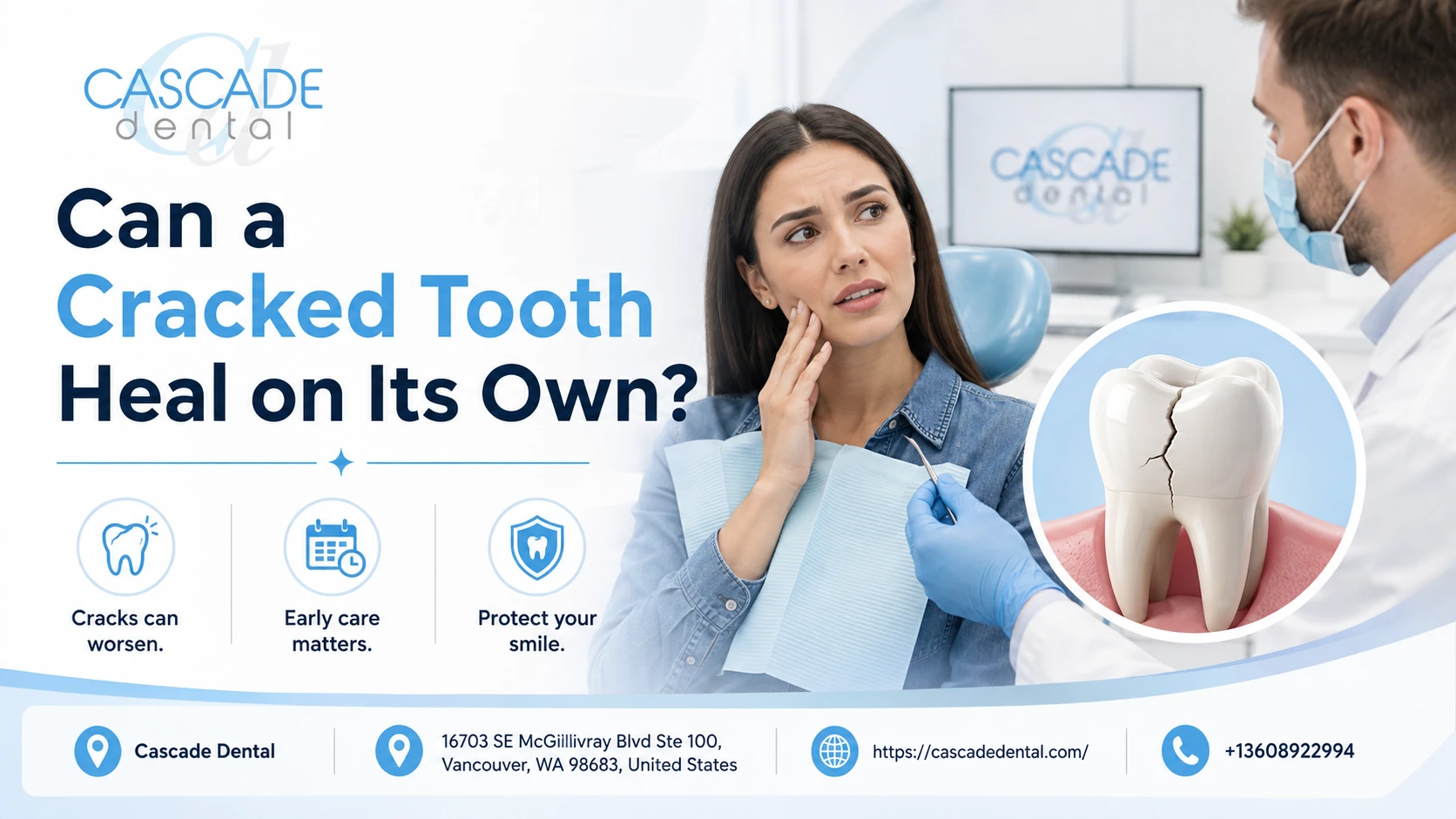
A cracked tooth can be confusing because its symptoms are not always constant. You may feel a sharp pain while chewing one day and notice nothing the next. Cold water might suddenly cause sensitivity, yet you may have difficulty identifying exactly which tooth is responsible.
Because the discomfort can disappear temporarily, it is easy to assume the tooth is healing. Unfortunately, a cracked tooth does not repair itself. The pain may come and go, but the physical crack remains and may gradually extend deeper into the tooth.
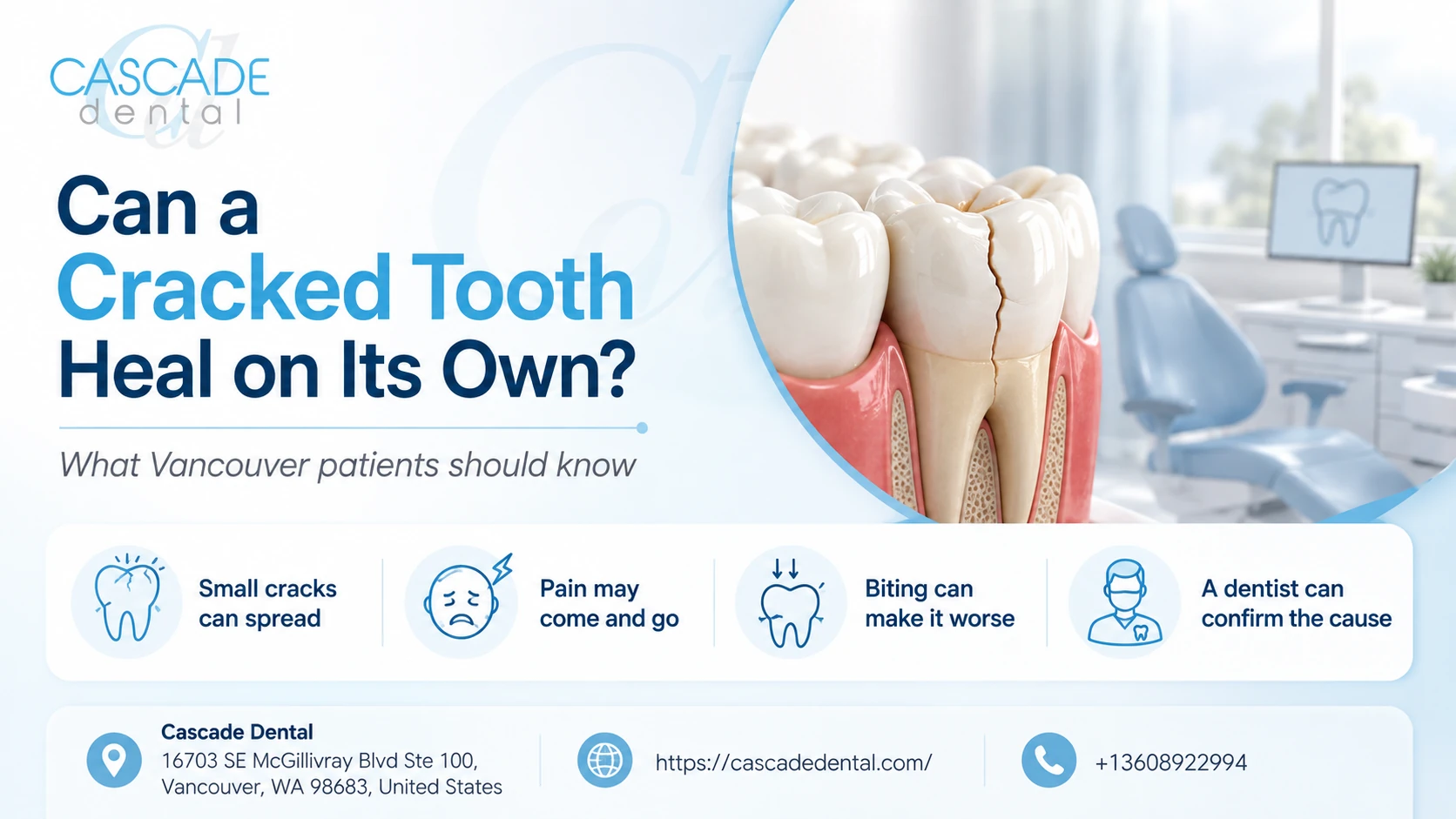
Unlike bone and many soft tissues, mature tooth enamel does not naturally regenerate after it fractures. A very small surface line may remain stable and require only monitoring, but a true structural crack generally needs professional evaluation. Depending on its location and depth, treatment may involve bonding, a protective dental crown, root canal therapy, or, in severe cases, extraction.
Recognizing the symptoms and arranging an examination early can improve the chances of preserving the natural tooth.
Cracked Tooth? Don’t Wait for It to Get Worse
A cracked tooth won’t heal on its own. Get professional dental care before the damage leads to more pain.
Can a Cracked Tooth Heal on Its Own?
No, a cracked tooth cannot heal on its own.
Teeth are made from several layers. Enamel forms the hard outer surface, dentin lies underneath it, and the pulp at the center contains nerves and blood vessels. Although the pulp is living tissue, the enamel covering the tooth does not rebuild itself after a structural crack develops.
This makes a cracked tooth different from a broken bone. When a bone fractures, living cells can produce new tissue that gradually joins the broken sections. Tooth enamel does not have the cells needed to perform that kind of repair.
Some very fine lines in the enamel, commonly called craze lines, may not require restorative treatment. These shallow lines are frequently cosmetic and do not always weaken the tooth. However, it can be difficult for a patient to distinguish a harmless surface line from a deeper crack.
A deeper crack may pass through the enamel and into the dentin. In some cases, it can eventually reach the pulp or extend beneath the gumline. The American Association of Endodontists explains that treatment and prognosis depend largely on the type, location, and extent of the crack.
Temporary improvement in pain does not mean the crack has closed. Symptoms may decrease when you stop chewing on the tooth or when inflammation briefly settles. The tooth still needs to be evaluated to determine whether it requires protection.
What Symptoms Suggest a Tooth Is Cracked?
Cracked tooth symptoms can vary considerably. Some cracks produce significant pain, while others are found during a routine dental examination before the patient notices any discomfort.
One of the most recognizable symptoms is pain when biting down or releasing pressure. The cracked sections may move slightly during chewing, irritating the inner tissues of the tooth. The discomfort may be sharp but brief.
Other possible symptoms include:
- Sensitivity to cold drinks or foods
- Sensitivity to hot temperatures
- Pain when eating sweet foods
- Intermittent tooth pain
- Discomfort that seems to move between teeth
- Pain when chewing firm or crunchy foods
- Tenderness around the tooth
- Swelling of the nearby gum
- A rough or sharp area that can be felt with the tongue
- Difficulty determining which tooth hurts
In a large study of cracked posterior teeth, pain associated with cold testing and bite testing was common, although symptoms varied among patients.
The discomfort may also appear only when you bite at a particular angle. This is one reason cracked teeth can be difficult to diagnose based on symptoms alone.
A crack that reaches the pulp may cause lingering temperature sensitivity, spontaneous aching, or pain that continues after you stop eating or drinking. If bacteria enter the inner tooth, an infection or dental abscess may develop.
Warning signs of a possible infection include swelling, a pimple-like bump on the gum, a bad taste in the mouth, fever, facial swelling, or persistent throbbing pain. The American Dental Association notes that a cracked or injured tooth can allow bacteria to reach the pulp and contribute to an abscess.
Not every episode of sensitivity means a tooth is cracked. Tooth decay, exposed roots, worn fillings, gum problems, and enamel wear can produce similar symptoms. A dental examination is needed to identify the cause.
Why Do Cracks Usually Get Worse Over Time?
Teeth experience repeated pressure every day. Biting, chewing, clenching, and grinding place force on the enamel and the structures beneath it.
When a tooth is already cracked, these forces can make the damaged sections move slightly. Over time, the crack may extend farther across the chewing surface or deeper toward the root.
Several factors can accelerate this process:
Normal Chewing Pressure
Even ordinary foods create repeated stress. A small crack may gradually widen as the tooth absorbs thousands of chewing cycles.
Hard foods such as ice, popcorn kernels, hard candy, and unpopped seeds can place particularly strong pressure on a weakened tooth. The ADA recommends avoiding chewing hard objects that can crack teeth.
Teeth Grinding or Clenching
Bruxism can place substantial pressure on the back teeth. A person may grind during sleep without realizing it, repeatedly stressing a crack.
Large Fillings
Teeth with large fillings may have less remaining natural structure. The walls surrounding the filling can flex or fracture, particularly when exposed to heavy chewing forces.
Temperature Changes
Hot and cold temperatures cause dental materials and tooth structures to expand and contract slightly. A damaged tooth may become more sensitive to these changes.
Bacterial Entry
A deeper crack can create a pathway through which bacteria enter the dentin or pulp. Continued bacterial entry may lead to inflammation, infection, or loss of pulp vitality.
Research reviewed by the American Association of Endodontists indicates that deeper cracks can weaken the tooth and provide an avenue for continued bacterial penetration.
Delayed Treatment
The longer a crack remains unprotected, the more opportunities it has to spread. A crack that may initially be manageable with bonding or a crown could eventually involve the pulp or extend below the gumline.
Early diagnosis does not guarantee that every tooth can be saved, but it often gives the dentist more treatment options.
What Treatment Options Are Available?
Treatment depends on the type of crack, its depth, the condition of the pulp, and the amount of healthy tooth structure remaining.
The dentist’s goal is generally to stabilize the tooth, relieve symptoms, prevent bacterial contamination, and preserve the natural tooth whenever reasonably possible.
Monitoring Minor Craze Lines
Craze lines are shallow marks limited to the outer enamel. They are common in adult teeth and may not cause pain or structural instability.
If a line is purely cosmetic and the tooth is healthy, the dentist may recommend monitoring it. Cosmetic treatment may be considered if its appearance is a concern.
Dental Bonding
Dental bonding may be appropriate for a small chip or minor crack that has not significantly weakened the tooth.
The dentist applies tooth-colored resin to repair the damaged area and restore its shape. Bonding is generally most suitable for limited defects that do not require full coverage.
It may not provide enough protection for a back tooth with a deep structural crack or a tooth exposed to substantial chewing pressure.
Dental Crowns
A dental crown covers the visible portion of a tooth and helps hold weakened sections together. It can redistribute biting pressure and reduce movement around the crack.
Crowns are often considered when a tooth has a significant crack but still has enough healthy structure to be restored. They may also be recommended when an older filling has left the surrounding tooth weak.
Placing a crown does not cause the crack to heal. Instead, it protects and stabilizes the tooth to reduce the likelihood of further separation.
Early treatment may sometimes allow a cracked tooth to be protected with a crown before root canal treatment becomes necessary. The AAE notes that earlier diagnosis in appropriate cases may support more conservative care.
The exact crown material and treatment approach depend on the tooth’s location, appearance, bite forces, and remaining structure.
Root Canal Treatment
Root canal treatment may be recommended if the crack has irritated, inflamed, infected, or damaged the pulp.
During the procedure, the affected pulp is removed, the inside of the tooth is cleaned and sealed, and the tooth is typically restored with a crown afterward. The crown helps protect the remaining tooth from chewing forces.
A root canal treats the damaged tissue inside the tooth, but it does not erase the crack. Whether the tooth can be successfully preserved depends partly on how far that crack extends.
Extraction
Extraction is generally considered when the tooth cannot be predictably restored. This may occur when a crack extends deeply below the gumline, travels down the root, or causes the tooth to split into separate sections.
Extraction is not automatically necessary simply because a tooth is cracked. Many cracked teeth can be treated, and the AAE encourages patients to discuss tooth-preserving options before deciding to remove a compromised tooth.
A careful examination is necessary before determining that extraction is the appropriate option.

What Should You Do If You Have a Severe Toothache?
A bad toothache is hard to ignore, but a severe toothache can feel impossible to deal with. It can hit…

When Should You Call a Dentist?
Contact a dentist promptly when you suspect a cracked tooth, even when the discomfort is mild or intermittent.
Symptoms that warrant an examination include:
- Sharp pain when biting or releasing pressure
- New sensitivity to heat or cold
- Pain when chewing
- A visible line or missing piece of tooth
- A tooth that feels rough or unstable
- Unexplained pain that comes and goes
- Swelling or tenderness near a tooth
- Discomfort following an injury to the mouth
Try to avoid chewing on the affected side until the tooth has been evaluated. Choose softer foods and avoid ice, hard candy, nuts, and other foods that place concentrated force on the tooth.
Do not place aspirin directly on the tooth or gum. It can irritate the soft tissue and will not repair the crack.
A broken or cracked tooth may require urgent attention, particularly when the damage is extensive or accompanied by significant pain. The ADA advises contacting a dentist when a tooth cracks or breaks.
Seek urgent dental or medical care when you experience facial swelling, fever, difficulty swallowing, difficulty breathing, uncontrolled bleeding, or severe pain. These symptoms may indicate an infection or another condition that should not be delayed.
What Will the Dentist Check During Your Visit?
Cracked teeth are not always obvious. Some cracks are too small to see easily, and they may not appear clearly on standard dental X-rays. The examination often combines several diagnostic methods.
Your dentist may begin by asking:
- When the symptoms started
- Whether pain occurs during biting or release
- Which temperatures trigger sensitivity
- Whether the pain lingers
- Whether you grind or clench your teeth
- Whether the tooth has a large filling
- Whether you recently bit something hard
- Whether the tooth has been injured
The dentist will then examine the tooth and surrounding tissues. This may involve looking for visible crack lines, checking existing fillings, examining the gum, and testing whether the tooth moves.
A bite test may be performed by asking you to bite on a small instrument with different parts of the tooth. Pain in one particular area can help the dentist locate the problem.
Temperature testing may be used to evaluate the health of the pulp. The dentist may also gently tap the tooth or check the gums for a deep, isolated pocket that could suggest a crack extending below the surface.
Dental X-rays can help identify infection, bone changes, large restorations, or other causes of pain. However, a narrow crack may not be visible on an X-ray. The ADA notes that some tooth cracks can be difficult to detect and may not appear radiographically.
In some situations, the dentist may use magnification, special lighting, transillumination, or dye to improve visibility. An existing filling may need to be removed before the full extent of the damage can be assessed.
Because cracks can behave differently, the final treatment recommendation is based on the combined findings rather than a single test.
How Cascade Dental Can Help
At Cascade Dental, we understand that unexplained tooth pain can be frustrating, especially when it comes and goes or is difficult to locate.
Our team can evaluate the affected tooth, listen to the pattern of your symptoms, and examine the surrounding teeth and gums. The goal is to determine whether the discomfort is caused by a crack, a damaged filling, decay, bite pressure, pulp inflammation, or another dental concern.
When a crack is present, we explain its apparent location, how much of the tooth is affected, and which treatment options may offer the best chance of preserving it.
Some minor defects may respond to conservative care. A weakened tooth may benefit from the structural protection of a dental crown. When the pulp has been affected, root canal treatment may be considered. If the tooth cannot be saved, we will explain why and review the available next steps.
The sooner a suspected crack is evaluated, the sooner steps can be taken to limit additional damage. Even when the pain has temporarily stopped, an examination can provide clarity and help protect your long-term oral health.
FAQs
Can a small crack in a tooth heal naturally?
No structural tooth crack heals naturally. A very shallow craze line may not need treatment, but it will not regenerate or fuse back together. A dentist should determine whether the line is cosmetic or affects the tooth’s strength.
Can a cracked tooth stop hurting?
Yes. Pain from a cracked tooth can come and go. Symptoms may temporarily decrease when the tooth is not under pressure, but the absence of pain does not mean the crack has healed.
How quickly does a cracked tooth get worse?
There is no fixed timeline. Some cracks remain relatively stable for a period, while others progress quickly after biting hard food, grinding the teeth, or experiencing another injury. Prompt evaluation is the safest approach.
Does every cracked tooth need a crown?
No. Treatment depends on the location and depth of the damage. A small chip may be treated with bonding, while a structurally weakened tooth may need a crown. Some superficial lines require only monitoring.
Can a crown save a cracked tooth?
A crown can often help protect a restorable cracked tooth by covering it and reducing movement between weakened sections. Its suitability depends on how deeply the crack extends and whether the root and supporting tissues remain healthy.
Does a cracked tooth always need a root canal?
No. Root canal treatment is generally considered when the crack has affected the pulp. A tooth with a healthy or reversibly irritated pulp may be treatable without a root canal, depending on the clinical findings.
Can a dentist see a cracked tooth on an X-ray?
Not always. X-rays can reveal infection, bone changes, decay, and other problems, but narrow cracks may not be visible. Dentists frequently use bite testing, magnification, lighting, temperature tests, and other examination methods as well.
What happens if a cracked tooth is left untreated?
The crack may spread, weaken the tooth, or allow bacteria to reach the pulp. This can result in increasing pain, infection, nerve damage, or a fracture that makes the tooth more difficult or impossible to restore.
Can I chew on a cracked tooth while waiting for an appointment?
It is best to avoid chewing on the affected tooth. Choose soft foods, chew on the opposite side, and avoid hard or sticky items that could place additional force on the crack.
Is a cracked tooth considered a dental emergency?
It can be. A minor crack without pain may not require emergency treatment, but it should still be evaluated promptly. Severe pain, facial swelling, fever, significant trauma, or difficulty swallowing or breathing requires urgent care.
Is it possible to save a badly cracked tooth?
Some significantly cracked teeth can be preserved with appropriate treatment, while others cannot. The outcome depends on whether the crack extends below the gumline, involves the root, has split the tooth, or has damaged the surrounding tissues. A professional diagnosis is the only reliable way to assess the tooth.
Think You Have a Cracked Tooth?
Protect your tooth and prevent further damage. Call today to schedule a dental evaluation.