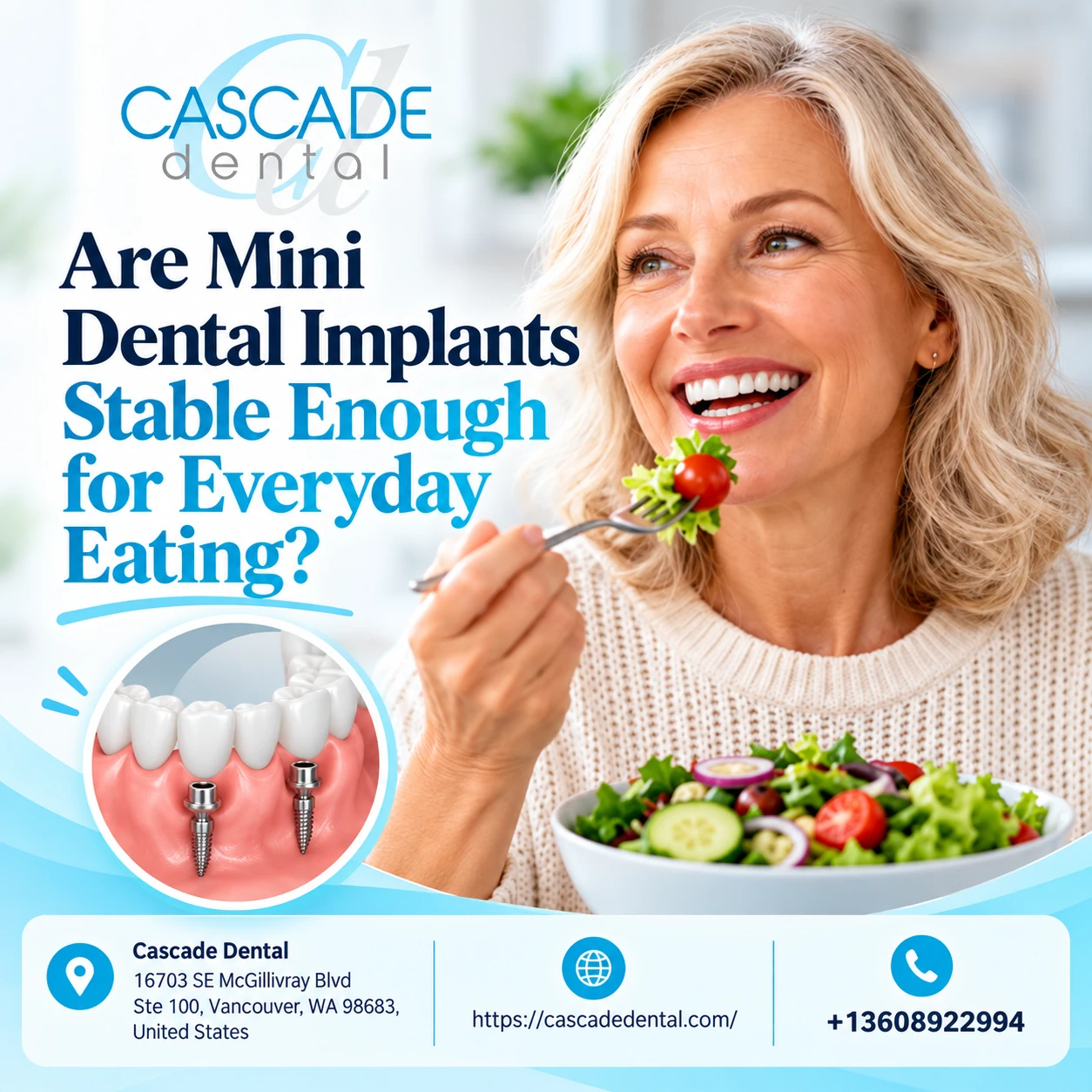
If you are considering mini dental implants, one of the most practical questions you may have is simple: Will they feel stable enough when I eat?
For many properly selected patients, the answer is yes. Mini dental implants can provide reliable support for everyday activities such as chewing, speaking, and smiling, particularly when they are used to stabilize a loose denture. However, mini dental implant stability is not exactly the same for every person or every type of restoration.
The amount and quality of available jawbone, the location of the implants, the forces created by your bite, the number of implants being used, and the type of tooth replacement they support can all influence how well mini implants function.
At Cascade Dental, we believe patients should understand both the possibilities and the limitations of their treatment options. Mini implants can be an effective solution in the right circumstances, but choosing between mini and traditional dental implants requires careful examination and personalized treatment planning.
Eat With More Confidence
Wondering if mini dental implants can handle everyday meals? Schedule a consultation today and find out if they’re right for you.
Are Mini Dental Implants Stable Enough for Everyday Eating?
Mini dental implants can provide enough stability for many normal eating activities when they are appropriately planned, positioned, and restored.
One of their common applications is helping stabilize dentures that move during chewing or speaking. A conventional removable denture rests primarily on the gums and underlying tissues. As the shape of the jaw changes over time, a denture may begin to shift, lift, or slide.
Mini implants can act as small anchoring points that allow a compatible denture to attach more securely. The increased retention may make it easier for patients to chew a wider variety of foods without constantly worrying about their denture moving.
Research comparing mini implants with standard implants for mandibular implant overdentures has found that mini implants can be a viable alternative in appropriately selected cases, with clinical outcomes that can be comparable in certain applications.
That does not mean every mini implant can withstand unlimited chewing pressure.
The stability of an implant-supported restoration depends on several factors, including:
- The density and volume of the patient’s jawbone
- The position and angle of the implant
- How many implants are being used
- Whether the implant is supporting a denture or an individual restoration
- How strongly the patient bites or clenches
- The location of the missing tooth or teeth
- The condition of the surrounding gums and bone
- Whether the patient grinds their teeth
- How well the implant and restoration are maintained
For example, the forces generated in the back of the mouth can be considerably different from those affecting the front teeth. A treatment that works very well for stabilizing a lower denture may not automatically be the best way to replace an individual molar.
This is why implant diameter alone does not determine whether a treatment will be successful.
How Do Mini Dental Implants Work?
Mini dental implants operate according to many of the same basic principles as conventional dental implants.
An implant is positioned within the jawbone to create a stable foundation for a dental restoration. As healing takes place, the implant develops a close connection with the surrounding bone, helping it remain secure while supporting the forces associated with normal oral function.
The primary difference is size.
Mini dental implants are narrower than conventional implants. The American Academy of Implant Dentistry describes mini implants as implants measuring less than 3 millimeters in diameter, while standard implants are generally larger.
Their smaller diameter may allow them to be considered in situations where the available ridge is too narrow for certain conventional implants or where a less invasive approach may be appropriate.
One particularly common use is denture stabilization.
Several mini implants may be positioned along the jaw. Attachments within the denture then connect to the implants, increasing retention while still allowing the denture to be removed for cleaning when the restoration is designed as an overdenture.
Mini implants may also be considered for replacing select individual teeth in certain circumstances. However, because different parts of the mouth experience different chewing forces, they are not automatically appropriate for every missing tooth.
Traditional dental implants generally provide dentists with a broader range of restorative options because of their larger diameter and the variety of implant sizes, components, and restorations available.
Neither design should be considered universally “better.” The appropriate option depends on the patient’s anatomy and restorative needs.
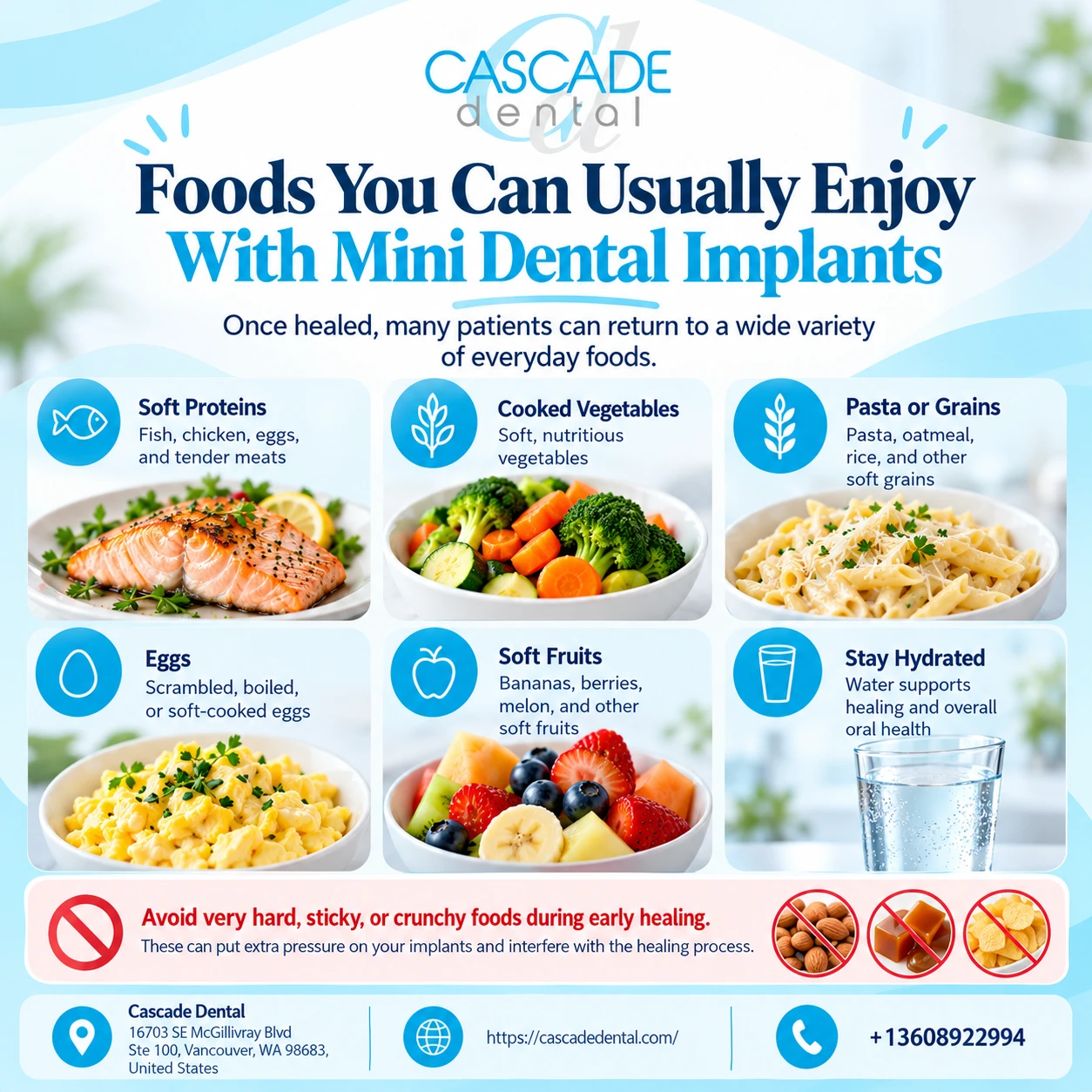
What Foods Can You Eat With Mini Dental Implants?
After appropriate healing and once a dentist confirms that the implants and restoration are functioning properly, many patients can return to a varied everyday diet.
Depending on the restoration, that can include foods such as:
- Cooked vegetables
- Pasta and rice
- Fish
- Chicken and other appropriately prepared meats
- Fruits
- Breads
- Eggs
- Sandwiches
- Soups and stews
During the initial healing period, however, eating recommendations may be much more conservative.
Your dentist may recommend softer foods temporarily so unnecessary pressure is not placed on the treatment area while the tissues recover. Exactly how quickly you can progress to firmer foods depends on how the implants were placed, the type of restoration being used, implant stability, and your individual healing response.
Even after healing, patients should use reasonable caution with foods that create unusually high or unpredictable forces.
Examples can include extremely hard candies, chewing ice, very hard nuts, popcorn kernels, and particularly sticky foods. Whether these foods need to be avoided completely depends on the restoration and the instructions provided by your dentist.
It is also helpful to remember that implant-supported teeth, like natural teeth and conventional restorations, are not indestructible.
The goal of implant treatment is comfortable, useful everyday function, not creating teeth that can tolerate unlimited force.
What Are the Benefits and Limitations of Mini Implants?
Mini dental implants can offer meaningful advantages for certain patients.
Potential Benefits
Improved denture stability
For someone struggling with a lower denture that slides while eating or talking, mini implants may provide additional retention. The AAID identifies stabilization of loose or complete lower dentures as one of the common applications of mini implants.
Smaller diameter
Their narrow design may make mini implants an option when available bone width is limited.
Potentially less invasive placement
Depending on the clinical situation, their smaller dimensions can sometimes allow treatment using a less invasive surgical approach than would otherwise be required.
Improved chewing confidence
A more stable denture can make everyday activities such as eating and speaking feel more predictable.

Can a Dentist Fix a Chipped or Cracked Tooth in One Visit?
That sudden chip in your tooth can feel like a big deal, right? Whether it happened while eating or from…
Potential Limitations
Mini implants also have important limitations.
Because they are narrower, dentists must carefully consider how much force will be placed on them. A solution that is appropriate for retaining a lower overdenture may not be appropriate for a different restoration experiencing greater bite forces.
The scientific evidence can also vary depending on where mini implants are placed and how they are used.
For example, research involving mini-implant-supported overdentures in the upper jaw has reported less predictable survival than traditional implant treatment in some circumstances, reinforcing the importance of careful case selection.
Mini implants may therefore be an alternative rather than a direct substitute for traditional implants in every situation.
Choosing them simply because they are smaller would overlook some of the most important factors involved in implant dentistry.
Who Is a Good Candidate for Mini Dental Implants?
The best candidates are determined through an individual dental evaluation rather than a single checklist.
Mini implants may be considered for patients who:
- Want greater stability from a loose denture
- Have limited bone width in certain areas
- Need replacement of select teeth where a narrow implant is appropriate
- Have anatomy that makes a smaller-diameter implant worth considering
- Have healthy enough oral tissues to support implant treatment
- Are willing to maintain good oral hygiene and attend follow-up appointments
They can sometimes be particularly useful when conventional implant placement would require additional procedures because of limited available bone. However, limited bone does not automatically mean mini implants are the correct solution.
A dentist still needs to determine whether enough healthy bone exists in the correct locations to support the proposed treatment.
Factors that may affect candidacy include uncontrolled oral disease, inadequate bone support, certain medical conditions, smoking, significant teeth grinding or clenching, and bite patterns that place excessive forces on the proposed implants.
Some of these factors do not automatically rule out implant treatment. They simply need to be evaluated during treatment planning.
How Does a Dentist Determine the Best Implant Option?
Determining whether mini or traditional implants are appropriate involves much more than examining the space left by a missing tooth.
A comprehensive implant evaluation may include an examination of your teeth and gums, review of your health history, evaluation of your bite, and diagnostic imaging.
Your dentist will typically consider questions such as:
How much bone is available?
Implants need appropriate bone support. Both the width and height of the available bone can influence implant selection.
What is the quality of the bone?
Bone density can affect the initial stability of an implant and how forces are distributed during function.
Where will the implant be placed?
A front tooth and a back molar perform different jobs. The forces involved can influence implant diameter, length, number, and positioning.
What will the implants support?
Stabilizing a removable denture is different from supporting an individual crown or a larger fixed restoration.
How strong is the patient’s bite?
Patients with powerful bite forces or significant grinding and clenching habits may require a different treatment approach.
What will provide reliable long-term function?
The simplest treatment is not always the treatment most likely to provide the best long-term result.
The objective is to select an implant and restoration that work together as a complete system.
How Cascade Dental Can Help
At Cascade Dental, we approach implant dentistry by first understanding what you want your replacement teeth to accomplish.
For one patient, the biggest concern may be a lower denture that moves whenever they eat. Another patient may want to replace one missing tooth without affecting neighboring teeth. Someone else may have experienced significant bone loss and want to understand what implant options remain available.
Those situations should not automatically receive the same treatment.
Our team can evaluate your oral health, available bone, bite, missing teeth, existing restorations, and long-term goals before discussing whether mini dental implants, traditional implants, or another restorative option may be appropriate.
When mini implants are well suited to the situation, they can provide valuable stability and make everyday function more comfortable. When traditional implants would provide a stronger or more predictable foundation, we want patients to understand that distinction as well.
The most important step is not choosing an implant based on its name or size. It is choosing a treatment plan designed around your anatomy, lifestyle, and restorative needs.
If you are wondering whether mini dental implants could help you eat more comfortably and confidently, schedule an evaluation with Cascade Dental. We can assess your individual needs and explain which implant approach is most appropriate for your smile.
FAQs
Are mini dental implants strong enough to chew food?
Mini dental implants can provide excellent stability for everyday chewing in properly selected patients. Their ability to handle chewing forces depends on implant position, bone quality, bite strength, the number of implants, and the type of restoration being supported.
Can you eat normally with mini dental implants?
Many patients can return to a varied diet after healing. Your dentist may initially recommend softer foods and gradually allow firmer foods as the treatment area heals. Long-term recommendations depend on your specific restoration.
Are mini dental implants as stable as regular implants?
Both mini and traditional implants can provide stable results when used appropriately, but they are not interchangeable in every clinical situation. Traditional implants have a larger diameter and may be preferred when greater support or different restorative options are necessary. Mini implants can perform very well for indications such as stabilizing certain overdentures.
Why would a dentist recommend mini implants instead of traditional implants?
A dentist may consider mini implants when a patient has a narrow ridge, wants additional denture stabilization, or has another clinical situation where a smaller implant provides an appropriate solution. Treatment recommendations should always be based on a complete evaluation.
Can mini dental implants be used for individual teeth?
They may be used for select individual tooth replacements when the available space, bone, bite forces, and tooth location are appropriate. However, mini implants are not suitable for every missing tooth, particularly when significant chewing forces are expected.
Do mini dental implants prevent dentures from moving while eating?
Mini implants can significantly improve the retention of certain implant-supported overdentures, helping reduce the sliding or lifting associated with conventional dentures. The amount of stability achieved depends on the number and position of the implants as well as the design and fit of the denture.
Are there foods you should avoid with mini dental implants?
During healing, softer foods may be recommended. After healing, many patients can eat a broad range of foods, although extremely hard, sticky, or forceful foods may require caution depending on the restoration. Your dentist can provide specific instructions for your treatment.
How long do mini dental implants last?
There is no single lifespan that applies to every implant. Longevity depends on factors such as implant location, bone condition, bite forces, oral hygiene, restoration design, health habits, and ongoing professional care. Research supports mini implants as a useful option in selected applications, while outcomes can differ depending on the location and type of restoration.
How do I know whether mini or traditional dental implants are right for me?
The only reliable way to determine the appropriate option is through a professional implant evaluation. Your dentist can examine your mouth, review diagnostic imaging, assess your bite and bone, and recommend an implant approach based on the type of replacement teeth you need.
Ultimately, mini dental implant stability depends on matching the implant to the right patient and the right restoration. When treatment is carefully planned, mini implants can offer comfortable and dependable function for many everyday activities. When another implant design would provide better support, a personalized evaluation allows your dentist to identify that before treatment begins.
Ready for a Stronger Smile?
Explore mini dental implants for improved stability and comfortable everyday eating. Call today to schedule your consultation.