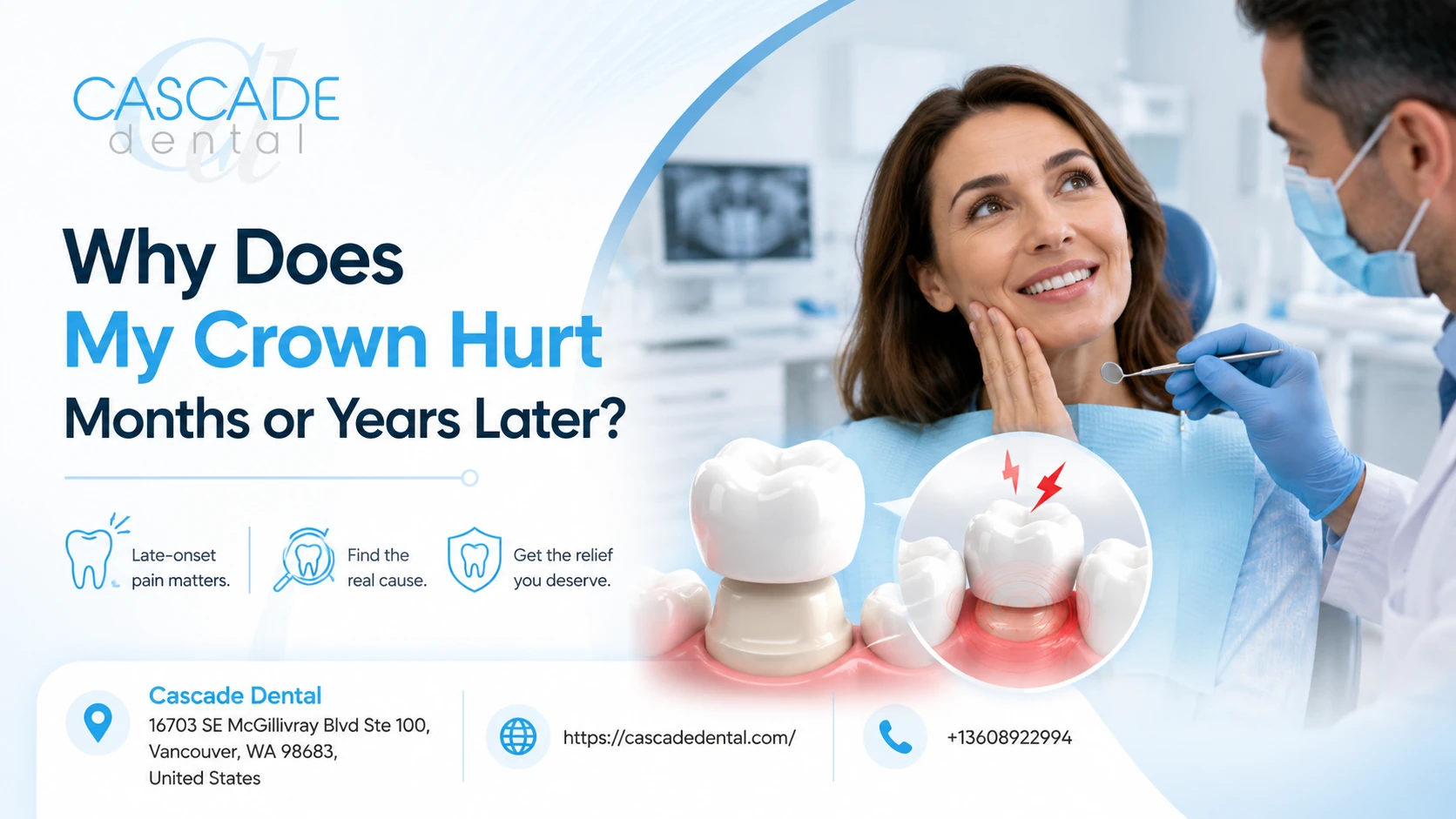
A dental crown may feel completely comfortable for months or even years before it begins causing pain. When that happens, it can be confusing. The crown has already healed, the tooth has been functioning normally, and there may be no visible sign of damage.
Although a crowned tooth can occasionally feel temporarily sensitive, new or recurring pain after a long symptom-free period should not be ignored. The discomfort may come from the crown itself, the natural tooth underneath it, the surrounding gums, the tooth’s nerve, or changes in how the upper and lower teeth come together.
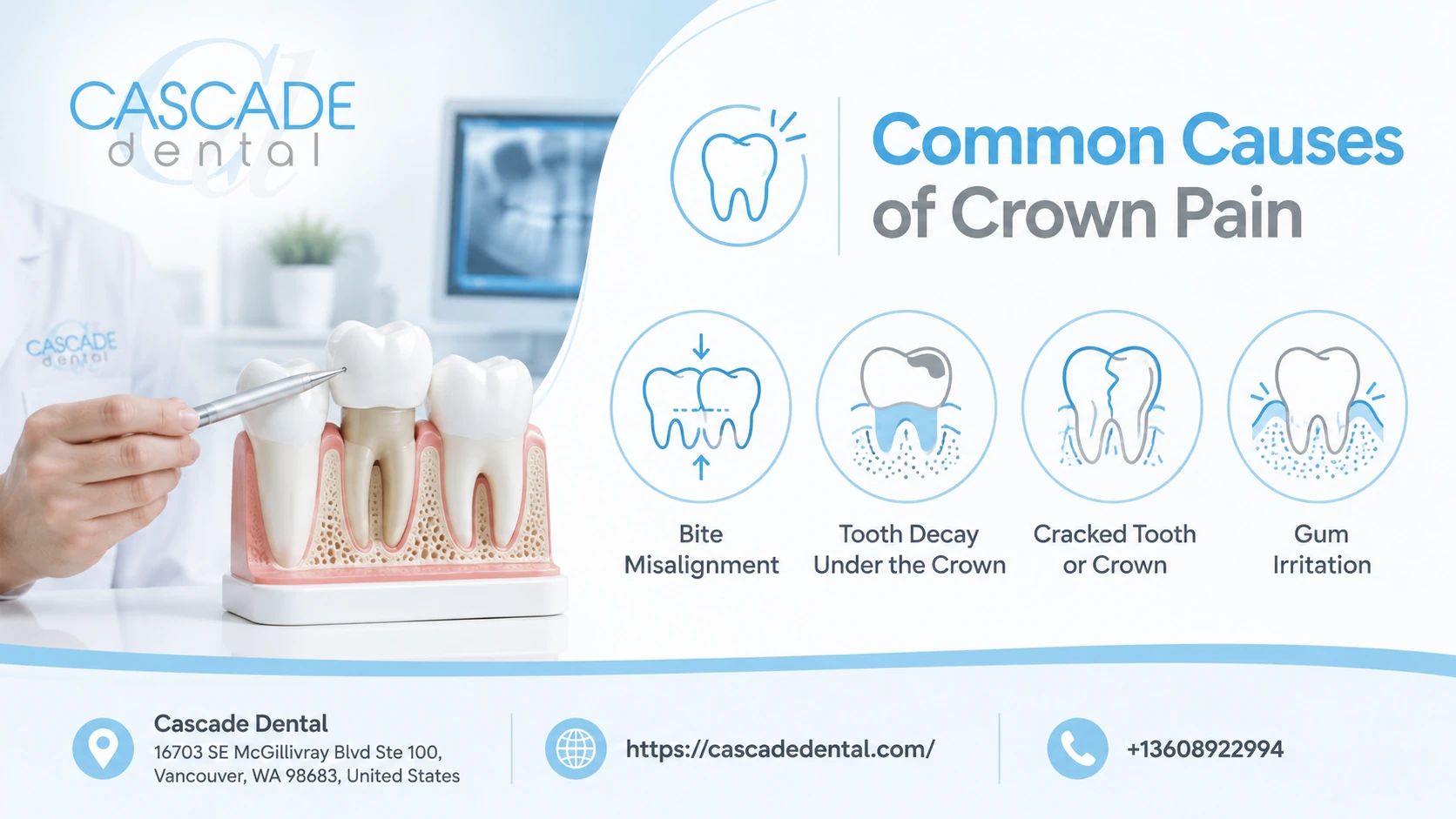
Common causes include decay developing beneath the crown, a loose restoration, gum recession, teeth grinding, bite changes, a crack in the supporting tooth, or inflammation around the tooth’s root. Not every one of these problems requires a new crown. Some can be corrected with a small adjustment, improved cleaning, treatment for grinding, or another conservative solution when identified early.
A dental examination is the most reliable way to determine why a crown hurts years later. The timing, location, and type of pain can offer helpful clues, but symptoms alone usually cannot confirm the cause.
Crown Pain That Won’t Go Away?
Don’t ignore ongoing discomfort. Get your crown checked and find out what’s causing the pain.
Why Can a Crown Hurt Months or Years Later?
A crown covers and protects a natural tooth, but it does not make that tooth immune to future problems. The tooth still has roots, surrounding ligaments, gum tissue, and, unless it previously received root canal treatment, living tissue and nerves inside it.
Changes can occur gradually underneath or around the restoration. A small area of decay may develop near the crown’s edge. The cement holding the crown in place may weaken. The gums may recede and expose sensitive tooth structure. A patient may also begin grinding their teeth or develop a change in their bite that places additional pressure on the crowned tooth.
Possible reasons for delayed crown pain include:
- An uneven or changing bite
- Decay beneath or around the crown
- A loose crown
- A chipped or cracked restoration
- Gum recession
- Gum inflammation
- Teeth grinding or clenching
- A crack in the supporting tooth
- Inflammation inside the tooth
- Infection around the tooth’s root
- Problems involving a previously treated root canal
- Pain referred from a nearby tooth, jaw muscle, or sinus
A crown may also make it difficult for patients to determine exactly where the discomfort begins. Pain from one tooth can sometimes feel as though it is coming from another location. This is why an examination may include several nearby teeth rather than only the crowned one.
Is Crown Pain Always a Sign Something Is Wrong?
Not every brief sensation means the crown has failed. Teeth can occasionally feel sensitive after exposure to very cold foods, hard chewing, or temporary jaw clenching. Mild gum irritation can also occur when food becomes trapped near the crown.
However, a crown that has functioned comfortably for months or years should not routinely hurt. Pain that returns repeatedly, becomes more intense, or lasts after the trigger is gone deserves professional attention.
The pattern of discomfort may help indicate what type of problem is developing.
Brief sensitivity to cold
A quick response to cold that stops almost immediately may be associated with exposed root structure, gum recession, or mild irritation. The American Dental Association identifies exposed tooth roots, decay, fractured teeth, worn restorations, and gum disease as possible causes of dental sensitivity.
Lingering sensitivity
Pain that continues after a hot or cold drink has been removed may suggest deeper inflammation inside the tooth. The duration of the discomfort matters, so patients should tell the dentist whether it lasts for seconds, minutes, or longer.
Pain when biting
Discomfort under chewing pressure may be associated with an uneven bite, a loose crown, inflammation around the root, or a crack in the tooth. Cracked teeth can cause unpredictable pain during chewing, particularly when biting pressure is released.
Pain that comes and goes
Intermittent pain does not necessarily mean the problem is minor. Cracked teeth, early nerve inflammation, grinding, and loose restorations may cause symptoms that disappear temporarily before returning. The American Association of Endodontists notes that pain from a cracked tooth can be inconsistent and difficult to locate.
Throbbing pain or swelling
Continuous throbbing, swollen gums, facial swelling, or a bump near the tooth may indicate inflammation or infection. A dental abscess is an infection in or around a tooth’s root and requires professional care.
The crown does not automatically need replacement simply because discomfort has developed. The appropriate response depends on the source of the pain and the condition of the crown and supporting tooth.
What Should You Check Before Assuming the Crown Has Failed?
Patients should not attempt to remove, glue, reshape, or repair a crown at home. However, a few simple observations can help provide useful information for the dental team.
Consider when the pain occurs
Pay attention to whether discomfort develops:
- When biting down
- When releasing a bite
- After eating something cold
- After drinking something hot
- When chewing sticky foods
- During the morning
- After periods of stress
- When flossing around the crown
- Without any clear trigger
Morning soreness may be associated with nighttime grinding. Pain caused by a specific temperature may suggest sensitivity or inflammation, while pain during chewing may point toward bite pressure, a loose crown, or a crack.
Look at the surrounding gums
Use a mirror to check for:
- Redness
- Swelling
- Bleeding
- Gum recession
- A small bump or pimple
- Food trapped around the crown
- A visible gap near the gumline
Do not press firmly on a swollen area or attempt to drain it.
Check whether the crown feels loose
A crown should not move when you chew, brush, or floss. Avoid repeatedly pushing on it with your fingers or tongue, but make note of any clicking, shifting, or movement.
If the crown feels loose, avoid chewing on that side and schedule an examination. Continued pressure could damage the crown or the remaining tooth structure.
Think about recent changes
A crowned tooth can begin hurting after changes elsewhere in the mouth. Consider whether you have recently:
- Received another filling or crown
- Lost a tooth
- Begun wearing a dental appliance
- Experienced an injury
- Started clenching during stress
- Noticed jaw soreness
- Changed chewing habits
- Had sinus pressure or congestion
A new restoration on another tooth can sometimes alter the bite. Tooth movement or missing teeth can also change how pressure is distributed.
Avoid repeatedly testing the tooth
It may be tempting to keep biting on the tooth or applying hot and cold substances to see whether it still hurts. Repeated testing can irritate the area and does not provide a diagnosis.
Until the tooth is evaluated, avoid hard, crunchy, or sticky foods on that side of the mouth.
How Bite Changes, Decay, and Nerve Problems Cause Pain
Several of the most common causes of delayed crown pain develop gradually and may not be visible to the patient.
Changes in the bite
A crown that was comfortable when first placed can begin receiving excessive pressure later. Teeth naturally shift over time, and restorations or tooth loss elsewhere in the mouth may change the bite.
Grinding and clenching can also place repeated force on a crowned tooth. Excessive pressure may irritate the periodontal ligament, which is the tissue surrounding the tooth’s root. The tooth may then feel sore, bruised, or sensitive when biting.
Signs that bite pressure may be involved include:
- The crowned tooth feels like it contacts first
- Pain occurs mainly when chewing
- The tooth feels tender after waking
- Jaw muscles feel tired or tight
- Other teeth show signs of wear
- The symptoms are worse during stressful periods
A bite adjustment may help in certain cases, but the dentist must first rule out decay, cracks, and infection.
Decay beneath the crown
The crown material cannot develop a cavity, but the natural tooth underneath it can. Decay frequently begins near the margin where the crown meets the tooth.
Plaque and bacteria can collect around this edge, particularly if the fit has changed, the gums have receded, or the area is difficult to clean. Tooth-root surfaces exposed by recession are more vulnerable to decay and temperature sensitivity than enamel-covered areas.
Decay beneath a crown may cause:
- Sensitivity to sweets, heat, or cold
- Pain when chewing
- A bad taste
- Food becoming trapped
- Gum irritation
- An unpleasant odor near the crown
- Loosening of the restoration
Early decay does not always produce pain. Dental X-rays and a close examination may be needed to identify a problem that cannot be seen directly.
A loose or damaged crown
Dental cement can weaken over time, and crown material may chip or crack under heavy pressure. A small opening between the crown and tooth can allow bacteria or food debris to enter.
A loose crown may produce movement, an unusual taste, temperature sensitivity, or pain during chewing. It should be evaluated promptly even if the discomfort is mild.
Some loose crowns can be recemented when the restoration and supporting tooth remain healthy. If decay or structural damage is present, a different solution may be needed.

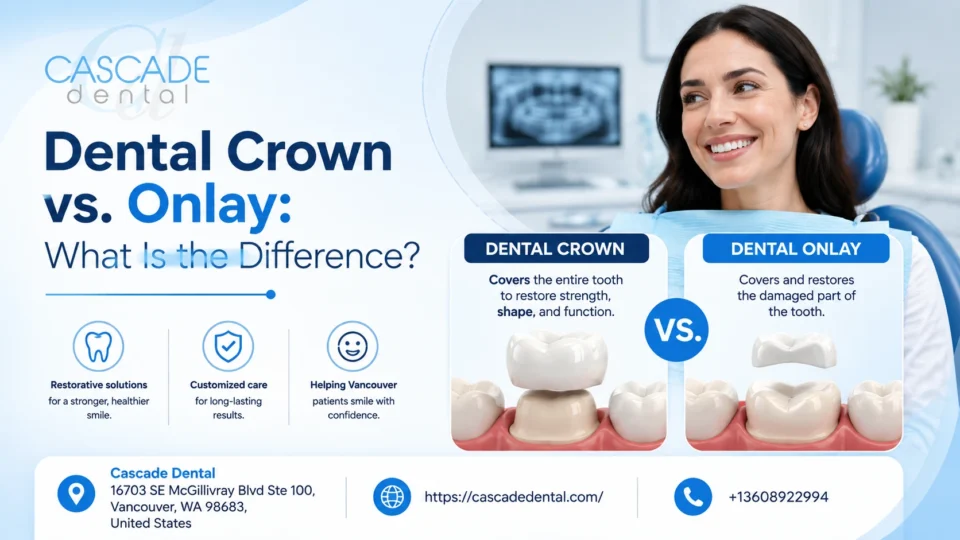
Dental Crown vs. Onlay: What Is the Difference?
When a tooth is too damaged for a routine filling, a dentist may recommend an indirect restoration such as a…
Gum recession and exposed tooth structure
The gums can gradually move away from the edge of a crown because of periodontal disease, aggressive brushing, aging, tooth position, or other factors. Recession may expose part of the root that was not previously visible.
The exposed area may be especially sensitive to cold, touch, or sweet foods because the root is not protected by enamel.
Recession does not always mean the crown has failed. The dentist will evaluate the crown’s fit, the condition of the gums, and whether decay is present.
Cracked tooth syndrome
A crown strengthens a damaged tooth, but a crack may still develop or progress beneath it. Cracks can be caused by grinding, biting hard objects, trauma, large previous restorations, or natural weakening of the tooth.
Symptoms may include:
- Sharp pain when chewing
- Pain when releasing biting pressure
- Sensitivity to hot or cold
- Symptoms that come and go
- Difficulty identifying the exact painful tooth
The depth and location of the crack affect whether the tooth can be restored. Some cracked teeth can be treated successfully, while deeper fractures may have a less predictable outlook.
Inflammation of the tooth’s nerve
If a crowned tooth has not had root canal treatment, the soft tissue inside it can become inflamed months or years later. This tissue, called the pulp, contains nerves, blood vessels, and connective tissue.
Inflammation may develop because of:
- Decay beneath the crown
- A crack in the tooth
- Repeated dental treatment
- Trauma
- Leakage around the crown
- Heavy bite pressure
Early inflammation may cause sensitivity. More advanced involvement can produce lingering temperature pain, spontaneous aching, throbbing, or pain that interferes with sleep.
Infection around the root
When bacteria reach the inner tissue of a tooth, infection can spread through the root canal system and affect the surrounding bone and tissues.
Possible symptoms include:
- Persistent pain
- Pain when biting
- Swollen gums
- Facial swelling
- A pimple-like bump on the gums
- Drainage or an unpleasant taste
- Fever or general illness
An abscess may be painful, but some infections cause limited discomfort.
Problems after previous root canal treatment
A tooth that already received root canal treatment does not contain the same responsive pulp tissue, but it can still become painful. The tissues around the root remain alive and can become inflamed or infected.
A previously treated tooth may develop problems because of a new crack, new decay, contamination beneath the restoration, or untreated canal anatomy. The AAE notes that some root canal-treated teeth may require additional treatment when the tooth did not heal as expected or when a restoration did not adequately prevent contamination.
Pain in a root canal-treated tooth should therefore be evaluated rather than dismissed because the nerve was previously removed.
When Should You Schedule a Dental Exam?
Schedule an examination when crown pain persists, returns repeatedly, or begins after the tooth has been comfortable for a long time.
Contact the dental office if you experience:
- Pain when biting or chewing
- Sensitivity that is new or worsening
- Discomfort that lingers after heat or cold
- A loose or moving crown
- A visible chip or crack
- Swollen or bleeding gums around the crown
- A bad taste or odor near the tooth
- Pain that wakes you at night
- Symptoms that come and go over several days
- A change in how your teeth meet
- Food repeatedly becoming trapped around the crown
More urgent care may be appropriate when there is facial swelling, rapidly increasing pain, fever, difficulty swallowing, difficulty breathing, or swelling spreading toward the eye, jaw, or neck.
Patients should not wait for severe pain before seeking care. Decay, cracks, and infection may become more difficult to treat as they progress. Early evaluation may also increase the likelihood that the existing crown or natural tooth can be preserved.
What Will the Dentist Check During Your Visit?
The dentist will begin by asking about the symptoms, including when they started, what triggers them, and how long they last. These details can help distinguish between bite pressure, sensitivity, nerve inflammation, cracking, gum problems, and other possible causes.
The examination may include the following steps.
Evaluating the crown
The dentist may check whether the crown is:
- Loose
- Chipped
- Cracked
- Worn
- Properly sealed
- Difficult to clean around
- Showing gaps or damaged margins
Examining the gums
The gums will be checked for inflammation, recession, bleeding, swelling, drainage, and periodontal pocketing.
Checking the bite
The dentist may use marking paper to see where the crowned tooth contacts the opposing teeth. This can reveal whether it is receiving excessive pressure.
Testing the tooth
Depending on the situation, the dentist may test the tooth’s response to temperature, tapping, pressure, or biting. Nearby teeth may also be checked because dental pain can be difficult to localize.
Bite testing and other clinical methods are commonly used when a crack is suspected.
Taking dental X-rays
X-rays may help identify:
- Decay near or beneath the crown
- Bone changes around the root
- Infection
- Problems involving previous root canal treatment
- Loss of supporting bone
- Changes in nearby teeth
Not every crack appears clearly on an X-ray, so the dentist may combine imaging with magnification, bite tests, light examination, and other clinical findings.
Reviewing grinding and jaw tension
The dentist may look for worn teeth, small fractures, cheek ridges, tongue impressions, or tender jaw muscles that suggest clenching or grinding.
The final recommendation depends on the diagnosis. Possible next steps may include monitoring, a bite adjustment, treatment for gum inflammation, repair or recementation of the crown, decay removal, root canal treatment, replacement of the restoration, or referral to a specialist.
How Cascade Dental Can Help
At Cascade Dental, we evaluate the entire crowned tooth rather than assuming that new discomfort automatically means the restoration needs replacement.
Our dental team can examine the crown, the supporting tooth, the surrounding gums, and the patient’s bite to identify the most likely source of the pain. Dental X-rays or additional tests may be recommended when the cause is not visible during a routine examination.
Depending on the findings, the crown may only need monitoring, cleaning around its margins, a bite adjustment, or another limited correction. When the tooth has decay, a crack, nerve inflammation, or infection, we can explain the available treatment options and why a particular approach may be recommended.
The purpose of the evaluation is to preserve healthy tooth structure whenever reasonably possible while addressing the cause of the discomfort. A crown that hurts years later does not always need to be replaced, but persistent symptoms should be assessed before the underlying problem becomes more extensive.
FAQs
Why does my crown hurt when I bite down?
Pain while biting may result from excessive bite pressure, inflammation around the root, a loose crown, decay, or a crack in the tooth. Pain that occurs when biting pressure is released is commonly associated with cracked teeth, although an examination is necessary to confirm the cause.
Can a tooth decay under a crown?
Yes. The crown material cannot develop a cavity, but the natural tooth beneath it can. Decay often begins near the crown’s margin and may spread underneath the restoration.
Why is my old crown suddenly sensitive to cold?
Cold sensitivity may develop because of gum recession, exposed root structure, decay, a loose crown, or a crack. The ADA identifies exposed roots, decay, fractured teeth, gum disease, and worn restorations as common sources of sensitivity.
Does crown pain mean I need a root canal?
Not necessarily. The pain may come from the bite, gums, grinding, a loose restoration, or another problem. Root canal treatment may be considered when the tissue inside the tooth is irreversibly inflamed or infected.
Can a crown hurt because it is too high?
Yes. If the crowned tooth receives excessive pressure, the ligament around its root can become tender. A dentist can evaluate the bite and determine whether an adjustment is appropriate.
Can teeth grinding make a crowned tooth hurt?
Yes. Grinding and clenching can place repeated pressure on the crown and supporting tooth. This may contribute to soreness, wear, loosening, chips, or cracks.
Why does the gum around my crown hurt?
Gum discomfort may result from trapped food, plaque buildup, recession, periodontal disease, crown shape, or a damaged margin. Swelling, bleeding, or persistent tenderness should be evaluated.
Can a crown become loose after several years?
Yes. Dental cement can weaken, and changes in the tooth or crown may reduce its stability. A loose crown should be examined promptly and should not be reattached with household glue.
Can an old root canal tooth hurt under a crown?
Yes. Although the inner nerve tissue was removed, the tissues surrounding the root can still become inflamed or infected. New decay, cracks, contamination, or problems involving the original root canal may cause discomfort.
Will the crown always have to be removed to find the problem?
No. Dentists can often gather significant information through an examination, bite tests, sensitivity tests, and X-rays. Crown removal may be necessary when the dentist needs to access decay, inspect the underlying tooth directly, or perform certain treatments.
Can a painful crown be repaired?
Sometimes. A minor bite problem, small chip, gum issue, or loose but otherwise healthy crown may be corrected without complete replacement. More extensive decay, fractures, or poor fit may require a new restoration.
How long should I wait before calling a dentist?
New pain in a crown that was previously comfortable should be monitored closely, but persistent, recurring, or worsening discomfort should be evaluated promptly. Do not wait when there is swelling, severe pain, fever, drainage, or difficulty swallowing.
Do Not Ignore New Pain in a Previously Comfortable Crown
A crown that begins hurting months or years after placement may have a correctable problem, but the cause cannot be determined from symptoms alone. Bite changes, gum recession, decay, grinding, cracks, and nerve or root inflammation can all produce similar discomfort.
Avoid repeatedly testing the tooth, chewing hard foods on it, or attempting to repair the crown at home. Make note of when the pain occurs, how long it lasts, and whether you have noticed swelling, movement, or sensitivity.
Scheduling a dental examination allows the crown and supporting tooth to be evaluated before a small concern becomes a more complicated issue. Early diagnosis may make it possible to relieve the pain while preserving the restoration or natural tooth.
Is Your Old Crown Starting to Hurt?
Get professional dental care to identify the problem and protect your tooth before it gets worse.