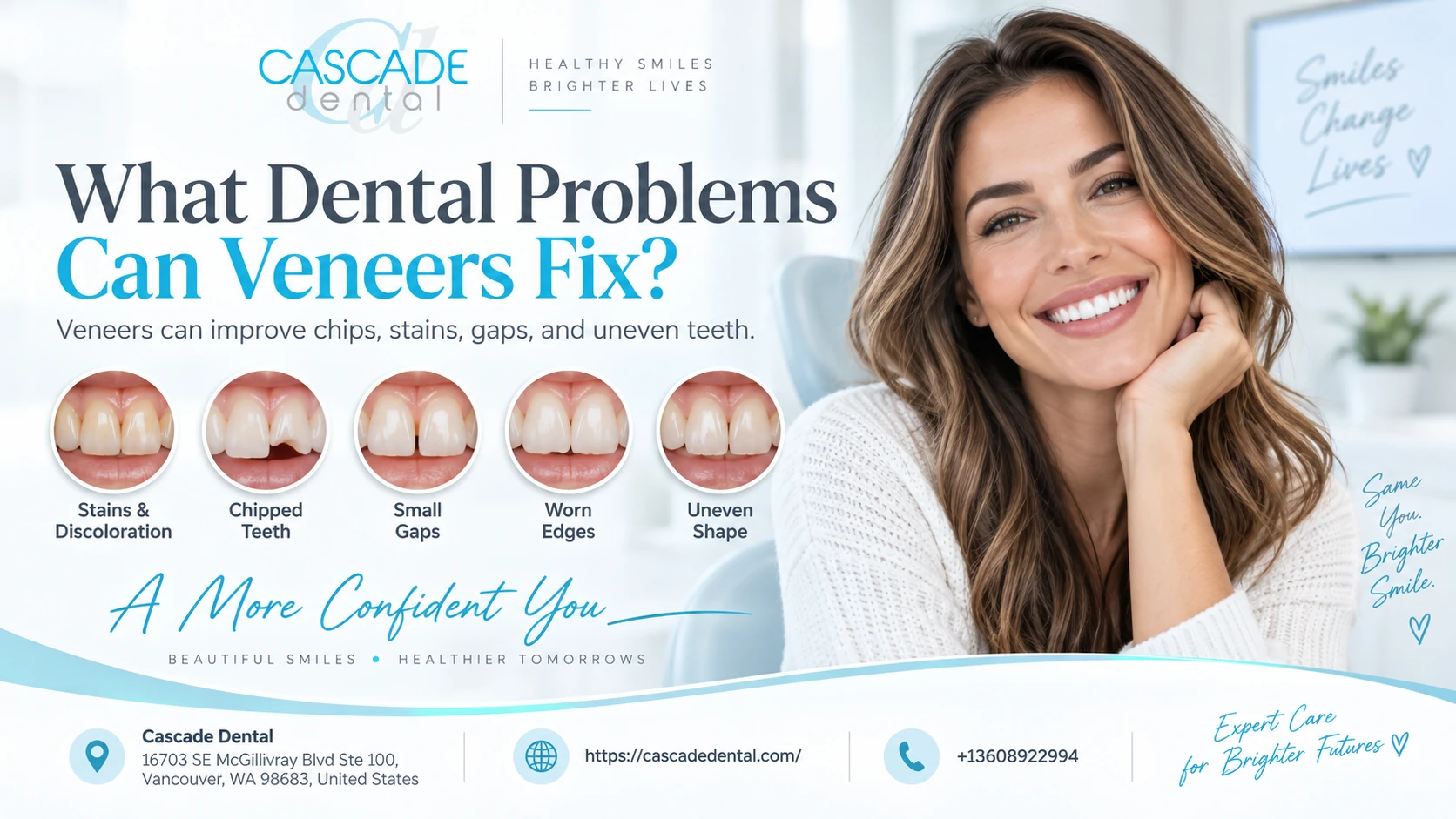
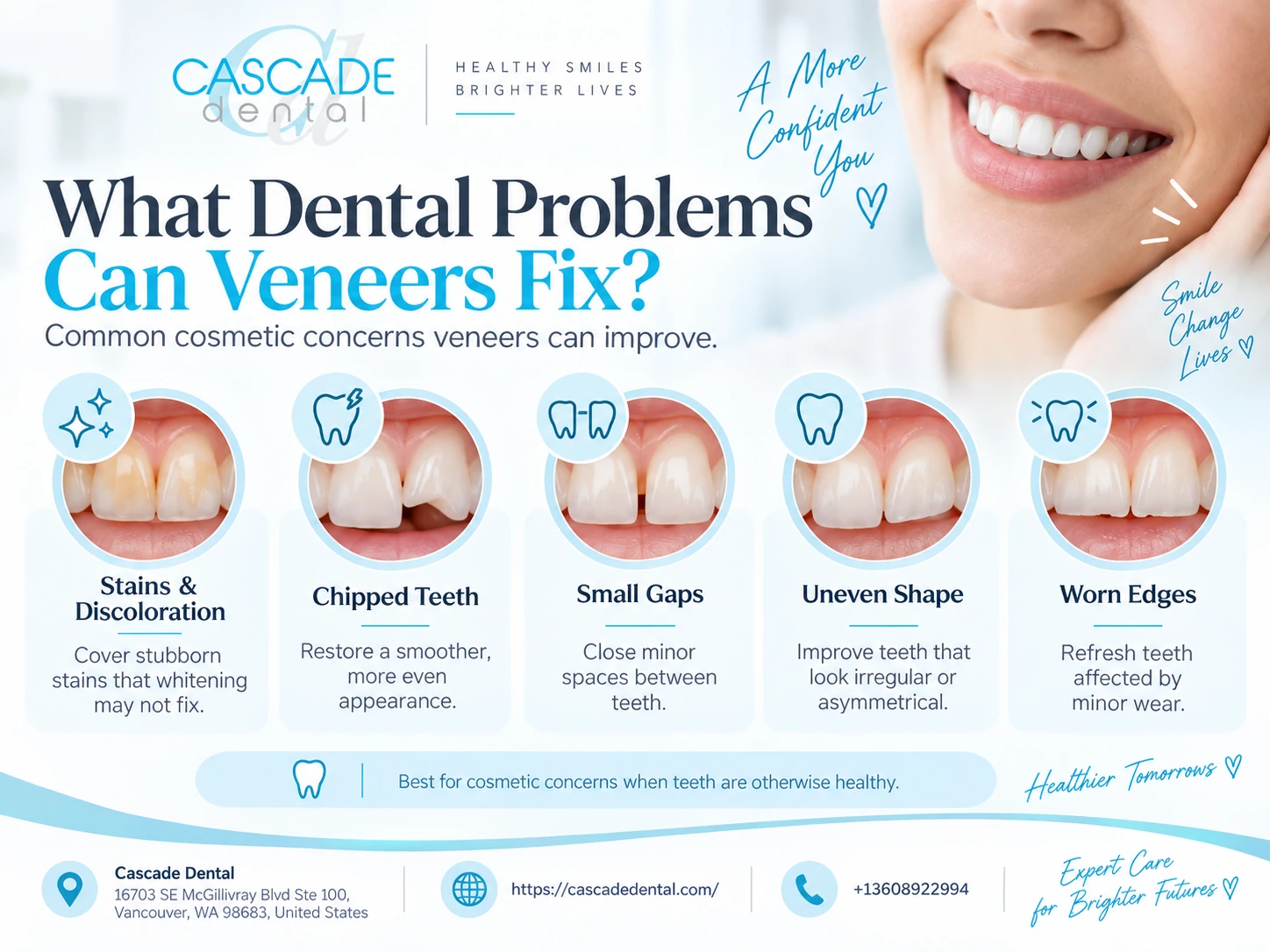
Veneers can improve several cosmetic concerns, including chipped teeth, small gaps, stubborn discoloration, uneven tooth shapes, and mild differences in tooth size or alignment. They work by covering the visible front surface of a tooth to create a more even, balanced appearance.
However, veneers are not designed to treat every dental problem. Active decay, gum disease, significant bite problems, or severely damaged teeth may need other treatment first. At Cascade Dental, a cosmetic evaluation helps determine whether veneers are appropriate or whether another option may provide a healthier, more predictable result.
Fast Answer: What Can Veneers Fix?
Dental veneers are thin restorations placed over the front surface of teeth to change their visible appearance.
Depending on the patient’s needs, veneers may help improve:
- Small chips
- Minor cracks limited to the visible tooth surface
- Small spaces between teeth
- Stubborn tooth discoloration
- Teeth that appear too small
- Uneven tooth shapes
- Mildly crooked-looking teeth
- Minor differences in tooth length
- Worn-looking front teeth
- Cosmetic asymmetry within the smile
Veneers are most commonly considered for teeth that are otherwise healthy enough to support the restoration.
They change how a tooth looks rather than correcting every underlying dental condition. For example, a veneer may make a slightly uneven tooth appear straighter, but it does not physically move that tooth into a new position the way orthodontic treatment does.
That distinction is important when deciding whether veneers are the right cosmetic option.
Can Veneers Fix Chipped Teeth?
Yes, veneers can often improve the appearance of mildly chipped front teeth.
A chip may make one tooth look shorter or create an uneven edge that stands out when a person smiles. A veneer can cover the front surface and rebuild the visible shape of the tooth.
Veneers may be particularly useful when:
- The chip affects the appearance of a front tooth
- The remaining tooth structure is healthy
- The damage is relatively limited
- The patient wants to improve additional cosmetic concerns at the same time
However, not every chipped tooth needs a veneer.
A small chip may sometimes be repaired with dental bonding, which uses tooth-colored composite material to restore the missing area. Bonding generally requires less alteration of the natural tooth and may be a practical option for minor damage.
A heavily fractured tooth may need something stronger, such as a dental crown.
Before recommending veneers, the dentist needs to determine how much tooth structure remains and whether the chip is purely cosmetic or involves deeper damage.
Can Veneers Close Small Gaps Between Teeth?
Veneers can sometimes close small spaces between neighboring front teeth.
The restorations can be designed slightly wider than the natural teeth, allowing them to visually reduce or eliminate a small gap while maintaining natural-looking proportions.
This approach may work well when the gap is relatively minor and the surrounding teeth are otherwise positioned appropriately.
However, veneers are not always the best solution for spacing.
Larger gaps, multiple spaces, or spacing caused by significant tooth-position problems may be better addressed with orthodontic treatment.
A cosmetic dentist also needs to consider the size and shape of the surrounding teeth. Making veneers too wide simply to close a large space can create proportions that look unnatural.
The goal should be a balanced smile, not simply eliminating every visible gap.
Can Veneers Improve Tooth Discoloration?
Yes. Discoloration is one of the most common cosmetic concerns veneers can address.
Professional teeth whitening can improve many types of staining, but not every tooth responds equally well.
Veneers may be considered when discoloration is:
- Deep within the tooth
- Uneven across several teeth
- Resistant to whitening
- Associated with previous dental treatment
- Noticeably different from neighboring teeth
Because veneers cover the visible surface of the tooth, their shade can be selected to create a more uniform smile.
The dentist will normally consider the patient’s natural tooth color, skin tone, surrounding teeth, and overall cosmetic goals when choosing a veneer shade.
It is also important to understand that veneers themselves do not respond to whitening products the same way natural enamel does.
Patients considering both whitening and veneers may therefore be advised to complete whitening first so the final veneer shade can be matched to the desired color.
Can Veneers Change the Shape or Size of Teeth?
Yes. Veneers can be used to modify the visible shape, width, or length of certain teeth.
Some people naturally have teeth that appear:
- Smaller than neighboring teeth
- Shorter than expected
- Narrow
- Pointed
- Irregularly shaped
- Uneven along the edges
Carefully designed veneers can create more consistent proportions across the smile.
For example, one front tooth may appear slightly shorter than the tooth beside it. A veneer can potentially increase its visible length so the two teeth appear more balanced.
Similarly, veneers may be used to make naturally small teeth appear fuller.
The key is proportion.
Making a tooth larger does not automatically make the smile more attractive. The dentist must consider how each tooth relates to neighboring teeth, the gumline, lips, facial features, and the patient’s bite.
Can Veneers Help With Mildly Uneven Teeth?
Veneers can sometimes improve the appearance of mildly uneven or slightly misaligned teeth.
For example, veneers may make teeth appear more uniform when there are minor differences in:
- Tooth angle
- Length
- Shape
- Position
- Spacing
This is sometimes described as creating the appearance of a straighter smile without physically moving the teeth.
However, veneers should not be confused with orthodontics.
Braces and clear aligners move teeth into different positions. Veneers cover the visible surfaces and change how those teeth appear.
If the misalignment is more significant, orthodontic treatment may be the healthier or more conservative choice.
A dentist also needs to evaluate how the upper and lower teeth come together. Attempting to disguise significant crowding or bite problems with veneers may place excessive stress on the restorations or require unnecessary removal of healthy tooth structure.
What Dental Problems Can Veneers Not Fix?
Veneers are cosmetic restorations, not a treatment for every oral health condition.
Certain dental problems should be treated before veneers are considered.
Active Tooth Decay
A veneer should not simply be placed over an untreated cavity.
Decay needs to be removed or otherwise appropriately treated first. The dentist must confirm that the remaining tooth is healthy enough to support the restoration.
Gum Disease
Healthy gums help support a stable and natural-looking cosmetic result.
Inflamed, bleeding, or receding gums may need periodontal treatment before veneers are planned.
Major Tooth Damage
If a tooth has lost a significant amount of structure, a veneer may not provide enough coverage or strength.
A crown may be more appropriate because it covers more of the tooth.
Severe Misalignment
Significantly rotated, crowded, or displaced teeth may require orthodontic treatment rather than veneers.
Trying to disguise severe misalignment with restorations can sometimes require excessive reshaping of healthy teeth.
Significant Bite Problems
Veneers do not correct major bite relationships.
Problems such as substantial overbite, underbite, crossbite, or heavy biting forces may require orthodontic or other treatment before cosmetic restorations are considered.
Active Teeth Grinding
People who frequently grind or clench their teeth may place substantial pressure on veneers.
That does not necessarily mean veneers are impossible, but the underlying habit and risk of damage should be evaluated. A protective nightguard may sometimes be recommended.
Missing Teeth
A veneer requires a tooth underneath it.
Missing teeth usually require options such as a dental implant, bridge, or removable prosthetic treatment rather than veneers.
When Is Another Cosmetic Treatment a Better Option?
Veneers are only one way to improve a smile.
Another cosmetic or restorative treatment may be more appropriate depending on what the patient wants to change.
Teeth Whitening
Professional whitening may be preferable when tooth color is the only concern and the teeth respond well to bleaching.
Whitening does not require covering the natural tooth surface.
Dental Bonding
Bonding can often improve small chips, slight gaps, or minor shape irregularities.
Composite resin is applied directly to the tooth and sculpted into the desired shape.
For relatively small cosmetic corrections, bonding may require less tooth preparation than porcelain veneers.
Clear Aligners or Braces
Orthodontic treatment may be preferable when the main concern is tooth position rather than tooth shape or color.
Moving the natural teeth can often address crowding, spacing, and certain bite concerns without covering them with restorations.
Dental Crowns
Crowns are designed to cover more of the tooth than veneers.
They may be recommended when a tooth has significant damage, a large existing restoration, or inadequate structure to support a veneer.
Gum Contouring
Sometimes the teeth themselves are not the primary reason a smile looks uneven.
An irregular gumline can make one tooth appear shorter than another. In selected cases, reshaping the gumline may improve symmetry.
A cosmetic evaluation helps identify the treatment that addresses the actual source of the concern.
Who Is a Good Candidate for Veneers?
A good candidate for veneers generally has cosmetic concerns affecting otherwise reasonably healthy teeth.
Potential candidates may have:
- Healthy teeth and gums
- Adequate enamel for bonding
- Small chips or cosmetic imperfections
- Persistent discoloration
- Minor spacing issues
- Uneven tooth shapes or sizes
- Realistic expectations about the result
- Good daily oral hygiene habits
The dentist will also evaluate the patient’s bite and whether habits such as grinding could affect the longevity of the restorations.
Veneers also require a long-term commitment.
Depending on the type of veneer and preparation required, a small amount of enamel may be removed from the tooth. Because enamel does not grow back, some veneer treatments are considered irreversible.
Patients should therefore understand both the cosmetic benefits and the long-term maintenance involved before proceeding.
Veneers can eventually need replacement if they become worn, damaged, or otherwise no longer provide an acceptable fit or appearance.
How a Cosmetic Dental Evaluation Helps Determine the Best Option
Knowing what dental problems can veneers fix is only the first step.
Two patients may dislike similar features of their smiles but need completely different treatments.
During a cosmetic evaluation, the dentist can examine:
- Tooth color
- Tooth shape and proportions
- Enamel condition
- Existing fillings or restorations
- Gum health
- Tooth alignment
- Bite relationships
- Signs of grinding or clenching
- The number of teeth that would need treatment
The dentist will also ask what specifically bothers the patient.
For example, someone who says, “I want veneers because my smile looks uneven,” may actually have several possible solutions.
One patient might benefit from a small amount of bonding. Another may need orthodontic treatment. Someone else may achieve the desired change with whitening and cosmetic reshaping.
If veneers are appropriate, treatment planning also involves deciding how many teeth should be treated and selecting the shape, length, and shade of the restorations.
At Cascade Dental, the goal of a cosmetic evaluation is not simply to determine whether veneers are possible. It is to identify an option that makes sense for the condition of the teeth and the patient’s cosmetic goals.
FAQs
Do veneers fix crooked teeth?
Veneers can make mildly uneven or slightly misaligned teeth appear straighter by changing their visible shape. They do not actually move the teeth. Moderate or severe alignment problems may be better treated with orthodontics.
Can veneers fix gaps?
Small gaps between front teeth may sometimes be closed with veneers. Larger spaces or multiple spacing problems may require orthodontic treatment or another approach.
Can veneers cover stained teeth?
Yes. Veneers can cover certain types of discoloration, including staining that does not respond well to whitening. A dentist should first determine what caused the discoloration.
Can veneers fix broken teeth?
Veneers may restore the appearance of minor chips or limited damage to front teeth. A tooth with substantial structural damage may need a crown or another restorative treatment.
Can veneers make small teeth look bigger?
Yes. Veneers can be designed to increase the visible size, length, or width of certain teeth. The dentist should carefully plan the proportions so the result looks natural alongside neighboring teeth.
Can veneers replace missing teeth?
No. Veneers need natural tooth structure underneath them. Missing teeth may instead be treated with dental implants, bridges, or other tooth-replacement options.
Can you get veneers if you have cavities?
Active decay usually needs to be treated before veneers are placed. The dentist must confirm that each tooth is healthy enough to support the restoration.
Find Out Whether Veneers Are Right for Your Smile
Veneers can address many cosmetic concerns, including chips, stubborn discoloration, small gaps, irregular tooth shapes, and mild unevenness. They can create noticeable changes in a smile, but they are not the best treatment for every problem.
Active cavities, gum disease, substantial tooth damage, major alignment concerns, or significant bite problems may require treatment before veneers are considered. Some patients may also achieve their goals with a more conservative option such as whitening, bonding, or orthodontics.
At Cascade Dental, a cosmetic dental evaluation can help determine what is causing the concern and which treatment options are appropriate for your teeth.
If you are considering veneers or want to explore ways to improve your smile, contact Cascade Dental to schedule a cosmetic evaluation and discuss the options that fit your goals.