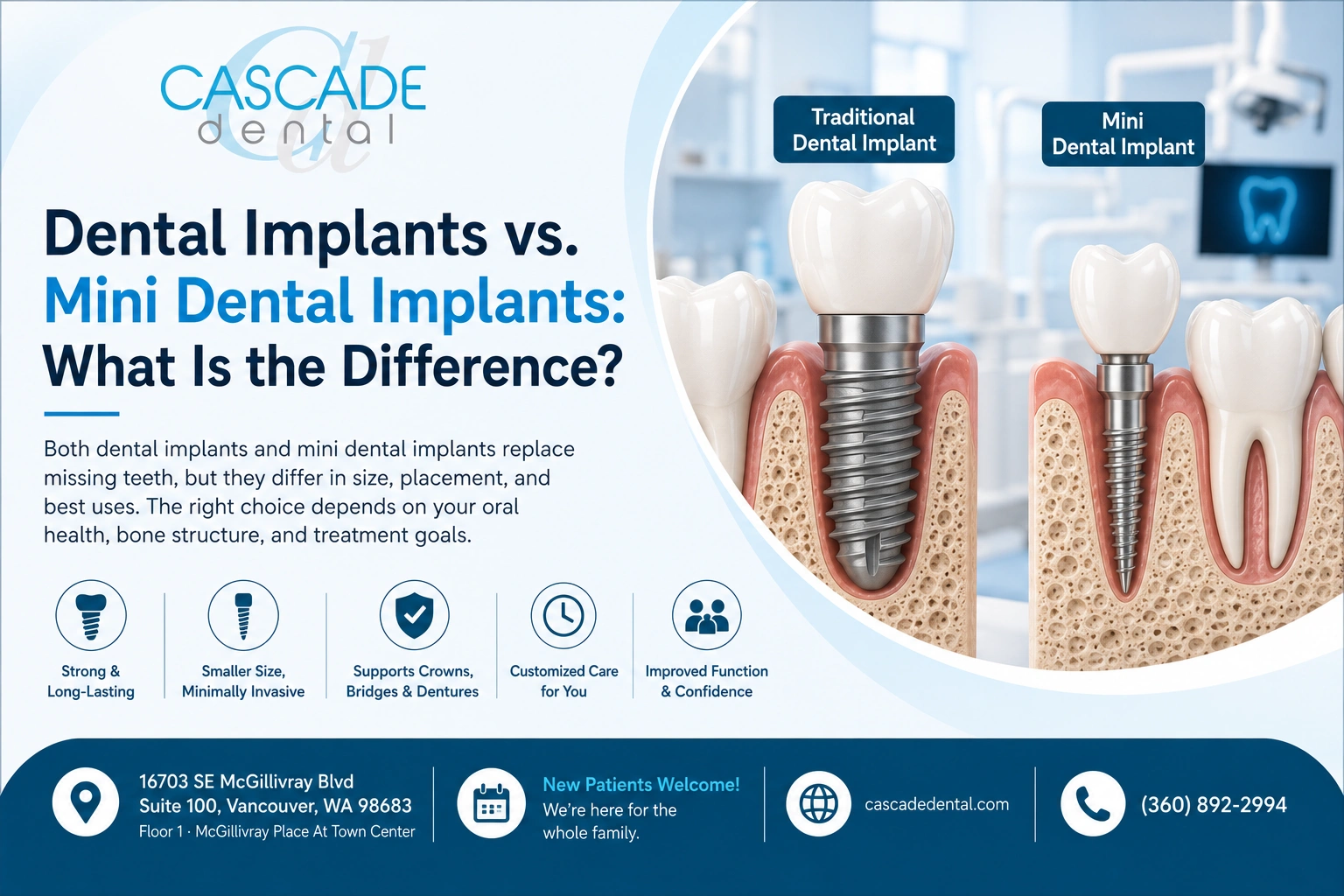
When patients start researching tooth replacement, they often come across two similar-sounding options: dental implants and mini dental implants. Both are designed to support replacement teeth, but they are not exactly the same. The biggest differences usually come down to implant size, bone requirements, placement method, treatment timeline, and the type of restoration being supported.
Traditional dental implants are commonly used for replacing one or more missing teeth with crowns, bridges, or dentures. Mini dental implants are smaller in diameter and may be considered in certain cases where space, bone volume, or treatment goals make a smaller implant option useful. Understanding the different types of dental implants can make it easier to see why one design may be more appropriate than another.
The right choice depends on your oral health, jawbone structure, missing tooth location, bite forces, restoration needs, and long-term goals.
Ready to Replace Missing Teeth?
Get expert guidance on dental implants and mini implants. Call today to schedule your consultation.
Fast Answer: Implants vs Mini Implants
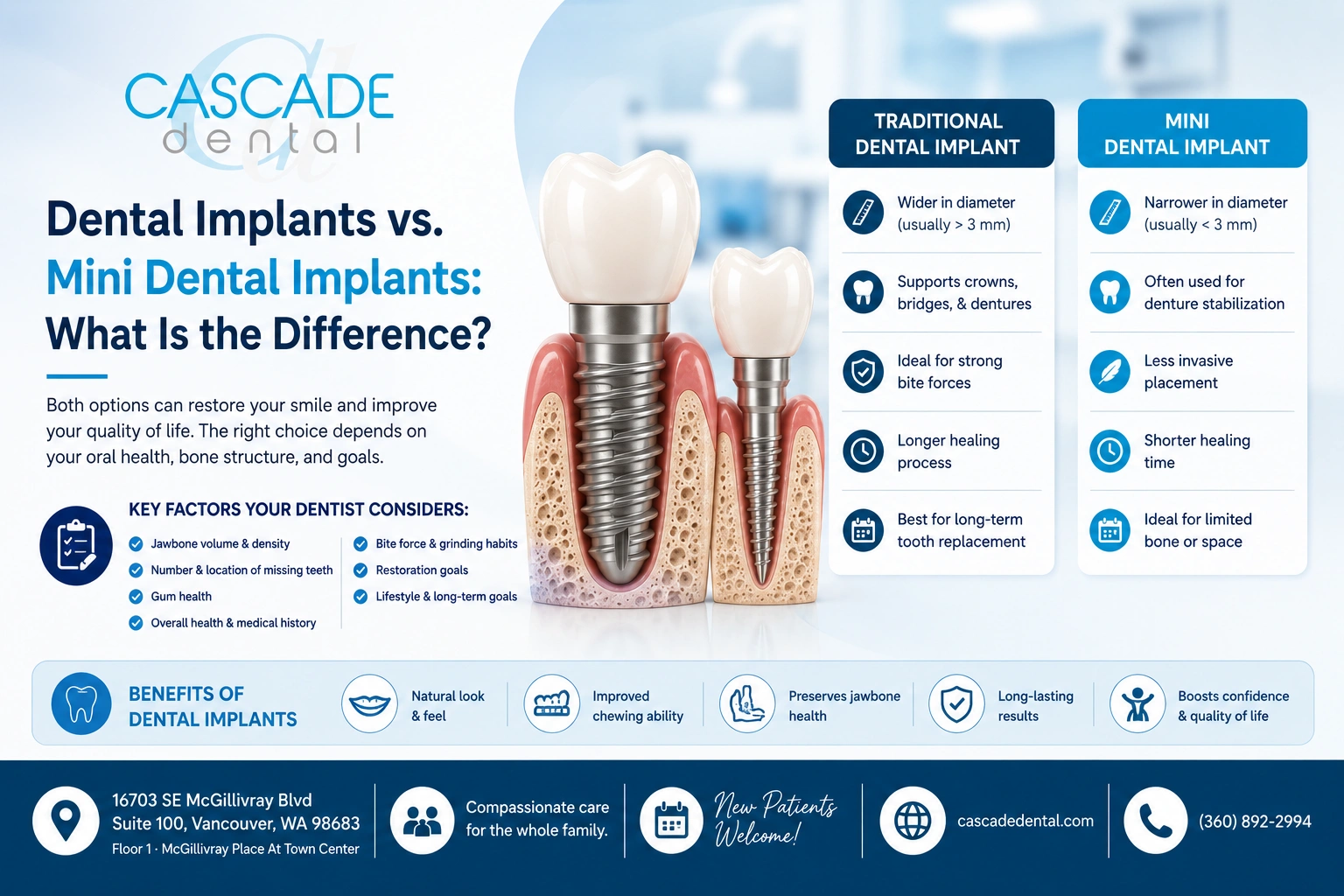
Traditional dental implants are generally wider and are placed into the jawbone to support a crown, bridge, or denture. Mini dental implants are narrower, often less than 3 millimeters in diameter, and may be used when there is limited bone width or when a less involved placement approach is appropriate. A medical reference from StatPearls describes mini implants as reduced-diameter implants, usually less than 3 mm, compared with conventional implants that are typically greater than 3 mm in diameter.
In simple terms:
Traditional dental implants are often recommended when a patient has enough bone support and needs a stable long-term replacement for one or more missing teeth.
Mini dental implants may be considered when a patient has thinner bone, limited space, or specific denture-stabilization needs.
Both are dental implants. Both are placed in the jaw. Both are intended to support replacement teeth. The difference is that they are used in different situations, and one is not automatically better than the other.
How They Work
A dental implant works by acting like an artificial tooth root. The implant is placed into the jawbone, where it provides support for a replacement tooth or teeth. The FDA describes dental implants as medical devices surgically implanted into the jaw to restore chewing ability or appearance, often supporting crowns, bridges, or dentures.
With a traditional implant, the dentist or implant provider places a titanium or similar biocompatible post into the jawbone. After placement, the surrounding bone usually needs time to heal and integrate with the implant. Once healed, an abutment and restoration, such as a crown, bridge, or denture, can be attached.
Mini dental implants follow a similar concept, but they are smaller in diameter. Because they are narrower, they may sometimes be placed in areas where a traditional implant would require more bone volume. In some cases, mini implants may also be used to help stabilize dentures.
The general difference is:
- Traditional implants: wider, often used for single crowns, implant bridges, and implant-supported dentures.
- Mini implants: narrower, sometimes used where space or bone width is limited, and often discussed for denture stabilization.
- Both options: require healthy surrounding tissue, careful planning, and good home care.
The replacement tooth is only one part of the process. A dentist also has to evaluate how the implant will handle chewing pressure, how it fits with neighboring teeth, and whether the gums and bone can support it properly. Maintaining the jawbone can also contribute to facial structure support after tooth loss, which is another reason implant planning goes beyond appearance alone.
Candidate Factors
Not every patient is a candidate for every type of implant. Before recommending either option, a dentist considers the full picture of your oral and overall health.
One of the biggest factors is jawbone volume and density. Traditional implants usually need enough bone width and height for stable placement. If bone loss has occurred after tooth loss, gum disease, injury, or long-term denture use, a bone graft may be discussed before implant placement. Mayo Clinic explains that dental implant surgeryplanning can involve multiple specialists and is customized based on the patient’s treatment needs.
Mini implants may be considered when the bone is too narrow for a standard implant or when a patient wants to avoid additional procedures, but they are not right for every case. Smaller implants may not be ideal for all bite forces or all tooth positions.
Dentists may also look at:
The number of missing teeth:
A single missing tooth, several missing teeth, or a full denture can each require a different plan.
The location of the missing tooth:
Back teeth often handle heavier chewing forces than front teeth, which can affect implant choice.
Gum health:
Healthy gums are important for implant stability. Gum disease may need to be treated before implant placement.
Medical history:
Healing ability matters. Conditions that affect bone healing or immune response may influence candidacy.
Smoking or tobacco use:
Tobacco use can affect gum health and healing, which may increase the risk of implant complications.
Bite pressure and grinding:
Patients who clench or grind may need special planning to protect the implant and restoration.
Restoration goal:
A single crown, bridge, removable denture, or fixed denture can all require different support.
This is why a consultation and exam are important. Implant recommendations should be based on your mouth, not just a general comparison online.

Am I Too Old for Dental Implants?
If you have been living with missing teeth for years, you may wonder whether you have waited too long to…

Timeline Differences
Traditional dental implants often involve a multi-step timeline. The process may include an exam, imaging, tooth extraction if needed, bone grafting if necessary, implant placement, healing time, abutment placement, and final restoration. The exact timeline varies depending on the patient’s bone health and whether extra procedures are needed.
A general traditional implant timeline may include:
- Consultation and exam
- Imaging and treatment planning
- Extraction or bone grafting, if needed
- Implant placement
- Healing and integration period
- Final crown, bridge, or denture attachment
Mini dental implants may sometimes involve a shorter or less involved process because of their smaller size. In select cases, they may require less bone preparation and may be placed with a simpler technique. However, “faster” does not always mean “better.” The dentist still has to make sure the implant can safely support the replacement tooth or denture.
Timeline differences can depend on:
- Whether the tooth is already missing
- Whether an extraction is needed
- Whether bone grafting is needed
- Whether the implant supports a crown, bridge, or denture
- Whether the patient needs gum disease treatment first
- How quickly the patient heals
- How much chewing force the implant must handle
Some patients are drawn to mini dental implants because they may offer a more streamlined path in certain cases. Others are better served by traditional implants because of their long-term support needs. The best timeline is the one that gives the restoration the strongest and safest foundation.
How Dentists Recommend
Dentists do not usually recommend an implant type based on size alone. They look at function, health, stability, and long-term success.
The recommendation process often starts with a complete dental exam, X-rays or 3D imaging, gum evaluation, bite assessment, and a conversation about the patient’s goals. Patients in the area can also visit the Vancouver, WA location page to learn more about local care access.
A dentist may recommend traditional implants when:
- There is enough healthy bone for placement
- The missing tooth area needs strong support
- A single crown, bridge, or full-arch restoration requires a wider foundation
- Long-term bite stability is a major concern
- The patient is a strong candidate for conventional implant treatment
A dentist may discuss mini dental implants when:
- The jawbone is narrow
- There is limited space between teeth
- The patient may not be a good fit for bone grafting
- Denture stabilization is a treatment goal
- A less involved placement approach may be appropriate
The key is that the implant should match the clinical situation. A mini implant is not simply a cheaper version of a traditional implant, and a traditional implant is not always the only valid option. Each has a purpose.
For many patients, the first step is not choosing between implant types. It is finding out what the mouth can support. Once the dentist understands your bone structure, gum health, bite, and restoration goals, they can explain whether traditional dental implants, mini dental implants, or another restorative option makes the most sense.
Dental implants and mini dental implants can both help restore confidence, chewing ability, and smile function. The right option depends on careful planning, not guesswork.
Not Sure Which Implant Option Fits You?
Learn the difference and find the right solution for your smile. Book your appointment now.