When a tooth is too damaged for a routine filling, a dentist may recommend an indirect restoration such as a dental crown or an onlay. Both options are designed to restore strength, function, and appearance, but they cover different amounts of the natural tooth.
An onlay repairs the damaged chewing surface and covers one or more weakened cusps, which are the raised points on the top of a back tooth. Because it leaves more unaffected enamel in place, it is often described as a partial-coverage or conservative restoration.
A dental crown covers the entire visible portion of the tooth above the gumline. This broader coverage can provide greater protection when decay, cracking, wear, or an older restoration has weakened a substantial part of the tooth.
Neither treatment is automatically better. The appropriate choice depends on the amount and location of the damage, the strength of the remaining tooth, the patient’s bite, and the tooth’s expected long-term prognosis. A comprehensive dental examination allows the dentist to determine how much protection the tooth needs while preserving as much healthy structure as practical.
Crown or Onlay? Get the Right Fit
Protect your tooth with the treatment that fits your needs. Call today to schedule your dental consultation.
What Is the Difference Between a Dental Crown and an Onlay?
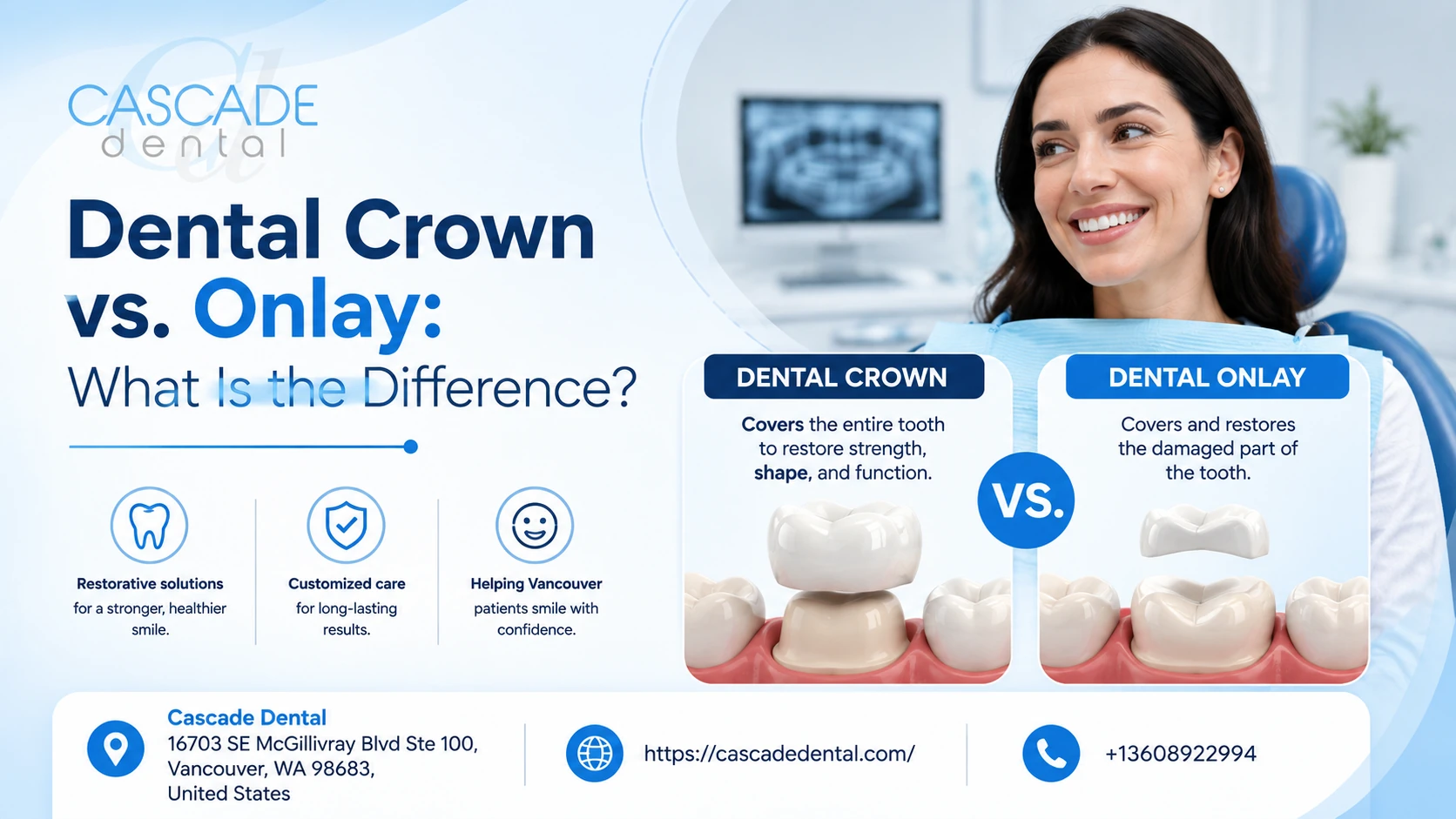
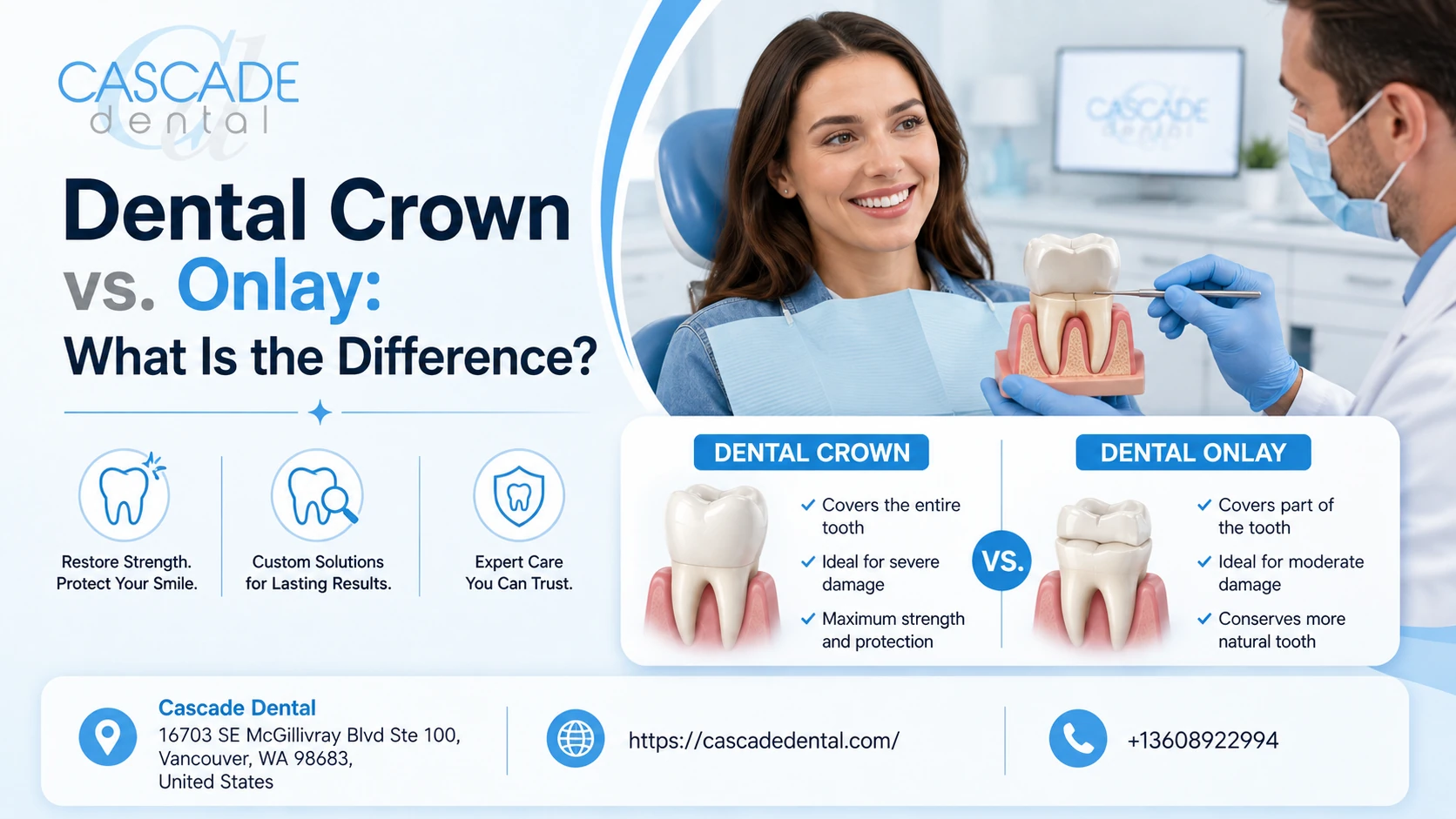
The primary difference between a dental crown and an onlay is how much of the tooth each restoration covers.
A dental onlay fits over part of the tooth’s chewing surface. It replaces damaged areas and extends over one or more cusps that need reinforcement. Healthy portions of the tooth that do not require coverage may remain intact.
A dental crown, sometimes called a cap, surrounds the entire visible part of the prepared tooth. Crowns are commonly used to repair teeth that have become weakened or extensively damaged because of large fillings, fractures, decay, or root canal treatment.
Both restorations are typically created outside the mouth from a detailed impression or digital scan. Depending on the dental office, material, and technology available, the restoration may be fabricated in a dental laboratory or produced with an in-office computer-aided design and manufacturing system.
Once completed, the crown or onlay is bonded or cemented to the prepared tooth.
The distinction can be summarized simply:
- An onlay covers the damaged portion and selected cusps.
- A crown covers the full visible surface of the tooth.
- An onlay generally requires less tooth reduction.
- A crown generally provides more complete structural coverage.
Modern adhesive materials have expanded the situations in which dentists can consider partial-coverage restorations. Research describes ceramic onlays as a more conservative alternative to complete crowns because they can preserve a greater amount of remaining natural tooth structure.
However, preservation must be balanced with protection. Leaving more natural enamel is only beneficial when that enamel is strong enough to support the restoration and withstand normal chewing forces.
When Is an Onlay Recommended Instead of a Crown?
A dentist may recommend an onlay when the tooth has more damage than a filling can reliably repair but still has enough strong, healthy structure to avoid complete coverage.
An onlay may be considered when:
- One or more cusps are weakened or fractured.
- A large cavity involves the chewing surface.
- An older filling is failing or has weakened part of the tooth.
- The remaining enamel can provide reliable support for bonding.
- The damage is limited to a specific section of the tooth.
- Preserving unaffected tooth structure is clinically appropriate.
- The tooth does not require the more extensive protection of a crown.
For example, imagine a molar with a large filling and one cracked cusp. If the other cusps and outer walls remain strong, an onlay may replace the filling, cover the damaged cusp, and preserve the healthier sections.
Onlays can also be used to reinforce certain cracked teeth by binding and protecting vulnerable cusps. Guidance from the American Association of Endodontists identifies both full crowns and onlays as possible cusp-reinforcing restorations in appropriate cracked-tooth cases.
An onlay may not be appropriate if very little enamel remains, several walls are severely weakened, decay extends around much of the tooth, or the fracture pattern requires full circumferential protection.
The location of the margins also matters. The dentist must be able to prepare, scan or impress, bond, and maintain the restoration successfully. Damage that extends deeply beneath the gumline may make a conservative bonded onlay less predictable.
What Should Patients Know Before Choosing a Restoration?
Patients do not usually need to select between a crown and an onlay based on appearance or preference alone. The recommendation should come from a careful evaluation of the individual tooth.
Before treatment, patients should understand how much healthy tooth structure remains and why the dentist believes a particular restoration offers suitable protection.
Helpful questions to discuss include:
- How much of the tooth is damaged?
- Are any cusps cracked or unsupported?
- Can the healthy enamel be preserved?
- Is there decay beneath the existing filling?
- Has the tooth received root canal treatment?
- How heavy are the chewing forces on this tooth?
- Do I grind or clench my teeth?
- What materials may be appropriate?
- What are the likely risks of each option?
- How will the restoration be maintained?
Although an onlay removes less tooth structure, it is not automatically the most conservative choice in every situation. A restoration that does not sufficiently protect a severely weakened tooth could fracture, potentially leaving fewer treatment options later.
Likewise, a full crown may not be necessary when damage is limited and the remaining tooth provides a dependable foundation for a bonded onlay.
Clinical research has not established that one option consistently outperforms the other in every type of damaged posterior tooth. A systematic review comparing crowns and onlays for teeth with substantial structural loss found that the evidence remained uncertain, reinforcing the importance of tooth-specific treatment planning.
Insurance coverage may also differ. A dental plan’s reimbursement policy does not always determine which restoration is clinically most appropriate. Patients may want to request an estimate and review their benefits while keeping the dentist’s clinical recommendation at the center of the decision.
How Crowns and Onlays Restore Damaged Teeth
Crowns and onlays restore damaged teeth by replacing missing structure and redistributing chewing pressure.
How an Onlay Works
An onlay is designed to fit into and over the damaged section of the tooth. The dentist removes decay, old restorative material, unsupported enamel, and any other compromised structure.
Healthy areas are retained whenever they can safely support the restoration. The finished onlay is then bonded to the prepared tooth.
Depending on its design, an onlay may cover:
- One weakened cusp
- Several cusps
- Most of the chewing surface
- Part of one or more side walls
By covering vulnerable cusps, the restoration can reduce flexing and help protect them from further fracture. Onlays may be made from ceramic, composite resin, metal, or other appropriate restorative materials.
How a Crown Works
To prepare a tooth for a crown, the dentist reshapes the tooth around its chewing surface and sides. This creates room for a restoration that fits over the entire visible portion.
The crown helps hold the remaining structure together while restoring the tooth’s normal shape, bite, and appearance.
A crown may be recommended when:
- A large portion of the tooth is missing.
- Several cusps or walls are weakened.
- A crack requires broader protection.
- A large filling has compromised the remaining structure.
- The tooth has extensive decay.
- Previous treatment has left the tooth vulnerable.
- A major change in shape, alignment, or appearance is needed.
Full-coverage restorations are often particularly important for certain endodontically treated or cracked teeth. The American Association of Endodontists reports favorable outcomes for root canal-treated cracked teeth when the crack remains confined to the clinical crown and a full-coverage restoration is placed.
Whether a crown or onlay is chosen, the goal is not simply to fill a hole. The restoration must protect the weakened areas while fitting accurately against the remaining tooth and neighboring teeth.
What Are the Pros and Limitations of Each Option?
Both restorations have meaningful benefits and limitations.
Potential Advantages of an Onlay
Preserves more natural tooth structure: Because an onlay covers only the areas that need reinforcement, less healthy enamel and dentin may need to be removed.
Supports weakened cusps: An onlay can cover one or more vulnerable cusps while leaving stronger portions uncovered.
Offers a natural appearance: Tooth-colored ceramic or composite onlays can be matched to the surrounding tooth.
May support future treatment options: Preserving more structure may be valuable if the tooth requires additional treatment later.
Can provide durable results: Systematic reviews have found that ceramic and composite inlays, onlays, and overlays can achieve strong long-term survival and success rates in suitable cases.
Potential Limitations of an Onlay
Not appropriate for every damaged tooth: An onlay requires enough sound structure for support and bonding.
Technique-sensitive placement: Successful bonding depends on careful preparation, moisture control, material selection, and fit.
May not provide sufficient coverage: Teeth with extensive cracks or weakened walls may require the broader protection of a crown.
Margins may be more complex: Because an onlay follows the shape of the damaged section, it may have a more intricate outline than a full crown.

Why Does My Crown Hurt Months or Years Later?
A dental crown may feel completely comfortable for months or even years before it begins causing pain. When that happens,…
Potential Advantages of a Crown
Provides broad protection: A crown surrounds the entire visible tooth and can reinforce several weakened surfaces at once.
Restores extensive damage: It may be appropriate when much of the original structure has been lost.
Can rebuild shape and function: A crown can restore height, contours, contact with neighboring teeth, and the chewing surface.
Works in many complex cases: Crowns are commonly considered for teeth with large restorations, substantial fractures, or significant structural weakness.
Potential Limitations of a Crown
Requires more tooth reduction: Preparing for complete coverage generally removes more natural structure than preparing for an onlay.
Does not make the tooth indestructible: A crowned tooth can still develop decay near the margin, experience fracture, or require future treatment.
May not be necessary for localized damage: Full coverage could be more extensive than required when most of the tooth remains healthy.
Requires long-term maintenance: Like any restoration, a crown must be kept clean and professionally monitored.
Patients should be cautious about viewing the decision as “minimally invasive versus aggressive.” A crown may be the more appropriate tooth-preserving treatment when full coverage reduces the risk of a serious fracture. Conversely, an onlay may provide enough protection without removing healthy sections unnecessarily.
How Does a Dentist Decide Which Treatment Is Best?
Treatment planning begins with a clinical examination. The dentist evaluates the tooth as a whole rather than looking only at the visible cavity or broken section.
Important factors include the following.
Size and Location of the Damage
Localized damage may be suitable for an onlay. Damage that surrounds much of the tooth or involves multiple surfaces may favor a crown.
Remaining Enamel and Dentin
The dentist examines whether the remaining walls and cusps are thick, supported, and suitable for bonding. Thin or undermined structure may need to be covered or removed.
Crack Location
A small fractured cusp differs from a crack running across the tooth. Cracks can be difficult to assess, and their depth and direction influence whether partial or full coverage is appropriate.
Dentists may use visual examination, magnification, bite testing, transillumination, periodontal probing, staining, and diagnostic imaging when evaluating a suspected crack. No single examination method can perfectly predict the long-term outcome of every cracked tooth.
Previous Restorations
Large fillings can leave less natural tooth around them. The dentist may need to remove an old restoration to see the true extent of decay, cracking, or unsupported enamel.
Pulp and Nerve Health
Persistent pain, prolonged temperature sensitivity, or signs of infection may indicate that the pulp is affected. Root canal treatment may be necessary before the final crown or onlay is placed.
Bite Forces
Molars absorb considerable chewing pressure. Grinding, clenching, missing teeth, or an uneven bite can increase the load placed on a restoration.
A patient who grinds heavily may require a different restoration design or material. The dentist may also recommend a protective nightguard after treatment.
Ability to Keep the Area Dry
Bonded restorations require reliable moisture control during placement. The location of the damage and the position of the restoration margins can affect whether an onlay can be bonded predictably.
Cosmetic Goals
Both crowns and onlays can be made from tooth-colored materials. However, the desired shade, translucency, location of the tooth, and amount of visible restoration may influence material selection.
Long-Term Prognosis
The dentist considers whether the tooth is likely to remain functional and comfortable after restoration. Gum health, bone support, root condition, decay risk, oral hygiene, and the patient’s ability to maintain the restoration all matter.
The final recommendation should balance conservation with durability. Preserving healthy enamel is important, but the tooth must also receive enough coverage to function safely.
How Cascade Dental Can Help
At Cascade Dental, we evaluate damaged teeth carefully before recommending a restoration.
Our team examines the location and extent of the damage, the condition of existing fillings, the strength of the remaining tooth, and the way the upper and lower teeth come together. When appropriate, diagnostic imaging and additional testing can help us identify concerns that may not be visible from the surface.
We also consider your symptoms, dental history, cosmetic preferences, and long-term oral health.
When an onlay can provide dependable protection while preserving healthy enamel, we can explain why partial coverage may be appropriate. When a tooth has extensive structural damage and needs broader reinforcement, we can discuss how a dental crown may help protect and restore it.
Our goal is not to recommend the largest restoration automatically. It is to select an option that gives the individual tooth an appropriate combination of protection, function, appearance, and maintainability.
Because the differences between a crown and an onlay depend on clinical findings, an examination is the most reliable way to determine which restoration is suitable.
FAQs
Is an onlay the same as a partial crown?
An onlay is often described as a partial-coverage restoration or partial crown because it covers one or more tooth cusps without surrounding the entire visible tooth. Terminology may vary depending on the restoration’s specific design.
Is an onlay better than a crown?
Neither option is universally better. An onlay may be preferable when enough strong tooth structure remains, while a crown may provide more reliable protection when the damage is extensive.
Does an onlay last as long as a crown?
Both restorations can provide long-term service when they are properly selected, made, placed, and maintained. Longevity depends on the tooth’s condition, restorative material, bite forces, oral hygiene, decay risk, and other individual factors.
Is an onlay stronger than a filling?
An onlay generally covers and reinforces more of the tooth than a standard filling. It may be recommended when a cavity or fracture is too extensive for a filling but does not require a full crown.
Does getting a crown remove more tooth than an onlay?
Generally, yes. A crown requires preparation around the entire visible portion of the tooth, while an onlay is shaped to cover selected damaged areas. The exact amount removed depends on the tooth and chosen material.
Can an onlay repair a cracked tooth?
An onlay may protect certain cracked teeth by covering and reinforcing the affected cusps. It is not appropriate for every crack, especially when the damage extends deeply, involves several walls, or compromises the root.
Does a root canal-treated tooth need a crown or an onlay?
The answer depends on the location of the tooth and how much structure remains. Many back teeth require cusp coverage after root canal treatment. A crown may be recommended for more extensive damage, while an onlay may be considered in selected cases with sufficient healthy structure.
Can a crown or onlay develop a cavity underneath it?
Decay can form near the edge of either restoration if plaque and bacteria accumulate or if the seal becomes compromised. Daily brushing, interdental cleaning, fluoride use, and regular dental examinations remain important.
Are crowns and onlays made from the same materials?
They can be. Both may be made from ceramic, composite resin, metal, or combinations of materials. The dentist recommends a material based on strength, appearance, bite forces, tooth location, and restoration design.
Is the procedure painful?
The tooth is typically numbed during preparation, so patients should not feel sharp pain during treatment. Temporary sensitivity or gum tenderness may occur afterward. Persistent or worsening discomfort should be reported to the dental office.
How many visits are needed?
Some crowns and onlays can be completed in one visit when the office uses chairside digital fabrication. Laboratory-made restorations commonly require one visit for preparation and scanning or impressions, followed by another visit for placement.
How should I care for a crown or onlay?
Brush twice daily with fluoride toothpaste, clean between the teeth, and attend regular dental examinations. Avoid chewing ice and other hard objects. Patients who grind their teeth should ask whether a nightguard may help protect the restoration.
Not Sure If You Need a Crown?
Get a professional evaluation and find out whether a crown or onlay is right for your smile.