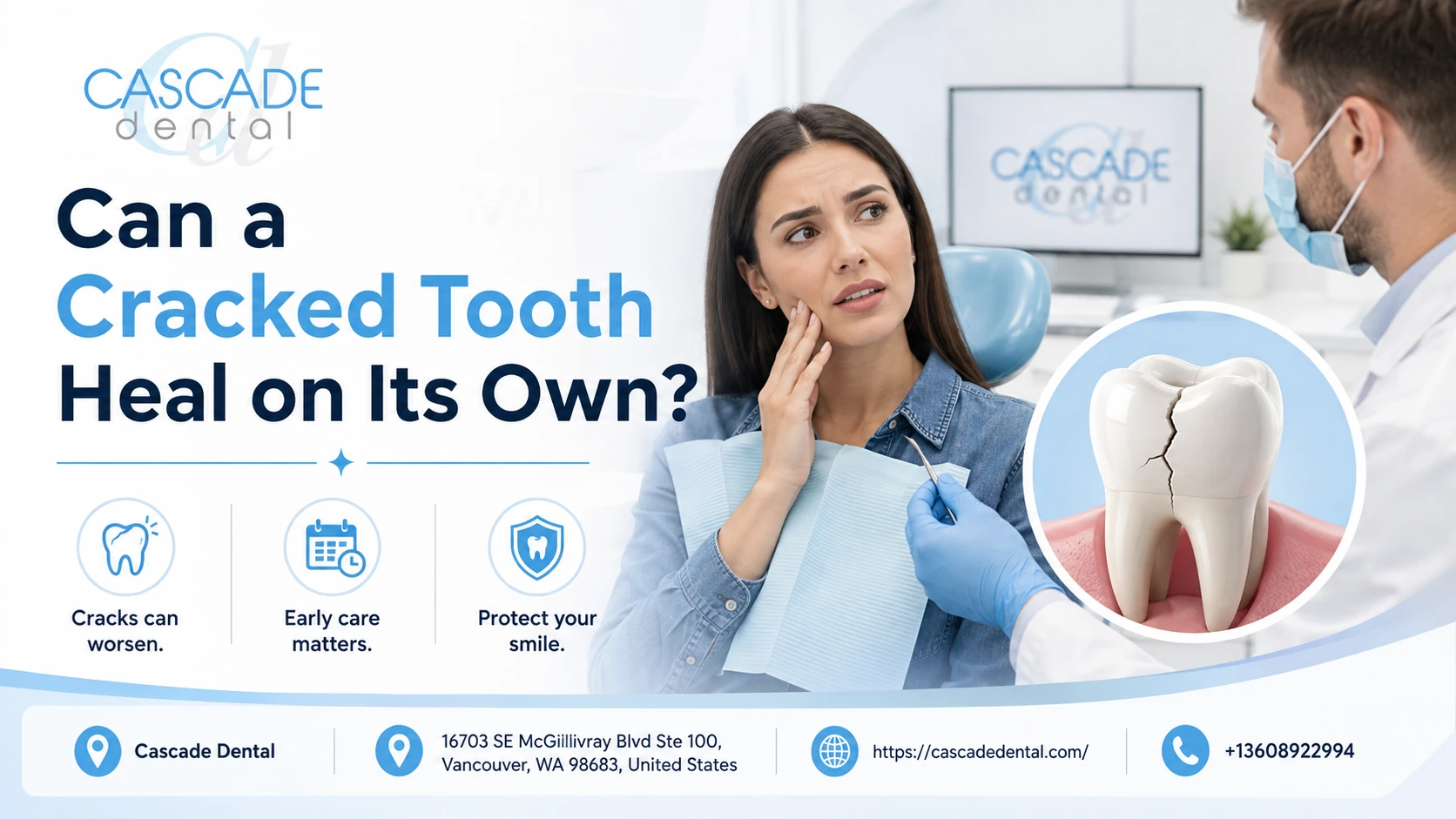
No, a cracked tooth cannot heal on its own because enamel and other hard tooth structures cannot repair fractures the way broken bones heal. Even when pain disappears, the crack may remain and can worsen under repeated chewing pressure.
Not every crack requires the same treatment. Superficial enamel lines may only need monitoring, while deeper cracks can require bonding, a crown, root canal treatment, or extraction.
The appropriate treatment depends on the crack’s depth, location, and effect on the tooth. A dental examination helps determine whether the tooth can be protected and what care is necessary.
Cracked Tooth? Don’t Wait for It to Get Worse
A cracked tooth won’t heal on its own. Get professional dental care before the damage leads to more pain.
Can a Cracked Tooth Heal on Its Own?
Will a cracked tooth repair itself if you leave it alone?
A cracked tooth cannot naturally close or fuse its fractured structure back together.
Teeth contain several layers, including enamel, dentin, and an internal pulp chamber that houses nerves and blood vessels.
Although living tissues inside the tooth can respond to injury, the hard tooth structure does not regenerate across a fracture.
A small crack may remain relatively stable for a long period. However, another crack can gradually extend as the tooth experiences repeated pressure.
This makes professional evaluation important, particularly when the tooth causes discomfort.
Can a cracked tooth stop hurting without treatment?
Yes. Cracked tooth pain may come and go.
Some patients experience sharp discomfort only when chewing, while others notice sensitivity to cold or sweet foods.
Symptoms may temporarily disappear when the tooth is not under pressure.
However, reduced pain does not establish that the crack has healed.
A tooth may remain structurally weakened even when it feels comfortable.
The American Association of Endodontists explains that cracks can progress despite periods without noticeable symptoms.
Does every cracked tooth need a crown?
No. The appropriate treatment depends on the type and extent of the crack.
Superficial enamel lines may require no restorative treatment.
A fractured cusp may sometimes be repaired with a filling or crown.
Deeper cracks can require more extensive treatment to protect the remaining tooth.
Your dentist should assess the tooth before recommending a specific restoration.
Why Can’t Tooth Enamel Repair a Crack?
How is tooth enamel different from bone?
Bone contains living cells and blood vessels that participate in healing.
Tooth enamel is different. It is a highly mineralized tissue without living cells capable of rebuilding a fractured surface.
Once enamel breaks, the separated portions cannot naturally grow back together.
The body may support remineralization of certain early enamel mineral changes, but this does not repair a physical crack.
Remineralization and fracture healing are different processes.
Can the inner tooth heal after a fracture?
Dentin and pulp contain living components that can respond to injury.
In certain circumstances, the tooth may produce additional dentin as a protective response.
However, this does not mean a crack through dentin will disappear.
If the fracture extends toward the pulp, bacteria and irritation may cause inflammation or infection.
The tooth’s ability to remain healthy depends on the extent of damage and whether appropriate treatment is provided.
What Are the Different Types of Tooth Cracks?
What are craze lines?
Craze lines are very shallow cracks limited to the outer enamel.
They are common in adult teeth and often appear as thin vertical lines.
These lines usually do not cause pain or affect the tooth’s function.
In many cases, they require no treatment beyond routine monitoring.
However, a dentist should distinguish harmless enamel lines from deeper structural fractures.
What is a fractured cusp?
A fractured cusp occurs when part of a tooth’s chewing surface breaks or becomes separated.
It often develops around a large filling or weakened portion of the tooth.
The damaged area may cause discomfort when biting or expose sensitive tooth structure.
Depending on the remaining tooth structure, treatment may involve a filling, onlay, or crown.
What is a cracked tooth?
A cracked tooth generally has a fracture extending from the chewing surface toward the root.
The tooth has not separated completely into distinct pieces.
However, the crack may extend deeper over time.
If it reaches the pulp, root canal treatment may be necessary in addition to restoration.
Cracks extending into certain root or supporting tissue areas can make the tooth difficult or impossible to preserve.
What are split teeth and vertical root fractures?
A split tooth develops when a crack progresses enough to separate the tooth into distinct segments.
The tooth generally cannot be preserved intact, although selected cases may allow part of the tooth to be saved.
A vertical root fracture begins within the root and extends toward the chewing surface.
These fractures can be difficult to detect because symptoms may be subtle.
Treatment may involve extraction or selected specialist procedures, depending on the location and extent of damage.
What Symptoms Can a Cracked Tooth Cause?
Why does a cracked tooth hurt when biting?
Chewing forces can place pressure on the damaged tooth structure.
In some cracked teeth, opposing portions of the tooth move slightly under pressure.
This movement may irritate sensitive tissues and produce sharp discomfort.
Some patients notice pain when biting down.
Others experience a sudden sensation when releasing biting pressure.
However, biting pain is not unique to cracked teeth.
An uneven filling, inflammation, or another dental condition can produce similar symptoms.
Can a cracked tooth cause temperature sensitivity?
Yes. A crack may affect the tooth’s protective structure and allow temperature changes to stimulate sensitive tissues.
Cold drinks are a common trigger.
Some patients also report discomfort from hot foods or sweet substances.
Sensitivity may be brief or linger after the trigger is removed.
Persistent or worsening temperature pain deserves professional evaluation because it may indicate deeper inflammation.
Can you have a cracked tooth without symptoms?
Yes. Certain cracks produce few or no symptoms.
A patient may discover a crack during a routine dental examination or after part of the tooth breaks.
This does not mean that every visible line is dangerous.
However, it reinforces why symptoms alone cannot determine crack severity.
Can a Small Crack Get Worse Over Time?
What causes a crack to spread?
Teeth experience repeated forces during chewing.
When a crack is already present, these forces can place additional stress on weakened tooth structure.
Grinding, clenching, chewing ice, and biting hard objects may increase that stress.
Large fillings can also leave thinner tooth walls that are more vulnerable to fracture.
Not every crack progresses at the same rate.
However, deeper untreated cracks may extend and compromise the tooth.
Can waiting make treatment more complicated?
Yes. When a crack is initially limited, a dentist may have more options for protecting the tooth.
If it extends into the pulp or below the gumline, treatment may become more complex.
A previously restorable tooth can eventually become unsuitable for predictable restoration.
Early assessment does not guarantee that every tooth can be saved.
However, delaying evaluation may allow additional damage to occur.
Is a small hairline crack always serious?
No. Some thin lines are limited to the enamel and have little clinical significance.
Others may represent deeper fractures that are difficult to identify visually.
The width of a visible line does not reliably reveal its depth.
A dentist may use magnification, lighting, biting tests, and other examination methods to assess the tooth.

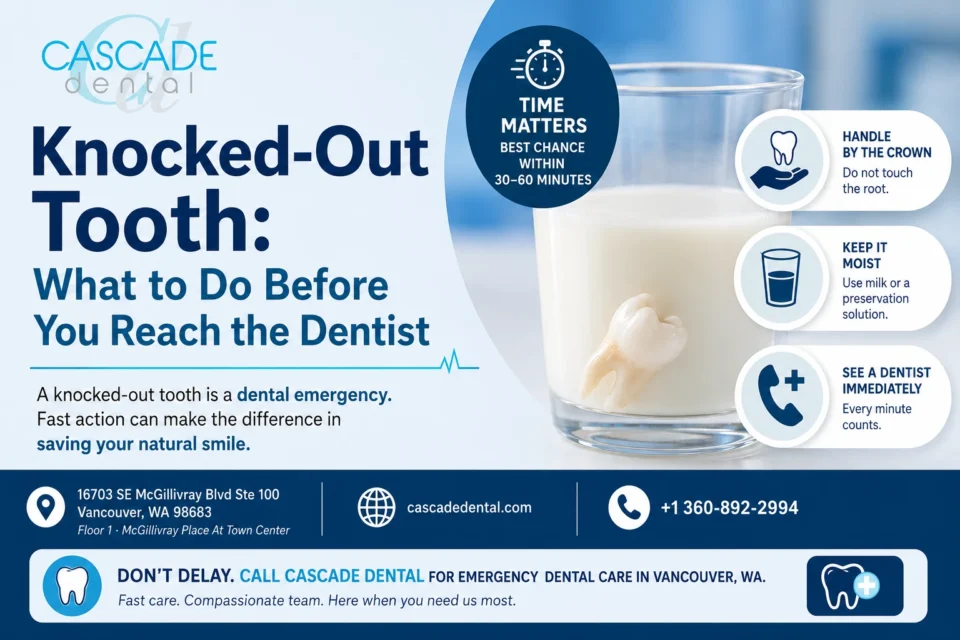
Knocked-Out Tooth: What to Do Before You Reach the Dentist
A knocked-out adult tooth is a true dental emergency, and timing matters. Pick it up by the crown, not the…
When Can a Dental Crown Protect a Cracked Tooth?
How does a crown help a cracked tooth?
A dental crown covers the visible portion of a prepared tooth.
When appropriate, it helps reinforce weakened tooth structure and distribute chewing forces across the restoration.
For certain cracked teeth, this coverage can reduce movement of compromised cusps and help protect the remaining tooth.
However, a crown does not fuse the fracture together.
It also cannot guarantee that the crack will stop progressing.
The American Association of Endodontists emphasizes that crowns provide protection but do not guarantee successful outcomes in every cracked tooth.
When might a crown be recommended?
A dentist may consider a crown when a tooth has significant structural damage but enough healthy supporting structure remains for restoration.
Examples include teeth with fractured cusps, large existing fillings, or cracks affecting substantial portions of the chewing surface.
The dentist also evaluates the tooth’s pulp, roots, gums, and bite.
A crown may be inappropriate when a fracture extends too deeply or the remaining tooth cannot provide reliable support.
Learn more about the purpose of protective restorations through our dental crowns page.
What Other Treatments May Be Needed?
Can a small crack be treated with bonding?
Sometimes. Dental bonding may help repair minor chips or limited areas of damage.
Tooth-colored composite resin can restore lost structure and improve the tooth’s shape.
However, bonding is not suitable for every fracture.
A crack extending through a major portion of the tooth may require broader protection.
The decision depends on location, depth, and biting forces.
When is root canal treatment necessary?
Root canal treatment may be recommended when a crack causes irreversible pulp inflammation or infection and the tooth remains suitable for restoration.
During treatment, the affected pulp is removed and the internal tooth spaces are cleaned and sealed.
The tooth may then require a crown or another appropriate restoration.
Root canal treatment addresses the damaged pulp but does not eliminate the physical crack.
The remaining tooth must still be protected.
When might extraction be necessary?
Extraction may be recommended when a tooth is split, severely fractured, or cannot be restored predictably.
Some fractures extend into areas where a crown or other restoration cannot provide adequate protection.
The dentist considers whether any portion of the tooth can be preserved.
If extraction is necessary, replacement options may include an implant, bridge, or removable appliance.
The appropriate approach depends on the location of the tooth and the patient’s overall oral health.
When Is a Cracked Tooth a Dental Emergency?
Which symptoms require prompt attention?
A cracked tooth should be evaluated promptly when it causes significant pain, difficulty chewing, or visible structural damage.
Other concerning symptoms include persistent sensitivity, a loose tooth fragment, or pain that is becoming more frequent.
A fracture exposing deeper tooth structure may require timely treatment to reduce further damage.
Do not wait for the tooth to become severely painful before arranging an examination.
What if swelling or infection develops?
Swelling around a cracked tooth may indicate inflammation or infection.
Contact a dentist promptly if swelling, drainage, fever, or worsening pain develops.
An untreated infection can spread beyond the tooth.
Difficulty swallowing, difficulty breathing, or rapidly spreading facial or neck swelling requires emergency medical attention.
If you need evaluation for an urgent dental concern, review Cascade Dental’s emergency dentistry information.
What if part of the tooth breaks off?
If a fragment breaks away, avoid chewing on the affected side.
Keep the area clean and contact your dentist.
If possible, save the broken piece in a clean container and bring it to the appointment.
Do not attempt to glue the fragment back into place.
A dentist can determine whether the tooth can be repaired and what treatment is appropriate.
What Should You Avoid Doing With a Cracked Tooth?
Should you continue chewing normally?
Avoid hard or forceful chewing on a tooth you suspect is cracked.
Pressure may produce pain or place additional stress on weakened structure.
Choose softer foods and chew on the opposite side when practical until you receive professional advice.
Avoid repeatedly testing the tooth by biting hard objects.
This can aggravate an existing fracture.
Which foods and habits should you avoid?
Ice, hard candy, unpopped popcorn kernels, and similarly hard objects may place substantial force on teeth.
Do not use your teeth to open packages or hold objects.
If you grind or clench your teeth, discuss this habit with your dentist.
A professionally recommended protective appliance may help manage some damaging forces.
However, a nightguard does not repair an existing crack.
Can home remedies fix a cracked tooth?
No home remedy can restore fractured tooth structure.
Saltwater rinses may help keep the mouth comfortable, but they do not close a crack.
Avoid placing aspirin directly on the tooth or gums because it can injure soft tissues.
Do not use household adhesives or attempt to file damaged enamel.
Professional treatment is necessary when a structural repair is required.
When Should You Schedule a Dental Evaluation?
Should you book an appointment if the crack does not hurt?
Yes. A newly noticed crack or chip deserves assessment even without pain.
A dentist can determine whether the finding is superficial or involves deeper tooth structure.
Some enamel lines may only need monitoring.
Other cracks require treatment before symptoms become significant.
You do not need to wait for a dental emergency to have a suspicious tooth examined.
How does a dentist check for a cracked tooth?
Your dentist reviews your symptoms and examines the affected tooth.
They may use magnification, directed light, periodontal measurements, or controlled biting tests.
Dental X-rays can help evaluate roots and surrounding structures, although some cracks may not appear clearly on conventional images.
Additional imaging or specialist evaluation may be appropriate in selected cases.
Because no single test identifies every crack, several findings may be considered together.
What should you ask about treatment?
Ask where the crack appears to extend and whether the tooth can be predictably restored.
Discuss whether monitoring, bonding, a crown, root canal treatment, or extraction is appropriate.
Also ask about the limitations of the recommended treatment.
A protected cracked tooth may function for years, but no restoration can guarantee that an existing fracture will never progress.
Understanding the findings helps you make an informed decision.
FAQs
Can a hairline crack in a tooth heal naturally?
No. A true crack in enamel or dentin cannot naturally fuse back together. However, shallow enamel craze lines may remain stable without causing problems. A dentist can determine whether the line requires monitoring or treatment.
Can a cracked tooth heal if the pain goes away?
No. Pain relief does not mean the crack has disappeared. Symptoms may fluctuate depending on chewing forces and the condition of the tooth’s internal tissues. A professional examination helps determine whether treatment is necessary.
How long can you leave a cracked tooth untreated?
There is no reliable safe waiting period. Some minor enamel lines remain unchanged for years, while deeper cracks can progress and compromise the tooth. Newly noticed cracks or symptoms should be evaluated promptly.
Can a dental crown permanently fix a cracked tooth?
A crown can protect certain cracked teeth and help restore chewing function. However, it does not heal the underlying fracture or guarantee that the crack will never spread. The outcome depends on the crack’s extent and remaining tooth structure.
Does a cracked tooth always need a root canal?
No. Root canal treatment is generally considered when the pulp is irreversibly inflamed or infected and the tooth can still be restored. Some cracks need only monitoring or restorative protection. Others may be too severe to save.
Can a cracked tooth cause an infection?
Yes. If a crack extends into vulnerable internal tissues, bacteria may contribute to pulp infection or infection around the tooth. Swelling, drainage, fever, or persistent pain requires prompt assessment. Severe spreading swelling or breathing difficulty requires emergency care.
Get Your Cracked Tooth Evaluated With Cascade Dental
A cracked tooth cannot repair itself, but appropriate treatment may help protect the remaining tooth structure and restore comfortable function.
At Cascade Dental, we help patients understand dental cracks, damaged restorations, and other concerns that may affect their oral health.
We examine the condition of the tooth, discuss the available findings, and explain whether monitoring, a crown, or another treatment may be appropriate.
Our goal is to help patients make informed decisions without assuming that every visible crack requires the same procedure.
If you have noticed a new crack, pain when biting, or sensitivity that keeps returning, we encourage you to arrange an evaluation.
Learn more about our dental crowns and emergency dentistry services.
We welcome patients from Camas, WA at our Vancouver dental office.
Contact Cascade Dental to discuss your symptoms and determine the next appropriate step for protecting your tooth.
Key Takeaways
A cracked tooth cannot heal naturally because hard tooth structure does not repair fractures like bone. However, not every crack requires extensive treatment. Superficial craze lines may only need monitoring, while deeper fractures can require bonding, crowns, root canal treatment, or extraction.
Cracked teeth may cause biting pain, temperature sensitivity, or no symptoms at all. Delaying evaluation can allow certain cracks to progress.
A dental examination helps determine the type and extent of damage. Seek prompt care for significant pain, worsening symptoms, swelling, or a newly broken tooth.
Think You Have a Cracked Tooth?
Protect your tooth and prevent further damage. Call today to schedule a dental evaluation.