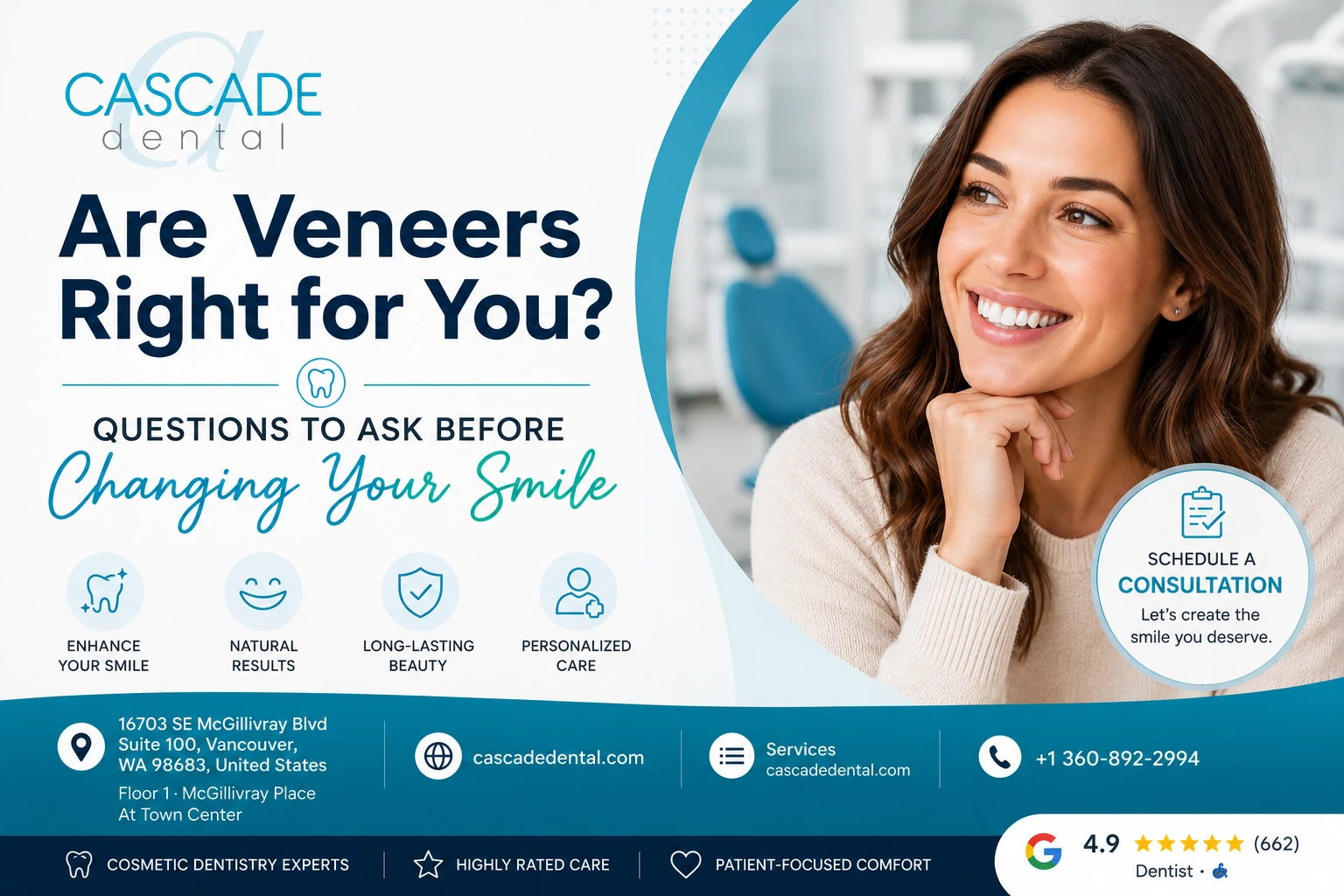
Thinking about changing your smile can be exciting, but it can also feel like a big decision. Dental veneers are one of the most popular cosmetic dentistry options because they can improve the appearance of teeth that are stained, chipped, uneven, worn down, or slightly spaced.
Still, veneers are not the right fit for every patient or every cosmetic goal.
Before choosing veneers, it helps to understand what they can improve, what they cannot correct, and what questions you should ask before starting cosmetic treatment. This guide can help you think through your options so you can have a more informed conversation with your dental team.
For full treatment details, visit our dedicated page on dental veneers or explore more options under cosmetic dentistry.
Thinking About Veneers?
Get expert cosmetic dental guidance today. Call now to find out if veneers are the right choice for your smile.
Fast Answer: Are Veneers Right for You?
Veneers may be right for you if you want to improve the shape, shade, size, or overall appearance of your front teeth and you have generally healthy teeth and gums. They are often chosen by patients who want a more balanced, brighter, or polished-looking smile without needing major orthodontic or restorative treatment.
However, veneers are not always the best solution if you have active tooth decay, gum disease, severe bite issues, heavy teeth grinding, or cosmetic concerns that could be addressed with a simpler option. In some cases, whitening, bonding, crowns, orthodontics, or another treatment may be more appropriate.
The best way to know whether veneers fit your smile goals is to schedule a cosmetic consultation. During that visit, your dentist can examine your teeth, discuss your expectations, review your oral health, and help you compare treatment options.
If you are located near Vancouver, WA, Cascade Dental can help you explore whether veneers are a smart choice for your smile.
What Are Porcelain Veneers?
Porcelain veneers are a type of porcelain used for medical applications that cover the front of your natural teeth. Dental veneers instantly transform a person’s smile. Porcelain veneers are custom-made for each patient to provide a flawless fit. The materials have been carefully created to mimic natural tooth enamel. Dental veneers can subtly transform imperfections into part of a more balanced, natural-looking smile, helping patients improve specific features without losing the character of their appearance.Dentists in Vancouver, WA use dental veneers to provide a variety of cosmetic adjustments, such as tooth whitening and dental repairs. Porcelain veneers are among the most widely used and trusted
cosmetic dentistryprocedures because of their realistic, natural-looking appearance and wide range of applications.
How It Works
Examination and Treatment PlanningYour complete participation is required for this first phase. Tell your Vancouver, WA dentist what outcome you hope to have. Your dentist will evaluate your teeth during your appointment to determine whether dental veneers are a good option.
They will also review the procedure’s requirements and a few restrictions. Finally, the dentist will make impressions of your mouth and teeth and take X-rays. Preparation of the Teeth Before the veneers can be applied, a small amount of your tooth enamel must be removed. This ensures that there is enough room for the veneers and that they look natural. Depending on your condition, you may need additional treatments such as orthodontics or gum contouring before your teeth are ready to receive the veneers. Your dentist will inform you if further preparations are necessary. Bonding and AdjustmentOnce everything is ready, your Vancouver, WA, dentist will bond each dental veneer into place one at a time. Once set, they will make any necessary adjustments to achieve optimal comfort and aesthetics.
Finalizing the Procedure Your dentist may ask you to return for a follow-up appointment if any adjustments need to be made. This is also an opportunity for your dentist to check how well you are taking care of your veneers. If everything looks good, it’s time to celebrate your new smile!Are You a Candidate?
Your dentist will arrange a pre-consultation where the condition of your teeth will be assessed to determine whether you are an appropriate candidate for dental veneers. Additionally, you will go over every potential course of treatment. Your dentist may also need to carry out many tests and scans to check the condition of your teeth before deciding if dental veneers are suitable. During this pre-consultation, the dentist will discuss the advantages, disadvantages, and risks associated with the treatment. It is important to note that only some are appropriate candidates for dental veneers. For example, if you have severe gum disease, tooth decay, or weakened enamel, then a different course of treatment may be more appropriate for you. Your dentist can advise on what options are best for your particular situation. If you and yourdentist
decide that dental veneers would be an appropriate solution for your needs, then the next step will be to discuss how many veneers you need and to go over the design. Your dentist will also explain what you can expect during treatment, including potential risks and side effects. Once you have gone through this pre-consultation process, your dentist can begin creating custom-made dental veneers that are explicitly tailored to your needs. This is a complex process; it may take several weeks before they are ready for placement. You must follow all instructions provided by your dentist during this time to ensure the best possible results with your new veneers.Advantages of Porcelain Veneers
Porcelain veneers offer a number of advantages over other dental treatments. They can provide a natural-looking solution for chipped, cracked, discolored, or misaligned teeth and can last up to 15 years with proper care. How long veneers last depends on factors such as daily care, oral hygiene, and lifestyle habits, so understanding their lifespan and what to expect can help protect your results. Unlike other treatments, they do not require invasive procedures or significant alterations to your existing teeth structure. Additionally, porcelain veneers are more stain resistant than natural teeth and require much less maintenance to retain their luster.Simple and Easy
Dental veneers are minute pieces of broken medical porcelain glued to the front of your teeth to improve their aesthetics. The most realistic-looking tint and the way that veneers reflect light is that of natural teeth. They are also stain-resistant, which makes them the ideal choice for those who wish to smile brightly without exerting too much effort or taking unnecessary precautions. In addition, dental veneers can withstand stains that may be long-lasting and persistent since they are non-permeable.Natural Look
You might require multiple dental visits if you use this dental repair technique. The result, however, is entirely natural. The dentist makes an impression on your teeth at your initial visit and sends them to a facility where the veneers will be created. Then, the veneers are created in a laboratory to match your natural teeth’s hue.Enhance the Confidence in Your Smile
Typically, a veneer treatment only requires two appointments at our office. During your initial meeting, your dentist will remove enough enamel from the fronts of your teeth to provide room for the veneers. Next, your dentist will place temporary veneers on your teeth to protect them for the time being. On your next visit, your permanent veneers will be ready. Your dentist will then ensure the restored tooth is the same shade as your original teeth. To make the veneers feel and appear more natural, we could slightly adjust how they fit. As a result, you’ll have an even more beautiful grin once the surgery is over.Why Go for Cascade Dental?
At Cascade Dental , we strive to ensure that each patient receives high-quality service and treatments so they can enjoy a beautiful smile for many years. Contact us today if you want more information about dental veneers or other cosmetic dentistry procedures available in Vancouver, WA. Our team is happy to help!What Veneers Can Fix
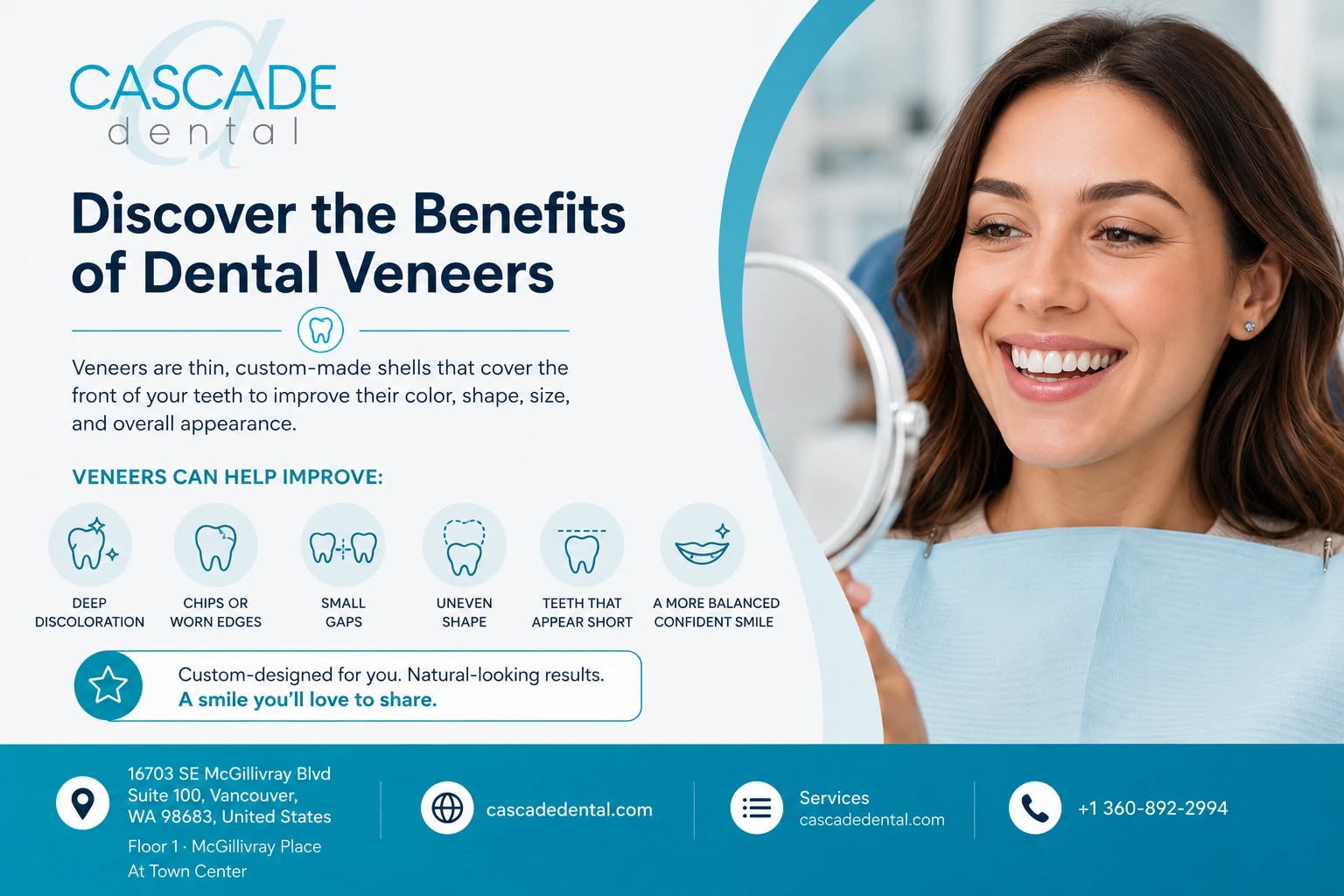
Dental veneers are thin, custom-made coverings placed on the front surfaces of teeth to enhance their appearance. They are commonly used for cosmetic improvements, especially on teeth that show when you smile.
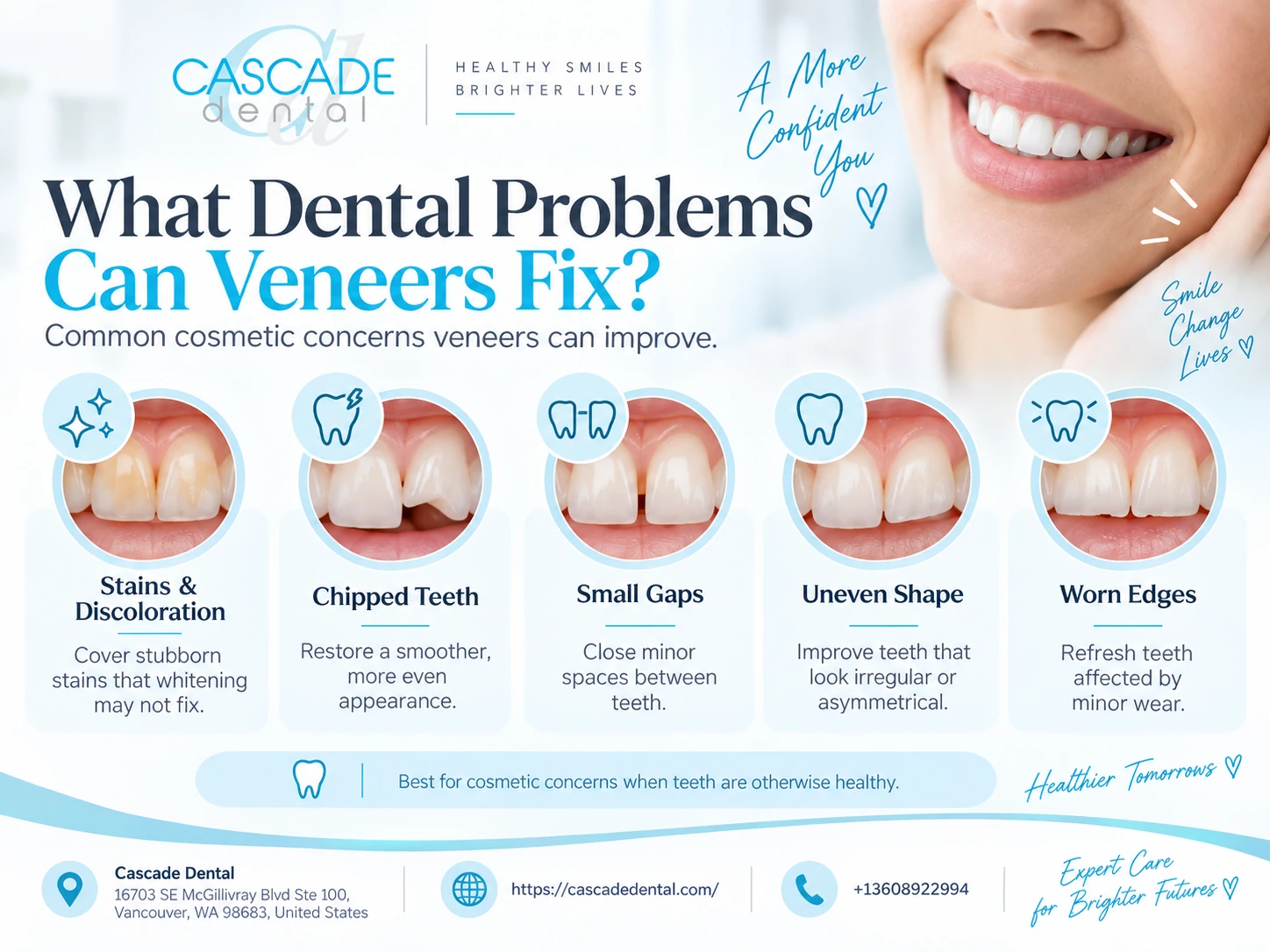
One of the most common reasons patients consider veneers is discoloration. While professional whitening can brighten many types of stains, some discoloration does not respond well to whitening treatments. Teeth affected by deep internal staining, old dental work, or natural color irregularities may benefit from veneers because the veneer covers the visible surface of the tooth.
Veneers can also help improve the appearance of chipped or slightly worn teeth. Small chips, uneven edges, or minor surface damage can make a smile look older or less symmetrical. Veneers can create a smoother, more uniform look while still appearing natural when planned carefully.
Another concern veneers may address is spacing. Small gaps between teeth can sometimes be improved with veneers, especially when the spacing is cosmetic rather than related to a larger bite or alignment issue. Veneers can widen the appearance of certain teeth just enough to create a more even smile.
Patients may also choose veneers to improve teeth that look too small, narrow, short, or uneven. For example, if one tooth looks slightly different from the others, veneers may help create better balance. The goal is not to make every tooth look identical, but to create a smile that feels natural, healthy, and proportional.
Veneers may help with:
- Deep discoloration or uneven tooth color
- Minor chips or worn edges
- Small cosmetic gaps
- Slightly uneven tooth shape
- Teeth that appear too short or narrow
- A smile that feels unbalanced or inconsistent
For many patients, veneers offer a way to address several cosmetic concerns at once. That is one reason they are popular for smile makeovers. Still, they work best when the foundation of the smile is healthy. Oral cancer awareness is also an important part of maintaining overall oral health before cosmetic treatments such as dental veneers.
Can Veneers Fix Chipped Teeth?
Yes, veneers can often improve the appearance of mildly chipped front teeth.
A chip may make one tooth look shorter or create an uneven edge that stands out when a person smiles. A veneer can cover the front surface and rebuild the visible shape of the tooth.
Veneers may be particularly useful when:
- The chip affects the appearance of a front tooth
- The remaining tooth structure is healthy
- The damage is relatively limited
- The patient wants to improve additional cosmetic concerns at the same time
However, not every chipped tooth needs a veneer.
A small chip may sometimes be repaired with dental bonding, which uses tooth-colored composite material to restore the missing area. Bonding generally requires less alteration of the natural tooth and may be a practical option for minor damage.
A heavily fractured tooth may need something stronger, such as a dental crown.
Before recommending veneers, the dentist needs to determine how much tooth structure remains and whether the chip is purely cosmetic or involves deeper damage.
Can Veneers Close Small Gaps Between Teeth?
Veneers can sometimes close small spaces between neighboring front teeth.
The restorations can be designed slightly wider than the natural teeth, allowing them to visually reduce or eliminate a small gap while maintaining natural-looking proportions.
This approach may work well when the gap is relatively minor and the surrounding teeth are otherwise positioned appropriately.
However, veneers are not always the best solution for spacing.
Larger gaps, multiple spaces, or spacing caused by significant tooth-position problems may be better addressed with orthodontic treatment.
A cosmetic dentist also needs to consider the size and shape of the surrounding teeth. Making veneers too wide simply to close a large space can create proportions that look unnatural.
The goal should be a balanced smile, not simply eliminating every visible gap.
Can Veneers Change the Shape or Size of Teeth?
Yes. Veneers can be used to modify the visible shape, width, or length of certain teeth.
Some people naturally have teeth that appear:
- Smaller than neighboring teeth
- Shorter than expected
- Narrow
- Pointed
- Irregularly shaped
- Uneven along the edges
Carefully designed veneers can create more consistent proportions across the smile.
For example, one front tooth may appear slightly shorter than the tooth beside it. A veneer can potentially increase its visible length so the two teeth appear more balanced.
Similarly, veneers may be used to make naturally small teeth appear fuller.
The key is proportion.
Making a tooth larger does not automatically make the smile more attractive. The dentist must consider how each tooth relates to neighboring teeth, the gumline, lips, facial features, and the patient’s bite.
Can Veneers Help With Mildly Uneven Teeth?
Veneers can sometimes improve the appearance of mildly uneven or slightly misaligned teeth.
For example, veneers may make teeth appear more uniform when there are minor differences in:
- Tooth angle
- Length
- Shape
- Position
- Spacing
This is sometimes described as creating the appearance of a straighter smile without physically moving the teeth.
However, veneers should not be confused with orthodontics.
Braces and clear aligners move teeth into different positions. Veneers cover the visible surfaces and change how those teeth appear.
If the misalignment is more significant, orthodontic treatment may be the healthier or more conservative choice.
A dentist also needs to evaluate how the upper and lower teeth come together. Attempting to disguise significant crowding or bite problems with veneers may place excessive stress on the restorations or require unnecessary removal of healthy tooth structure.
What Veneers Cannot Fix
Veneers can make a noticeable cosmetic difference, but they are not designed to solve every dental concern. Understanding their limits is important before deciding whether they are right for you.
First, veneers do not fix unhealthy teeth. If you have cavities, gum disease, infection, or untreated dental problems, those issues need to be addressed first. Placing veneers over unhealthy teeth can lead to complications and may shorten the life of the restoration.
Veneers also do not correct major alignment problems. They may improve the appearance of mild unevenness or small gaps, but they are not a replacement for orthodontic treatment when teeth are significantly crooked, crowded, or rotated. In those situations, clear aligners or braces may be recommended before cosmetic work.
Another limitation is bite function. If your bite places too much pressure on certain teeth, veneers may be at greater risk of chipping or loosening. Patients who grind or clench their teeth may still be candidates, but they may need additional protection, such as a nightguard, or a different treatment plan.
Veneers are also not always the best option for teeth with large fillings, fractures, or major structural damage. When a tooth needs more support, a crown may be more appropriate because it covers more of the tooth structure.
It is also important to understand that veneers do not stop the natural aging process of your mouth. Your gums, bite, and surrounding teeth can change over time. Veneers are long-lasting, but they do not last forever. They may need repair or replacement in the future.
Veneers may not be ideal if you have:
- Active cavities or gum disease
- Severe teeth grinding or clenching
- Major bite problems
- Significant crowding or misalignment
- Teeth with large existing restorations
- Unrealistic expectations about the final result
- A desire for a completely reversible treatment
This does not mean veneers are a bad choice. It simply means they should be planned carefully and only recommended when they match your oral health, smile goals, and long-term needs. If you notice hard lumps or swollen gums, those concerns should be evaluated before moving forward with dental veneers or other cosmetic treatment.

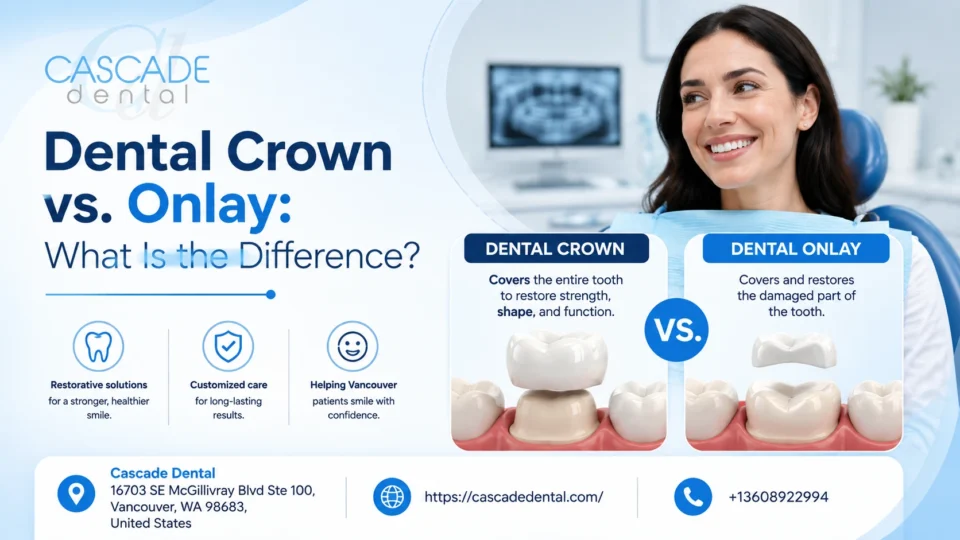
Dental Crown vs. Onlay: What Is the Difference?
When a tooth is too damaged for a routine filling, a dentist may recommend an indirect restoration such as a…
Who Is a Good Candidate for Veneers?
A good candidate for veneers generally has cosmetic concerns affecting otherwise reasonably healthy teeth.
Potential candidates may have:
- Healthy teeth and gums
- Adequate enamel for bonding
- Small chips or cosmetic imperfections
- Persistent discoloration
- Minor spacing issues
- Uneven tooth shapes or sizes
- Realistic expectations about the result
- Good daily oral hygiene habits
The dentist will also evaluate the patient’s bite and whether habits such as grinding could affect the longevity of the restorations.
Veneers also require a long-term commitment.
Depending on the type of veneer and preparation required, a small amount of enamel may be removed from the tooth. Because enamel does not grow back, some veneer treatments are considered irreversible.
Patients should therefore understand both the cosmetic benefits and the long-term maintenance involved before proceeding.
Veneers can eventually need replacement if they become worn, damaged, or otherwise no longer provide an acceptable fit or appearance.
How a Cosmetic Dental Evaluation Helps Determine the Best Option
Knowing what dental problems can veneers fix is only the first step.
Two patients may dislike similar features of their smiles but need completely different treatments.
During a cosmetic evaluation, the dentist can examine:
- Tooth color
- Tooth shape and proportions
- Enamel condition
- Existing fillings or restorations
- Gum health
- Tooth alignment
- Bite relationships
- Signs of grinding or clenching
- The number of teeth that would need treatment
The dentist will also ask what specifically bothers the patient.
For example, someone who says, “I want veneers because my smile looks uneven,” may actually have several possible solutions.
One patient might benefit from a small amount of bonding. Another may need orthodontic treatment. Someone else may achieve the desired change with whitening and cosmetic reshaping.
If veneers are appropriate, treatment planning also involves deciding how many teeth should be treated and selecting the shape, length, and shade of the restorations.
At Cascade Dental, the goal of a cosmetic evaluation is not simply to determine whether veneers are possible. It is to identify an option that makes sense for the condition of the teeth and the patient’s cosmetic goals.
Questions to Ask Before Getting Veneers
Before committing to veneers, it helps to ask thoughtful questions. Cosmetic dentistry is personal, and the right decision depends on more than wanting a brighter smile.
Start by asking what you want to change. Are you mainly concerned about color? Shape? Gaps? Chips? Tooth size? The more specific you can be, the easier it is for your dentist to recommend the right treatment. Sometimes patients think they need veneers when whitening or bonding may be enough. Other times, veneers may be the most efficient way to address several concerns at once.
You should also ask whether your teeth and gums are healthy enough for veneers. A beautiful smile needs a healthy foundation. If your dentist recommends treating decay, gum inflammation, or bite issues first, that is a good sign that they are planning for long-term success rather than only focusing on appearance.
Another important question is how natural you want your smile to look. Some patients want a very bright, camera-ready smile. Others prefer a more subtle improvement that still looks like their natural teeth. Shade, shape, translucency, and tooth proportion all matter. Veneers should be customized to your face, smile line, and personal preferences.
You may also want to ask how veneers will affect your daily routine. Veneers still require good brushing, flossing, regular dental visits, and mindful habits. Biting hard objects, using teeth as tools, or grinding at night can shorten their lifespan. Knowing the maintenance expectations ahead of time helps you make a confident decision.
Budget is another practical factor. Veneers are a cosmetic investment, and cost can vary depending on the number of teeth involved, the material used, and the complexity of your case. Instead of focusing only on price, ask what is included in the process and which other options may fit your goals.
Helpful questions to ask include:
- What cosmetic concerns are veneers best suited to fix in my case?
- Are my teeth and gums healthy enough for veneers?
- Would whitening, bonding, orthodontics, or crowns be better for me?
- How many teeth would need veneers to create a balanced result?
- What shade and shape would look natural with my smile?
- How long can I expect veneers to last with proper care?
- What habits could damage my veneers?
- Will I need a nightguard if I grind my teeth?
- What maintenance should I expect after treatment?
- What happens if a veneer chips, loosens, or needs replacement later?
These questions can help you avoid rushing into treatment and make sure the final plan fits your real goals.
Alternatives to Veneers
Veneers are only one option in cosmetic dentistry. Depending on your smile goals, another treatment may be simpler, more conservative, or better suited to your needs.
Professional teeth whitening may be a good choice if your main concern is tooth color and your teeth are otherwise healthy and evenly shaped. Whitening is often less involved than veneers, but it may not work as well for deep internal stains or discoloration caused by certain medications, trauma, or older dental work.
Dental bonding may be an option for small chips, minor gaps, or slight shape changes. Bonding uses tooth-colored resin to improve the appearance of a tooth. It is typically more conservative than veneers, but it may not last as long or resist staining as well.
Clear aligners or orthodontic treatment may be better if your main concern is crooked, crowded, or misaligned teeth. While veneers can visually improve mild unevenness, orthodontics actually moves the teeth into better positions. Some patients choose orthodontic treatment first and then consider veneers later for final cosmetic refinements.
Crowns may be recommended when a tooth needs more strength or coverage. If a tooth is badly worn, cracked, heavily filled, or structurally weakened, a crown may provide better protection than a veneer.
Tooth contouring may also help in select cases. If the issue is a slightly uneven edge or minor reshaping need, small adjustments may create a more balanced appearance without placing a veneer.
Common alternatives include:
- Teeth whitening for discoloration
- Dental bonding for small chips or gaps
- Clear aligners for alignment concerns
- Crowns for damaged or weakened teeth
- Tooth contouring for minor reshaping
- A combination plan for more complete smile improvements
Choosing between veneers and other cosmetic options is not always an either-or decision. Some patients benefit from combining treatments. For example, whitening may be done before veneers so the final shade blends with surrounding teeth. Others may complete orthodontic care first, then use veneers to refine tooth shape or color.
Are Veneers Worth Considering?
Veneers may be worth considering if you have cosmetic concerns that affect your confidence and you want a customized way to improve the appearance of your smile. They can be especially helpful when several concerns overlap, such as discoloration, small chips, uneven tooth shape, and minor spacing.
However, the right choice depends on your oral health, your goals, your bite, your budget, and your willingness to care for your results long-term. Veneers are not simply about creating a brighter smile. They are about designing a smile that fits your face, your needs, and your future dental health.
If you are unsure, that is completely normal. Many patients begin with questions rather than a clear decision. A cosmetic consultation can help you compare veneers with other options and decide what makes the most sense for your smile.
FAQ: Dental Veneers
Are veneers permanent?
Veneers are considered a long-term cosmetic treatment, but they do not last forever. Depending on the type of veneer, your oral health, and your habits, they may need repair or replacement in the future.
Do veneers damage your teeth?
Veneers often require some preparation of the natural tooth surface. Your dentist can explain how much preparation is needed and whether veneers are a conservative option for your specific case.
Are veneers better than whitening?
Veneers and whitening solve different problems. Whitening may be better for general surface staining, while veneers may be more useful for deep discoloration, uneven shape, chips, or multiple cosmetic concerns.
Can I get veneers if I grind my teeth?
Some patients who grind their teeth may still be candidates for veneers, but they may need extra protection, such as a nightguard. Your dentist will need to evaluate your bite and grinding habits before recommending treatment.
How do I know if veneers are right for me?
The best way to know is to schedule a cosmetic consultation. Your dentist can examine your teeth and gums, listen to your goals, and help you compare veneers with options like whitening, bonding, crowns, or orthodontics.
Ready to Explore Veneers with Cascade Dental?
Thinking about veneers but not sure where to start? Cascade Dental can help you make an informed and confident decision.
Our team can evaluate your teeth, listen to your goals, explain whether veneers may be a good fit, and walk you through other cosmetic options if another treatment is better suited to your needs.
Schedule a cosmetic consultation with Cascade Dental in Vancouver, WA, to learn whether dental veneers are right for your smile goals.
Are Veneers the Right Fit?
Let a trusted cosmetic dentist help you decide. Call now for personalized smile advice.