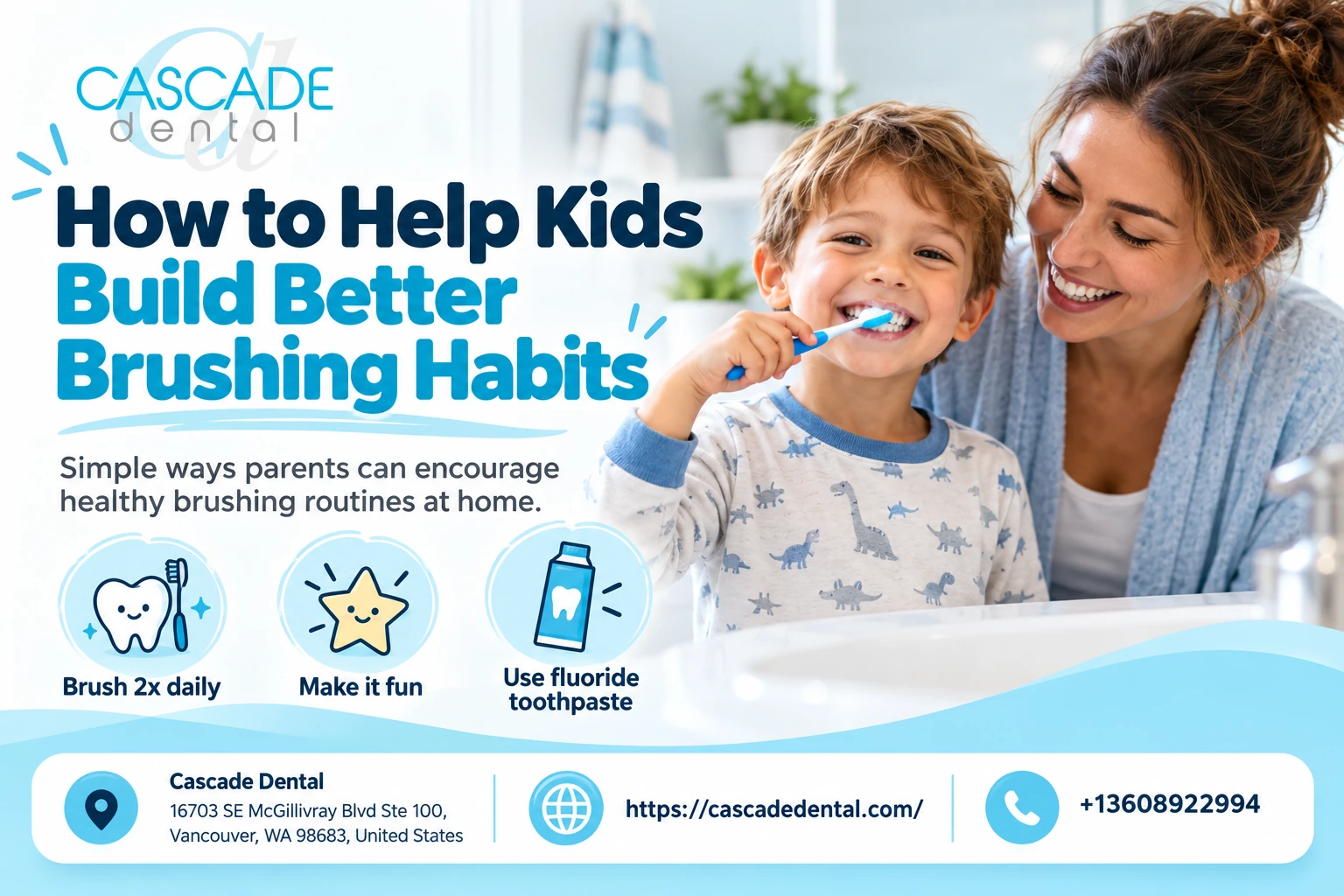
Helping kids build better brushing habits starts with making oral care consistent, simple, and appropriate for their age. Children generally need hands-on help or supervision for longer than parents may expect, especially while they are still developing the coordination needed to clean every tooth thoroughly.
At Cascade Dental, we encourage families to treat brushing and flossing as everyday routines rather than occasional reminders. Starting early, using the right amount of fluoride toothpaste, supervising technique, and keeping regular dental visits can help children develop habits that protect their smiles as they grow.
Start Better Brushing Habits Today
Give your child the guidance they need for healthier teeth and gums. Call now to book an appointment.
Fast Answer: How Can Kids Build Better Brushing Habits?
The best way to help children develop better brushing habits is to create a routine they can follow every morning and every night.
Parents can make that easier by:
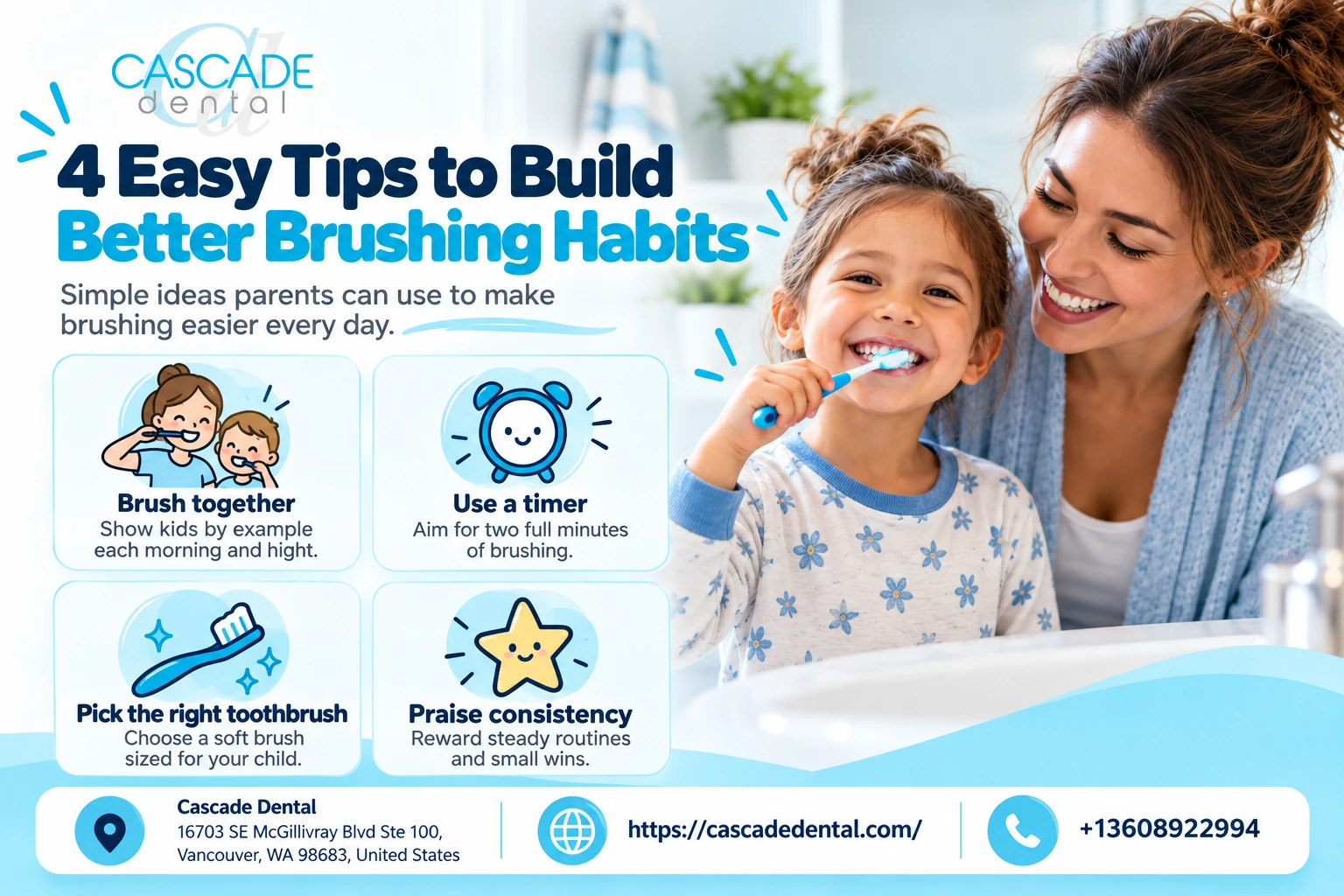
- Brushing at roughly the same times each day
- Using a child-sized, soft-bristled toothbrush
- Brushing for about two minutes
- Using an age-appropriate amount of fluoride toothpaste
- Helping children reach areas they routinely miss
- Introducing flossing when neighboring teeth begin touching
- Using songs, timers, charts, or rewards to keep younger children interested
- Modeling good brushing habits themselves
- Scheduling routine dental visits
The American Dental Association recommends brushing twice a day for two minutes with fluoride toothpaste. Young children should receive assistance or supervision from an adult while their brushing skills develop.
Consistency matters more than making every brushing session perfect. A child who learns that brushing is simply part of getting ready in the morning and going to bed at night is more likely to carry that habit forward.
When Should Children Start Brushing Their Teeth?
Brushing should begin as soon as a child’s first tooth appears.
Baby teeth may be temporary, but they still need protection from tooth decay. They also help children chew, speak, and maintain space for permanent teeth.
Before the first tooth erupts, parents can gently wipe a baby’s gums with a clean, soft, damp cloth. Once teeth appear, switch to a small, soft-bristled toothbrush.
For children younger than three, the ADA recommends using only a smear of fluoride toothpaste, roughly the size of a grain of rice. From ages three through six, a pea-sized amount is generally recommended.
Parents should place the toothpaste on the brush themselves so young children do not use too much.
Starting early has another advantage: brushing becomes familiar before children reach the stage when they may strongly resist it. A toddler who has always had teeth brushed after breakfast and before bed is more likely to recognize it as part of the normal daily routine.
How Much Help Do Kids Need at Different Ages?
There is no exact birthday when every child suddenly becomes a capable brusher. Fine motor skills, attention span, maturity, and willingness to follow instructions all develop differently.
Parents can use these general stages as a guide.
Babies and Toddlers
Parents should do the brushing.
Use a small toothbrush, gentle pressure, and the recommended rice-grain-sized smear of fluoride toothpaste once teeth begin erupting.
Toddlers can hold a toothbrush or imitate brushing, but they should not be expected to clean their teeth effectively on their own.
Preschool-Age Children
Children can begin participating more actively, but an adult should still complete or closely supervise brushing.
One useful method is letting the child brush first and then having the parent say, “Now it’s my turn to check.”
This provides independence without sacrificing thorough cleaning.
Early Elementary-Age Children
Many children can perform more of the brushing themselves at this stage, but parents should continue checking their technique.
Pay particular attention to:
- Back molars
- Teeth near the gumline
- Inside surfaces
- Areas around newly erupting permanent teeth
Children sometimes focus almost entirely on the front teeth because those are easiest to see.
Older Children
Older children may be capable of handling brushing independently, but occasional check-ins are still useful.
If plaque is repeatedly visible, cavities are developing, or certain areas are consistently missed, more supervision may still be appropriate.
Ability matters more than age alone.
How Can Parents Make Brushing More Consistent?
Consistency usually improves when brushing is attached to routines that already happen every day.
Instead of saying, “Remember to brush sometime before bed,” make brushing one fixed step in the bedtime sequence.
For example:
Dinner → bath → pajamas → brushing and flossing → story → bed.
Morning brushing can similarly happen after breakfast or as part of getting dressed and ready for school.
Keep Supplies Easy to Reach
Children are more likely to participate when their toothbrush, toothpaste, floss, and timer are ready and accessible.
Parents can also keep spare toothbrushes where they are useful, especially if children regularly spend nights with grandparents or another caregiver.
Avoid Turning Brushing Into a Daily Negotiation
Young children may resist brushing, particularly when tired.
Keeping the expectation consistent helps. Brushing should be treated like washing hands, wearing a seat belt, or getting dressed.
Choices can still help children feel involved.
Try asking:
“Do you want the blue toothbrush or green toothbrush?”
rather than:
“Do you want to brush your teeth?”
The first gives the child control over part of the routine without making oral care optional.
Use Visual Reminders
A simple morning-and-night brushing chart can work especially well for younger children.
They can add a sticker, checkmark, or smiley face after each completed session. The ADA also promotes brushing calendars as a way for children to track daily oral hygiene habits.
What Is the Best Brushing Technique for Children?
Good technique is more important than aggressive scrubbing.
Children should use a soft-bristled toothbrush and gentle movements to clean the outside, inside, and chewing surfaces of every tooth.
The ADA generally recommends positioning the toothbrush near the gumline at approximately a 45-degree angle and using short, gentle strokes. The inner surfaces of the front teeth can be cleaned by turning the brush vertically and using small up-and-down movements.
Parents can teach children to follow the same order every time.
For example:
- Brush the outside surfaces of the upper teeth.
- Brush the inside surfaces.
- Brush the chewing surfaces.
- Repeat on the lower teeth.
- Carefully clean around the gumline.
- Check the back molars before finishing.
A consistent sequence makes it less likely that certain teeth will be forgotten.
Two minutes can feel surprisingly long to a young child. A timer, brushing song, or electric toothbrush with a built-in timer can make it easier to reach the full brushing time.
Manual and powered toothbrushes can both clean effectively when used properly.
When Should Kids Start Flossing?
Children should begin cleaning between their teeth when neighboring teeth touch closely enough that a toothbrush cannot adequately clean between them.
For some children, this happens fairly early. Others may have wider spaces between their baby teeth for longer.
Traditional string floss is not the only option. Depending on the child’s age and dexterity, families may find floss picks or another dentist-recommended interdental cleaner easier to use.
Young children usually need a parent to do the flossing.
Gently guide the floss between two teeth, curve it around the side of one tooth, and move it carefully along the tooth surface. Then clean the neighboring tooth before moving to the next space.
Avoid snapping floss forcefully into the gums.
As children get older, parents can begin teaching them how to floss for themselves while continuing to check that they are reaching the spaces between their teeth properly.
The goal is not simply to “use floss.” It is to clean the areas a toothbrush cannot reach.
How Can You Make Brushing More Fun?
Brushing does not need to become a major event, but adding a little fun can reduce resistance.
Different strategies work for different children.
Use Music
Choose a song lasting roughly two minutes and make it the family’s regular brushing song.
Children can brush until the song ends instead of repeatedly asking, “Am I done?”
Let Kids Choose Their Toothbrush
A toothbrush featuring a favorite color or character can make younger children more interested in participating.
Just make sure it has an age-appropriate head and soft bristles.
Brush Together
Children learn by watching.
When parents brush alongside their children, they demonstrate that oral hygiene is something everyone does, not just something adults tell children to do.
Create a Brushing Challenge
For younger children, challenge them to find and clean every tooth.
Parents might say:
“Did you find those back teeth hiding behind the others?”
This turns careful brushing into a small game while reinforcing technique.
Use Positive Feedback
Instead of focusing only on mistakes, recognize progress.
“You remembered your back teeth tonight.”
“You brushed for the whole two minutes.”
“You did a good job letting me check.”
Positive reinforcement can help children associate oral care with achievement rather than criticism.
What Common Brushing Mistakes Should Parents Watch For?
Even children who brush twice each day can develop problems if their technique or routine leaves certain areas consistently uncleaned.
Here are several common issues parents can watch for.
Brushing Too Quickly
A ten-second scrub across the front teeth is not enough.
Children need time to reach the back, front, inside, and chewing surfaces.
Missing the Gumline
Plaque commonly collects where teeth meet the gums. Children may clean the center of each tooth while ignoring this area.
Encourage gentle brushing along the gumline instead of aggressive scrubbing.
Ignoring Back Teeth
Molars are easy to overlook, particularly newly erupting permanent molars.
Parents should regularly check that children are reaching all the way to the back of the mouth.
Using Too Much Toothpaste
More toothpaste does not mean cleaner teeth.
Parents should control the amount used, particularly for young children. Children younger than three generally need only a rice-grain-sized smear of fluoride toothpaste, while children ages three through six should use about a pea-sized amount.
Swallowing Toothpaste
Young children should be taught to spit out excess toothpaste rather than swallow it. Adult supervision helps ensure that the right amount is used.
Brushing Too Hard
Hard scrubbing does not remove plaque more effectively and may irritate the gums.
Use gentle pressure with a soft-bristled brush.
Forgetting to Replace the Toothbrush
The ADA recommends replacing toothbrushes approximately every three to four months, or sooner when bristles become visibly frayed or matted.
How Do Regular Dental Visits Support Good Oral Hygiene?
Home care is the foundation of good oral health, but regular dental visits provide an important second layer of prevention.
At Cascade Dental, routine appointments give us an opportunity to evaluate a child’s teeth and gums, look for early signs of decay, review brushing and flossing technique, and help parents understand areas that may need extra attention.
Professional visits can also reinforce lessons children hear at home.
Sometimes children respond differently when a dental professional shows them where plaque tends to collect or demonstrates how to reach their back teeth.
The American Academy of Pediatric Dentistry recommends establishing a dental home within six months of the first tooth erupting and no later than a child’s first birthday. The frequency of later dental visits should be based on the child’s individual oral health needs and cavity risk rather than assuming every child requires exactly the same schedule.
Preventive appointments can also include professional cleaning, fluoride treatment when appropriate, evaluation of tooth development, and personalized recommendations for home care.
When Can Children Brush Independently?
Children can brush independently when they have the coordination, patience, and attention needed to thoroughly clean every surface of every tooth without regular reminders.
There is no universal age.
One child may become reliable relatively early, while another may need parents to supervise or finish brushing for longer.
Instead of deciding based only on age, parents can watch for practical signs of readiness.
A child may be ready for more independence when they can:
- Brush for approximately two minutes without rushing
- Reach the back molars
- Clean the inside and outside surfaces
- Brush gently along the gumline
- Use the correct amount of toothpaste
- Spit toothpaste out appropriately
- Remember to brush morning and night
- Follow a consistent brushing pattern
- Floss effectively or ask for help when needed
Even after children take over brushing themselves, parents can periodically check their teeth.
Independence should be gradual. The goal is not to stop helping as quickly as possible. It is to teach children how to care for their teeth well enough that they can eventually manage the routine confidently on their own.
Learning how to help kids build better brushing habits is ultimately about repetition, support, and realistic expectations. Children need opportunities to practice, but they also need adults to step in when their skills have not yet caught up with their independence.
FAQs
How many times a day should children brush their teeth?
Children should generally brush twice each day for about two minutes using fluoride toothpaste. Morning and bedtime brushing are easiest for most families to maintain consistently.
What type of toothbrush is best for a child?
Choose an age-appropriate toothbrush with soft bristles and a head small enough to reach comfortably around the child’s mouth. Both manual and powered toothbrushes can work effectively when used correctly.
What should I do if my child refuses to brush?
Keep the routine predictable rather than making brushing optional. Offer small choices, such as selecting the toothbrush, toothpaste flavor, timer, or brushing song. For ongoing resistance, parents can ask their dentist for strategies based on the child’s age and needs.
Should parents brush their child’s teeth after the child brushes?
For younger children, this can be a useful approach. Letting the child brush first provides practice, while a parent completing the brushing helps ensure important areas are not missed.
At what age should children start using mouthwash?
Mouthwash is not a substitute for brushing and flossing. The ADA generally does not recommend fluoride mouthrinse for children younger than six unless a dental professional advises otherwise because younger children may swallow the rinse rather than reliably spit it out.
What if my child still gets cavities even though they brush?
Cavities can be influenced by several factors beyond whether a child brushes, including brushing quality, fluoride exposure, diet, frequency of sugary snacks or drinks, tooth anatomy, and individual cavity risk. A dental evaluation can help identify possible causes and determine whether changes in home care or additional preventive measures would be useful.
Help Your Child Build Healthy Habits With Cascade Dental
Good brushing habits do not develop overnight. They grow through consistent routines, age-appropriate supervision, patient instruction, and regular preventive care.
If your child is learning to brush, struggling with certain areas, or ready for more independence, the team at Cascade Dental can help you understand what is appropriate for their current stage. Routine dental visits also give us the opportunity to identify early concerns, reinforce proper brushing and flossing techniques, and provide preventive recommendations based on your child’s individual needs.
Do not wait for tooth pain or a visible cavity to make oral health a priority. Build the routine early and keep preventive care consistent as your child grows.
Contact Cascade Dental today to schedule your child’s next dental visit and give them the support they need to build healthier brushing habits for years to come.
Make Brushing Easier for Kids
Build healthy brushing habits early. Schedule a dental visit today and help protect your child’s smile.