
Preparing your child for a dental filling is mostly about keeping the explanation simple, calm, and appropriate for their age. Tell them the dentist is going to help make their tooth healthy and comfortable again, without giving too many procedural details that could create unnecessary worry.
Parents can also help by keeping their own tone positive, following the dental team’s eating and medication instructions, and bringing familiar comfort items if appropriate. At Cascade Dental, we want children to know what to expect without making the appointment feel frightening or overwhelming.
Fast Answer: How to Prepare Your Child for a Dental Filling
If your child needs a filling, preparation does not have to involve a long conversation.
A few practical steps can make the appointment easier:
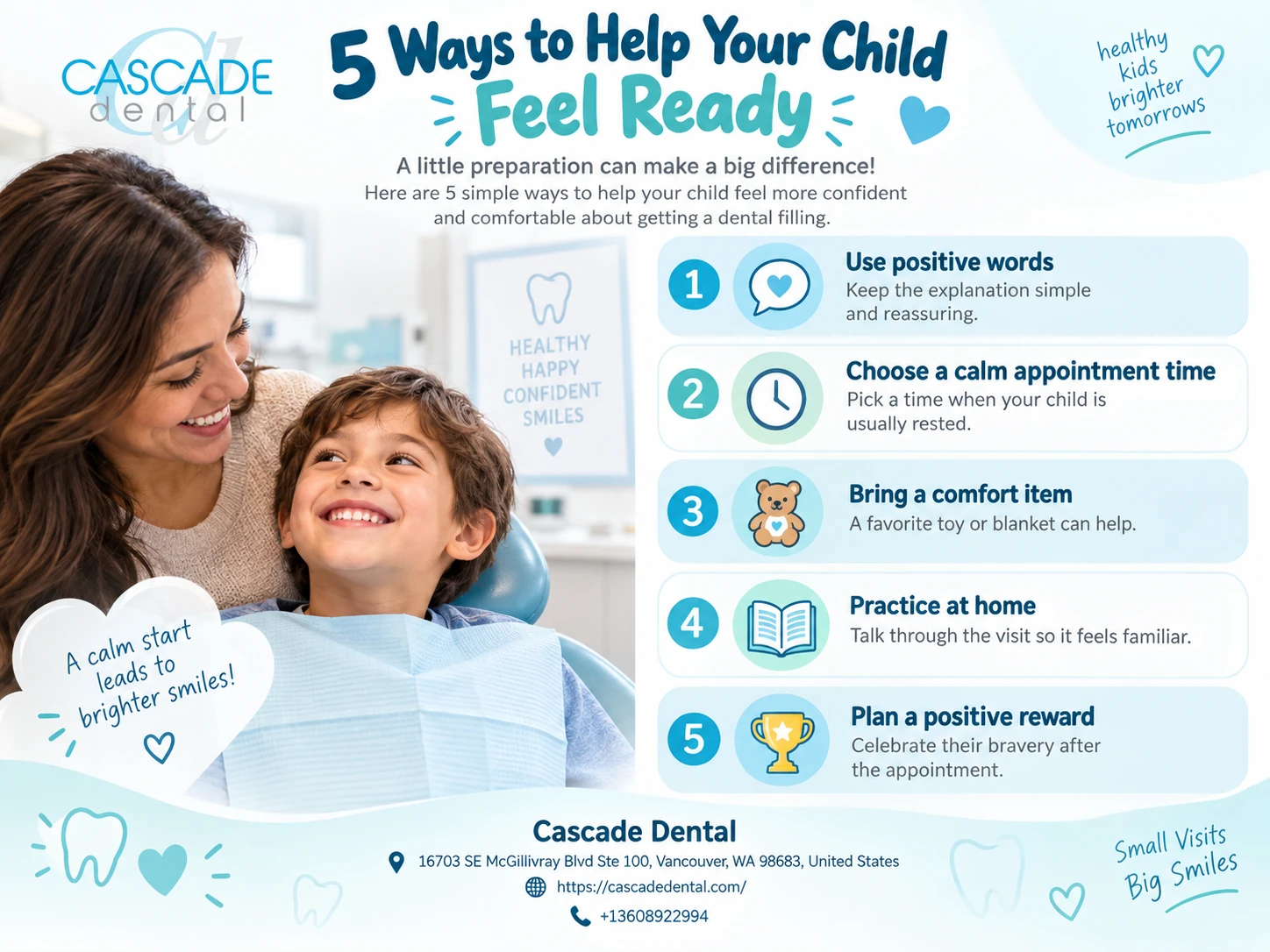
- Explain the visit using simple, reassuring language.
- Avoid words that may sound frightening, such as “needle,” “shot,” “drill,” or “pain.”
- Tell your child the dentist will clean and repair the tooth.
- Keep your own tone calm and matter-of-fact.
- Follow any instructions from the dental office about eating, drinking, or medications.
- Schedule the appointment at a time when your child is usually rested, when possible.
- Bring a favorite small comfort item if the office permits it.
- Let the dental team explain the equipment and procedure in child-friendly terms.
- Plan for a quieter period after treatment, especially if your child’s mouth remains numb.
Children often take emotional cues from their parents. If the appointment is presented as a normal healthcare visit rather than something scary, many children are more comfortable with the experience.
How Should You Explain a Dental Filling to Your Child?
Use an explanation your child can understand without giving them more information than they need.
For a younger child, you might say:
“The dentist found a little spot on your tooth that needs fixing. They’re going to clean the tooth and make it strong again.”
An older child may want a little more information. You can explain that a cavity is an area of the tooth that has been damaged and that the filling repairs the area so the tooth can continue working properly.
Try to keep your explanation focused on what the dentist is doing to help.
Keep the Language Neutral
Certain words can create fear before a child even reaches the dental office.
Instead of saying:
“They’re going to give you a shot so it doesn’t hurt.”
Try:
“The dentist may help your tooth feel sleepy and comfortable while they work.”
Instead of:
“They have to drill out the cavity.”
Try:
“They’ll carefully clean the damaged part of the tooth and repair it.”
The goal is not to mislead your child. It is to describe the procedure accurately without using language that may sound alarming.
Answer Questions Briefly
If your child asks whether the procedure will hurt, avoid making promises you cannot guarantee.
Rather than saying, “You won’t feel anything,” try:
“The dental team will do everything they can to keep you comfortable, and you can tell them if something bothers you.”
That builds trust without creating unrealistic expectations.
Avoid Sharing Your Own Dental Fears
Even well-intentioned stories can increase anxiety.
Comments such as “I hated fillings when I was a kid” or “I was terrified of the dentist too” may teach your child that there is something to fear.
Keep the conversation centered on their appointment and the support available to them.
What Happens During a Pediatric Dental Filling?
The exact process depends on which tooth is being treated, the size of the cavity, the filling material, your child’s age, and the treatment plan recommended by the dentist.
A typical appointment may involve several basic steps.
The Tooth Is Examined
The dentist may review the tooth and any available X-rays before beginning treatment.
The Area Is Made Comfortable
Local anesthetic may be used when necessary to numb the treatment area.
Some dental offices also offer additional comfort or anxiety-management options for appropriate patients. If anything beyond routine local anesthesia has been recommended for your child, follow the specific preparation instructions provided by the dental team.
The Decay Is Removed
The dentist carefully removes damaged tooth structure and prepares the area for restoration.
The Tooth Is Restored
The prepared area is filled with an appropriate dental material so the tooth can function normally again.
The Filling Is Checked
The dentist may ask your child to bite down so they can make sure the restoration feels appropriate with the surrounding teeth.
The appointment may look slightly different depending on the individual situation. Parents should follow the treatment plan provided by their child’s dentist rather than assuming every filling appointment will be identical.
How Can You Help Reduce Dental Anxiety Before the Appointment?
Some nervousness before dental treatment is normal, particularly if this is your child’s first filling.
Parents can help without making the appointment a major event.
Keep the Routine Normal
Try not to spend several days repeatedly reminding your child that the appointment is coming.
For younger children especially, too much advance discussion can give them more time to imagine what might happen.
A simple explanation the day before or morning of the appointment may be enough.
Choose the Appointment Time Carefully
If possible, schedule treatment when your child is usually rested and cooperative.
A younger child who becomes tired or irritable late in the afternoon may do better with a morning appointment.
Practice Calm Breathing
For children who are old enough to follow instructions, practice taking slow breaths before the visit.
You can turn it into a simple activity:
“Take a slow breath in, then blow it out like you’re cooling hot soup.”
This gives the child something familiar to use if they begin feeling nervous.
Let the Dental Team Do Some of the Explaining
Dental professionals are accustomed to describing procedures in language designed for children.
Giving the dentist or assistant room to introduce instruments and explain each step may prevent mixed messages.
Bring Familiar Comfort
Depending on office policies, a favorite small stuffed animal, blanket, headphones, or another familiar object may help a child feel more secure.
Ask the dental office beforehand if you are unsure what is allowed.
What Should Your Child Eat Before a Dental Filling?
What your child can eat before treatment depends on what type of procedure and anxiety management are planned.
For a routine filling performed with local anesthetic alone, the dental office may allow your child to eat normally beforehand. A balanced meal can help prevent hunger from becoming another source of irritability during the visit.
However, instructions may be completely different if sedation or another medication is planned.
In those situations, your child may need to avoid food and drinks for a specific period before the appointment.
Always follow the instructions given by your dentist.
Do not assume the fasting requirements from another child’s procedure apply to yours.
If you are uncertain, contact the dental office before the appointment and ask:
- Can my child eat beforehand?
- Are there foods or drinks we should avoid?
- Should regular medications still be taken?
- Is there a fasting period because sedation is planned?
Following these instructions is especially important when sedation is involved.
What Should You Bring to the Appointment?
A little preparation can prevent unnecessary stress once you arrive.
Consider bringing:
- Your child’s insurance information, if needed
- An updated medication list
- Information about allergies or medical conditions
- Any forms requested by the dental office
- A small comfort item
- An extra layer of clothing in case your child becomes cold
- A list of questions you want to ask the dentist
- Any instructions you were given before treatment
If another caregiver normally handles your child’s medications or medical history, make sure the person bringing the child knows the relevant information.
Also tell the dental team about any changes in your child’s health since the filling was scheduled.
How Can Parents Help During the Visit?
One of the most useful things parents can do is remain calm.
Children often notice changes in a parent’s facial expression, body language, or voice even when nothing has been said directly.
Follow the Dental Team’s Lead
Every child responds differently during dental treatment.
Some children feel safer with a parent nearby. Others cooperate better when the dental team communicates directly with them.
Follow the office’s approach and ask how you can best support your child.
Avoid Repeated Reassurance
Constantly saying “Don’t be scared” or “It’s not going to hurt” can accidentally suggest there is something to fear.
Instead, use simple encouragement such as:
“You’re doing a good job staying still.”
“Keep taking those slow breaths.”
“Listen to what the dentist is asking you to do.”
Avoid Negotiating During Treatment
If possible, let the dental team direct the procedure rather than repeatedly asking your child whether they want to continue.
Children need to feel heard, but frequent negotiations can make it harder for them to settle into the appointment.
Praise Specific Behaviors
Afterward, recognize what your child did well.
Instead of simply saying “You were so brave,” you might say:
“You did a great job keeping your mouth open when the dentist asked.”
Specific praise reinforces behaviors that will help at future appointments.
What Should You Expect After the Filling?
After a dental filling, your child may experience temporary numbness if local anesthetic was used.
The lip, cheek, or tongue near the treatment area may feel strange for several hours.
Children sometimes become curious about this sensation and may repeatedly touch, chew, pinch, or bite the numb area.
Parents should watch closely until normal sensation returns.
Prevent Lip or Cheek Biting
Remind your child that even though the cheek or lip feels unusual, they should not chew or suck on it.
Accidentally biting numb tissue can cause soreness and swelling later.
Mild Sensitivity Can Occur
Some teeth may temporarily feel sensitive after a filling.
The child might notice sensitivity when biting or when eating something cold.
Mild symptoms that gradually improve are generally different from significant or worsening pain.
Contact the dental office if you are concerned or if symptoms do not improve as expected.
Your Child May Feel Tired
The appointment itself can be tiring, particularly for younger children.
A calm afternoon may be helpful after treatment.
If sedation was used, follow all specific post-treatment instructions because activity, eating, supervision, and recovery recommendations may differ significantly from those for a routine filling.
What Foods Should Your Child Avoid After Treatment?
Your dentist’s specific instructions should come first.
If your child’s mouth is still numb, waiting before eating may help prevent accidental biting of the cheek, tongue, or lip.
Once eating is appropriate, softer foods can be easier initially.
Examples may include:
- Yogurt
- Applesauce
- Scrambled eggs
- Pasta
- Mashed potatoes
- Soft cooked vegetables
- Soup that is not excessively hot
- Smooth foods that require minimal chewing
For a short period, the dentist may recommend avoiding foods that are:
- Very hard
- Sticky
- Extremely chewy
- Very hot
- Difficult to bite while numb
Some filling materials are ready for normal chewing immediately, while others may have specific recommendations.
Ask the dentist when your child can return to their usual diet.
When Should You Call the Dentist After a Filling?
Most children return to normal activities without major problems after a routine filling.
However, contact the dental office if something does not seem right.
Call if your child experiences:
- Significant or worsening tooth pain
- Pain that repeatedly wakes them from sleep
- Swelling around the treated tooth
- Facial swelling
- Fever along with dental symptoms
- A filling that appears broken or missing
- Difficulty closing their teeth normally
- Pain every time they bite down
- Numbness that lasts significantly longer than the dental team said to expect
- A substantial injury to the lip, cheek, or tongue from biting while numb
Your child may occasionally say that the treated tooth feels “too tall” when biting.
A filling that interferes with the bite sometimes needs a minor adjustment. Contact the dental office rather than asking your child to simply tolerate persistent discomfort.
If you are unsure whether a symptom is normal, it is appropriate to call and ask.
FAQs
Should I tell my child about the filling ahead of time?
Yes, but the amount of advance notice should depend on your child’s age and temperament. Younger children often do better with a short, simple explanation shortly before the appointment. Older children may appreciate more information and time to ask questions.
What should I call the filling when explaining it?
You can say the dentist is going to “clean and fix the tooth” or “repair the spot on the tooth.” Keep the explanation accurate but simple.
Should I promise my child the filling will not hurt?
It is better not to make absolute promises. Tell your child that the dental team will work to keep them comfortable and that they can communicate if something bothers them.
Can my child eat before the filling?
Possibly. For routine treatment with local anesthetic, eating beforehand may be permitted. If sedation or other medications are planned, special fasting instructions may apply. Always follow your dental office’s directions.
How long will my child’s mouth stay numb?
The duration varies depending on the anesthetic, treatment area, and individual child. The dental team can tell you approximately what to expect. Closely supervise your child until full sensation returns so they do not accidentally bite their lip, cheek, or tongue.
Can my child go back to school after getting a filling?
Some children can return to school after a routine filling, but others benefit from a quieter remainder of the day. If sedation was used, returning to school or normal activities may not be appropriate. Follow the dentist’s recovery instructions.
Is it normal for a tooth to feel sensitive after a filling?
Temporary sensitivity can occur after treatment. Contact the dentist if the pain is severe, getting worse, interfering with sleep, continuing longer than expected, or occurring every time the child bites.
Help Your Child Feel More Comfortable About Dental Treatment
Learning how to prepare your child for a dental filling is less about explaining every detail of the procedure and more about creating a calm, predictable experience. Simple language, realistic reassurance, good preparation, and a relaxed parent can make a meaningful difference in how a child approaches treatment.
At Cascade Dental, we want both children and parents to understand what is happening and feel comfortable asking questions. We can explain your child’s treatment plan, discuss what to expect before and after the filling, and provide instructions based on their individual needs.
If your child has been diagnosed with a cavity or has an upcoming filling appointment, contact Cascade Dental with any questions before the visit so you can arrive prepared and confident about the next steps.