Dental implants are the only tooth replacement option that restores the root as well as the crown — stopping bone loss, stabilizing your bite, and giving you back a complete smile that functions like the real thing.
25+ Years potential lifespan
With proper care and maintenance
98% Implant success rate
Among healthy, well-maintained patients
4.8★ Patient satisfaction
200+ reviews across Clark County
What Is a Dental Implant — and Why Does It Work So Well?
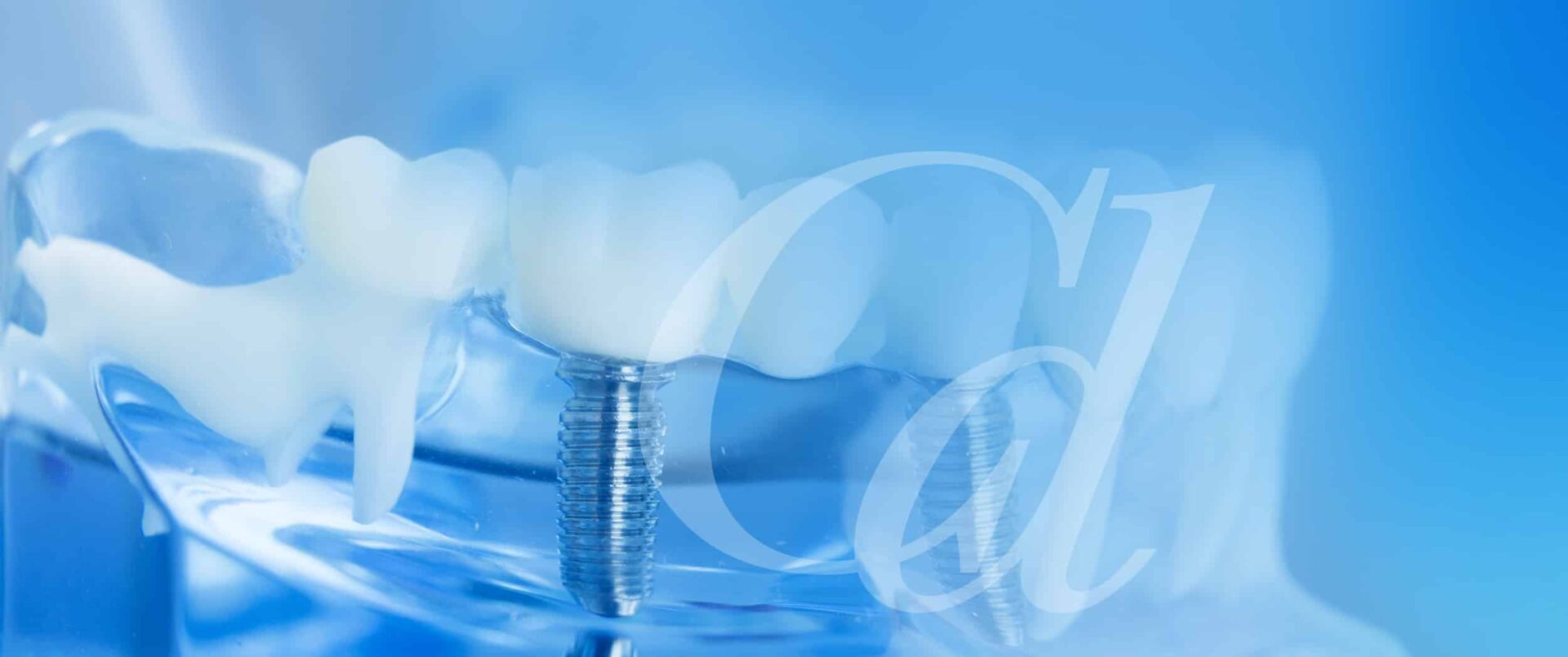
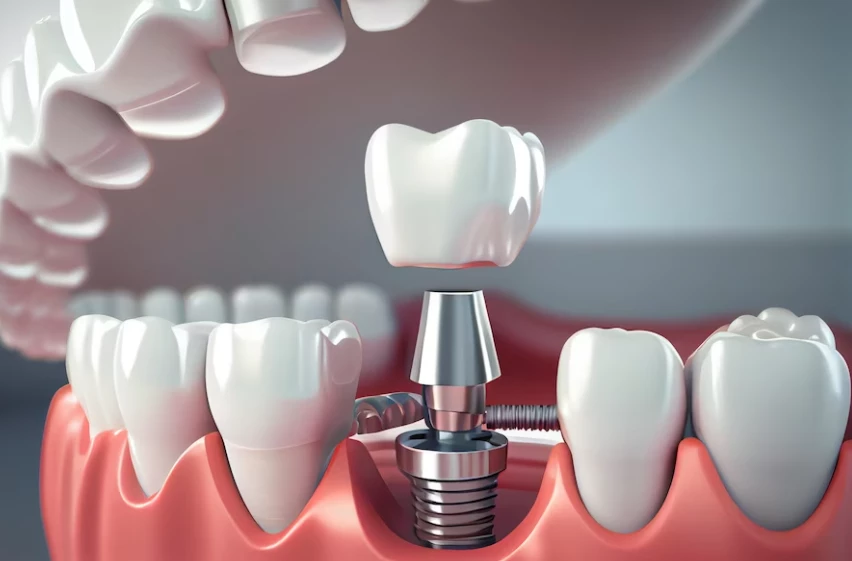
A dental implant is a small titanium post placed into the jawbone to replace the root of a missing tooth. As the area heals, the bone naturally bonds with the implant, creating a strong and stable foundation. Once healed, a connector called an abutment is attached, followed by a custom crown, bridge, or denture that restores the visible part of the smile.
What makes implants different from dentures or traditional bridges is that they replace the root, not just the tooth above the gumline. This helps keep the jawbone stimulated, which can reduce bone loss after tooth loss. Because implants are supported by the jaw like natural teeth, they can improve chewing strength, protect facial structure, and support long-term oral health.
Implant Anatomy
The Implant Post
A small titanium screw placed into the jawbone. Titanium is biocompatible — the bone accepts it and integrates with it over time through osseointegration.
The Abutment
A connector attached to the top of the implant post after healing. It serves as the interface between the implant and the visible restoration above the gumline.
The Restoration
The visible part — a crown for a single tooth, a bridge for multiple missing teeth, or a denture for a full arch. Custom-designed to match your natural smile.
Why Patients Choose Implants
What Dental Implants Restore — and Protect
The advantages of implants go well beyond appearance. Here’s what makes them the most comprehensive tooth replacement available.
✔️ They preserve your jawbone
The only option that stimulates bone the way a natural root does — stopping the resorption that begins as soon as a tooth is lost.
✔️ They function like natural teeth
Bite, chew, and speak normally. No adhesives, no removing at night, no clicking or shifting when you eat.
✔️ They leave adjacent teeth alone
Unlike a bridge, an implant doesn’t require reshaping the healthy teeth beside the gap to support the restoration.
✔️ They last decades
With proper care, implants can last 20–25 years or longer. Most other restorations need replacement well before that.
✔️ They maintain facial structure
Bone loss from missing teeth eventually changes the shape of the face. Implants slow or halt that process, preserving your natural contours.
✔️ They’re the lowest-maintenance option
Brush and floss like normal teeth. No special adhesives, soaking solutions, or appliances to manage.
Your Options
Types of Dental Implants We Offer in Vancouver, WA
Implant solutions are not one-size-fits-all. The right type depends on how many teeth you’re missing, your bone density, and your goals.
Single Tooth Implant
One implant post topped with a custom crown replaces a single missing tooth — leaving all surrounding teeth completely untouched. The most precise and conservative option for isolated tooth loss.
✔️Best for one missing tooth
Implant-Supported Bridge
When several teeth are missing in a row, implants at each end support a bridge spanning the gap — without reshaping healthy adjacent teeth or relying on them for support.
✔️Best for multiple adjacent teeth
Full Mouth / Full-Arch Implants
For patients missing all or most teeth on an arch, a full set of implants supports a permanent, fixed restoration — replacing an entire row of teeth with stability that dentures can’t provide.
✔️Best for full arch replacement
All-on-4 Implants
A full-arch restoration anchored by just four strategically angled implants — designed for patients with reduced bone volume who may otherwise need extensive grafting. Fewer implants, same complete result.
✔️Best for reduced bone density
Same-Day Implants
In carefully selected cases, a temporary restoration can be placed on the same day as implant surgery — meaning you leave with a functional tooth in place while the implant heals. Not right for every case, but available when conditions allow.
✔️Available for select cases
Are You a Candidate?
Who Dental Implants Work Best For — and When We Need to Plan Further
Most adults missing one or more teeth are candidates for implants, though some cases require additional preparation first. Here’s an honest breakdown.
Strong candidates
✔️Missing one or more teeth in any area of the mouth
✔️Healthy gums with no active periodontal disease
✔️Adequate jawbone density to support the implant post
✔️Non-smoker, or willing to stop during the healing period
✔️Generally good overall health (well-managed systemic conditions are usually fine)
✔️Jaw growth is fully complete (typically age 18+)
✔️Committed to regular dental visits and oral hygiene
May need additional steps first
✔️Active gum disease — must be treated and stabilized before implant placement
✔️Significant bone loss — may require bone grafting, sinus lift, or ridge augmentation
✔️Heavy smokers — significantly increases failure risk; cessation strongly recommended
✔️Uncontrolled diabetes or certain autoimmune conditions — requires coordination with your physician
✔️Patients taking certain medications (bisphosphonates, blood thinners) — requires evaluation
✔️Jaw still developing — typically not placed until adulthood
Even if you’ve been told you’re not a candidate elsewhere, modern techniques often make implants possible with proper preparation. We’ll give you an honest assessment at your consultation.
When Bone Preparation is Needed
Why Bone Health Is the Foundation of Implant Success
The jawbone must be dense enough to accept and hold the implant post through osseointegration. When bone has been lost — from a long-absent tooth, gum disease, or other causes — preparatory procedures can rebuild that foundation before implant placement.
Bone Grafting
Graft material is placed in the area of bone loss to stimulate new bone growth. Once the graft integrates — typically over a few months — the site is ready for the implant post.
Sinus Lift
For upper back teeth, the sinus floor sometimes sits too close to the jawbone to allow implant placement. A sinus lift raises the sinus membrane and adds bone below it to create sufficient depth.
Ridge Augmentation
When the jaw ridge has narrowed or flattened after tooth loss, augmentation rebuilds its width and height — restoring the natural contour and creating enough volume for a well-positioned implant.
Socket Preservation
Performed immediately after a tooth extraction, socket preservation fills the empty socket with graft material to prevent bone collapse before the implant is placed — often simplifying the overall timeline.
Step by Step
The Dental Implant Process at Cascade Dental
First Appointment
Consultation, Imaging & Evaluation
We start with a comprehensive exam, digital X-rays, and — where indicated — 3D cone beam imaging that gives us a detailed view of your bone structure, nerve locations, and sinus proximity. This isn’t just about confirming you’re a candidate; it’s about planning the implant position, angle, and depth with precision before anything is placed. You’ll leave this appointment knowing exactly what’s involved, what it costs, and what the timeline looks like.
Planning
Customized Treatment Plan
Based on your imaging and evaluation, we create a treatment plan tailored to your specific anatomy, the number of teeth being replaced, and your goals. If preparatory procedures like bone grafting are needed, those are sequenced into the plan. We go through every step with you — the procedure itself, the healing timeline, the type of restoration, anesthesia options, and total cost — before we schedule anything.
If Needed
Preparatory Procedures
If your jawbone needs additional volume or density before the implant can be placed — due to bone loss, extraction timing, or anatomy — preparatory procedures are completed first and given time to heal. This stage is often what separates a successful long-term implant from one that fails due to inadequate bone support. Skipping it to move faster is a false economy.
Surgery
Implant Post Placement
The titanium implant post is placed into the jawbone under local anesthesia. The site is numbed thoroughly — you will feel pressure but not pain. For most single-implant placements, the procedure itself takes 30–60 minutes. Multiple implants take longer. A temporary restoration or protective cover is placed while the implant heals, and you receive detailed aftercare instructions before leaving.
Healing — Several Months
Osseointegration: Bone Fuses With the Implant
Over the next 3–6 months, the jawbone grows around and integrates with the titanium
post — a process called osseointegration. This is what gives implants their exceptional stability and longevity. You’ll have periodic check-ins during this period so we can confirm the implant is integrating properly. Most patients find this phase uneventful — you’re healing, not in treatment.
Abutment
Abutment Placement
Once osseointegration is confirmed, the abutment — the connector between implant and restoration — is attached to the post. In some cases, the abutment is placed at the same time as the implant. Impressions or digital scans are taken at this stage to fabricate your final custom restoration.
Final Step
Crown, Bridge, or Denture Placement
Your custom-made restoration is attached to the abutment and adjusted for fit, bite, and appearance. We verify that the bite is correct and the restoration blends naturally with your surrounding teeth. At this point, your implant is complete — and from here, it’s maintained exactly like a natural tooth.
How Implants Stack Up
Dental Implants vs. Bridges, Dentures & No Treatment
Every tooth replacement option has trade-offs. Here’s an objective comparison so you can make an informed decision — not just the one with the best marketing.
|
Factor |
Dental Implants |
Dental Bridge |
Removable Denture |
No Treatment |
|
Replaces the tooth root? |
Yes, titanium post |
No |
No |
No |
|
Prevents bone loss? |
Yes, stimulates jawbone |
Partially |
No, bone loss continues |
Actively worsens |
|
Adjacent teeth affected? |
No, stands alone |
Yes, must be reshaped |
Clasps attach to nearby teeth |
Shifting begins |
|
Fixed or removable? |
Permanently fixed |
Fixed |
Removable |
N/A |
|
Typical lifespan |
20 to 25+ years |
10 to 15 years |
5 to 10 years |
Worsens over time |
|
Maintenance required |
Brush and floss |
Special flossing under pontic |
Daily removal, soaking, adhesives |
Increasing complexity |
|
Surgery required? |
Yes, placement procedure |
No, with traditional bridge |
No |
No |
|
Long-term cost |
Lower over time, fewer replacements |
Moderate, eventual replacement |
Ongoing costs, relining and adhesives |
Highest, compounding problems |
Protecting Your Investment
How to Care for Dental Implants
Implants are the lowest-maintenance tooth replacement available — but a few consistent habits make the difference between an implant that lasts 15 years and one that lasts 30.
- Brush twice daily: Use a soft-bristled toothbrush to clean around the implant crown and gumline to help prevent inflammation.
- Floss daily: Clean around the implant and nearby teeth using floss, a water flosser, or interdental brush.
- Keep regular checkups: Routine visits help monitor the implant, surrounding gum tissue, bone health, and restoration.
- Don’t smoke: Smoking can slow healing, reduce gum health, and increase the risk of implant failure.
- Manage bruxism: If you grind or clench, a custom nightguard can help protect your implant and natural teeth.
- Avoid extremely hard foods: Limit ice, hard candy, and similar foods to reduce stress on the implant crown.

Investment & Financing
What Dental Implants Cost — and How to Make Them Accessible
Implant costs vary based on your specific case. What we can promise is full pricing transparency before any treatment begins, and options that make the investment manageable.
The total cost of dental implants is determined by several factors that vary from patient to patient. We review all of these at your consultation and provide a complete cost breakdown — no hidden fees, no surprises.
- Number of implants: Costs vary depending on whether you need one implant, multiple implants, or a full-arch replacement.
- Preparatory procedures: Bone grafting, sinus lifts, or ridge augmentation may increase cost but can support long-term success.
- Type of restoration: Crowns, bridges, All-on-4 arches, and dentures each have different costs and levels of complexity.
- Imaging and diagnostics: 3D scans help plan safe, accurate implant placement.
Case complexity: Nerve location, bone condition, or previous implant issues may affect treatment cost.
Making Implants Work for Your Budget
Dental implants are a long-term investment — and when you factor in the cost of
eventually replacing a bridge or maintaining dentures over 20 years, implants are often the more cost-effective option. We offer flexible options to make that investment accessible now.
- Most major dental insurance accepted
- Flexible monthly payment plans available
- Full cost breakdown provided before treatment
- Insurance benefit review at your consultation
- No treatment begins without your full understanding
Patient Reviews
Trusted Across Vancouver and Clark County
4.8 ★★★★★
200+ verified patient reviews
Consistent recognition from Clark County’s dental patients for expertise, communication, and a care experience that’s noticeably different from the norm.
Everyone at Cascade Dental is so friendly and comforting in addition to being thorough and gentle. I had THE BEST dental cleaning experience ever with Jen (the hygienist) … I have recently been going thru an implant procedure and the dental rinse caused ALOT of staining but Jen went above and beyond to make sure every spot was removed and I was so impressed with the results! Sarah, my Dental Coordinator, is always so friendly and attentive to all of my calls and questions. I highly recommend Cascade Dental.
★★★★★ Donne Lankford
Tooth implant in went perfectly!
★★★★★ Steve Pyle
I have been seeing Dr. Wilson for many years. I had bad experiences with a prior dentist and hated to look for another local dentist. Instead I kept driving 4 hours to see another dentist. I did this for 7 or 8 years. One of my co-workers recommended Dr.Wilson. I now drive a long way to see him. He is the best there is. Today he took the extra time to prepare and set in my implant today, as I do come from so far away. His staff are.so nice, and they take the time to explain everything. I highly recommend Dr. Dan Wilson and all his staff at Cascade Dental.
★★★★★ Tawnee Gimlin
Dental Implant FAQs
How long does the full implant process take?
The full process usually takes 3 to 9 months, depending on healing time and whether bone grafting or other prep work is needed.
Is implant surgery painful?
No, the area is numbed during surgery, and most patients only experience mild soreness for a few days afterward.
What is osseointegration?
Osseointegration is when the jawbone bonds with the implant post, creating the stable foundation for your restoration.
Can implants fail?
Yes, but failure is uncommon and is usually linked to smoking, poor oral hygiene, gum disease, uncontrolled health conditions, or excessive bite pressure.
Does insurance cover dental implants?
Coverage varies by plan, so we review your benefits before treatment and explain what may or may not be covered.
What’s the difference between All-on-4 and traditional full-arch implants?
All-on-4 uses four angled implants per arch, while traditional full-arch implants usually use more posts and require more available bone.
How do I care for implants differently from natural teeth?
Care is similar: brush, floss, keep regular checkups, avoid very hard foods, and wear a nightguard if you grind your teeth.
I was told I don’t have enough bone for implants. Is that final?
Not always, because bone grafting, sinus lifts, and All-on-4 techniques may still make implants possible.
Where We Serve
Dental Implants for Vancouver, WA and the Surrounding Region
Cascade Dental is located on SE McGillivray Blvd in southeast Vancouver — easily accessible from throughout Clark County and the Portland metro area. We’re open early five days a week, making it possible to schedule a consultation around your workday.
Cascade Dental
16703 SE McGillivray Blvd, Ste 100
Vancouver, WA 98683
(360) 892-2994
Monday – Friday: 7 AM – 4 PM
Communities we serve
- Vancouver, WA
- Camas
- Washougal
- Orchards
- Hazel Dell
- Fisher’s Landing
- Felida
- Mill Plain
- Salmon Creek
- Battle Ground
- Ridgefield
- Walnut Grove
- Proebstel
- Burnt Bridge Creek
- Portland, OR
- NE Portland
- St. Johns, OR
- Fairview, OR
Also at Cascade Dental
Related Services You May Need
Dental Bridges
Fixed tooth replacement anchored to adjacent teeth — no surgery required
Dental Crowns
Protect and restore a damaged or weakened natural tooth
Wisdom Teeth Removal
Gentle extraction with sedation options in Vancouver, WA
SureSmile® Aligners
Discreet teeth straightening with Dr. Himsworth
Full Mouth Reconstruction
Comprehensive care for complex multi-tooth cases
Take the First Step
Find Out If Dental Implants Are Right for You
A consultation at Cascade Dental gives you a clear, honest answer — based on 3D imaging and a thorough evaluation — about whether implants are an option, what your timeline looks like, and what the full investment involves. No pressure, just information.
our service areas
washington
- Dental Implants in Fisher’s Landing East, WA
- Dental Implants in Cascade Park West, WA
- Dental Implants in Burnt Bridge Creek, WA
- Dental Implants in North Image, WA
- Dental Implants in Walnut Grove, WA
- Dental Implants in Washougal, WA
- Dental Implants in Vancouver, WA
- Dental Implants in Orchards, WA
- Dental Implants in Minnehaha, WA
- Dental Implants in Mill Plain, WA
- Dental Implants in Hazel Dell, WA
- Dental Implants in Fisher’s Landing, WA
- Dental Implants in Felida, WA
- Dental Implants in Camas WA